Example: bankruptcy
The Youth Gangs,
crack cocaine epidemic. The public linked these two developments, often with implications of cause and effect. Conventional wisdom, however, is not always reliable. Viewed through the lens of public perception rather than that of scientific knowledge, the relationships among youth gangs, drugs, and violence are more often talked about than ...
Tags:
Information
Domain:
Source:
Link to this page:
Documents from same domain
New Perspectives in Policing
www.ojp.govthe day. It produced a number of papers and concepts that revolutionized policing. Thirty years later, law enforcement has changed and NIJ and Harvard’s Kennedy School of Government are again collaborating to help resolve law enforce ment issues of the day. Learn more about the Executive Session on . Policing and Public Safety at:
Urban Street Gang Enforcement - Office of Justice Programs
www.ojp.govof Justice, law enforcement agencies in the United States are confronted with the presence of more than 4,800 gangs and 250,000 gang members. To help law enforcement agencies combat this menace, this monograph pre-sents a program model, or …
The Impact of Terrorism on State Law Enforcement
www.ojp.govmonth effort, researchers conducted a 50-state survey of state and local law enforcement agencies, conducted a series of case studies, and convened an expert work group of public officials. According to the survey results, state law enforcement agencies are very involved in their states’ homeland security initiatives.
The Analysis and Decision of Summary Judgment Motions·
www.ojp.govby jury, saying that the summary procedure essentially prescribes the means of making an issue. The issue made as pre scribed, the right of trial by jury accrues. The purpose of the [75th] rule is to preserve the court from frivolous defences and to defeat at tempts to use formal pleading as means to delay the recovery of jus~ demands.6
Collateral Consequences of Criminal Convictions Judicial ...
www.ojp.govDepartment of Justice to prepare the following resource: Document Title: Collateral Consequences of Criminal ... Collateral consequences are known to adversely affect adoptions, housing, welfare, immigration, employment, professional licensure, property rights, mobility, and other opportunities—the ... in Texas, California, and Connecticut ...

Psychology of Terrorism
www.ojp.govPsychology of Terrorism 5 hope to identify, describe, and evaluate what contribution – if any – psychological theory or research may have made to understanding
Child Delinquency: Early Intervention and Prevention
www.ojp.govnature of child delinquency, its develop-mental course, key risk and protective factors, and effective interventions. Child delinquency is an enduring and troubling phenomenon that requires more research and the efforts of a broader community to be fully under-stood and addressed. The work summa-rized in this Bulletin helps to advance
Treatment, Services, and Intervention Programs for Child ...
www.ojp.govchild delinquency from escalating into chronic criminality, the most successful interventions to date have been isolat-ed and unintegrated with other ongoing interventions. In fact, only a few well-organized, integrated programs designed to reduce child delinquency exist in North America today. The Study Group on Very Young Offend-
DOJ Grants Financial Guide - Office of Justice Programs
www.ojp.govMar 18, 2013 · Guide. However, recipients (and subrecipients) should refer to their award terms and conditions to determine the specific requirements that apply to their award. We have provided references to the underlying laws and regulations as much as possible. Financial Management Systems. Allowable Costs. Unallowable Costs. Federal Financial Reports
Fire and Arson Scene Evidence
www.ojp.govof Crime Laboratory Directors, the National District Attorneys Associa-tion, the International Association of Arson Investigators, and the Inter-national Association of Bomb Technicians and Investigators. Addition-ally, thanks are extended to the individuals, agencies, and organizations
Related documents
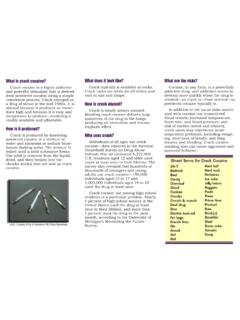
What is crack cocaine? What does it look like? What are ...
www.justice.govYes, crack cocaine is illegal. Crack cocaine is a Schedule II substance under the Controlled Substances Act. Schedule II drugs, which include PCP and metham-phetamine, have a high potential for abuse. Abuse of these drugs may lead to severe psychological or …

FORMS OF COCAINE, METHODS OF USE, EFFECTS, AND …
www.ussc.govCocaine is a powerful anesthetic and the most potent stimulant of natural origin to the central nervous system.49 In any form (coca leaves, coca paste, powder cocaine, freebase cocaine, and crack cocaine) cocaine produces the same types of physiological50 and psychotropic51 effects once the drug reaches the brain.52 Taken in small amounts (up ...

Cocaine and Federal Sentencing Policy
www.ussc.govMar 19, 2002 · differentiated between powder cocaine and crack cocaine and, concluding that crack cocaine was more dangerous, established significantly higher penalties for crack cocaine offenses. The 1986 Act implemented this differential by requiring 100 times less crack cocaine than powder cocaine to trigger five and ten-year mandatory minimum penalties.
Cocaine Abuse and Addiction Research Report
www.ci2i.research.va.govWhat is crack? Crack is the street name given to the freebase form of cocaine that has been processed from the powdered cocaine hydrochloride form to a smokable substance. The term “crack” refers to the crackling sound heard when the mixture is smoked. Crack cocaine is processed with ammonia or sodi-um bicarbonate (baking soda)

November 9, 2021 Cocaine: Crack and Powder Sentencing ...
sgp.fas.orgCocaine: Crack and Powder Sentencing Disparities Distinguishing Crack and Powder Cocaine Cocaine is a stimulant drug, usually distributed in a powder form that can be snorted or injected after being dissolved in water. It can also appear in a more solid, chunk form, known as cocaine base or crack, which can be smoked.

Drug Fact Sheet: Cocaine - DEA
www.dea.govCocaine base (crack) is smoked, either alone or on marijuana or tobacco. Cocaine is also used in combination with an opiate, like heroin, a practice known as “speedballing.” Although injecting into veins or muscles, snorting, and smoking are the common ways of using cocaine, all mucous membranes readily absorb cocaine. Cocaine users often binge

Recommended methods for the Identification and Analysis of ...
www.unodc.org“Crack” cocaine A flaky, hard material obtained by adding ammonia or sodium bicarbonate (baking soda) and water to cocaine hydrochloride and heating the resulting precipitated powder. The term “crack” which is the street name given to freebase cocaine, refers to the crackling sound produced when the mixture is heated.

Pharmacokinetics of Cocaine: Considerations When Assessing ...
archives.drugabuse.govCocaine hydrochloride, a crystalline salt, is commonly snuffed or injected. Cocaine base (crack) is the form usually smoked because the base is more volatile, vaporizing at a lower temperature, in contrast to cocaine hydrochloride, which decomposes before it volatizes when heated. Cocaine is a weak base with a pKa of 8.6. In its basic form in

The Drug Enforcement Administration (DEA) 1985-1990
www.dea.govThe first crack house had been discovered in Miami in 1982. However, this form of cocaine was not fully appreciated as a major threat because it was primarily being consumed by middle class users who were not associated with cocaine addicts. In fact, crack was initially considered a purely Miami phenomenon until it be