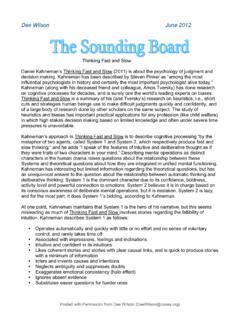
Transcription of Thinking, Fast and Slow
1 Studies in Intelligence Vol. 56, No. 2 (Extracts, June 2012)1 All statements of fact, opinion, or analysis expressed in this article are those of the author. Nothing in this article should be construed as asserting or implying US government endorsement of its factual statements and in Public LiteratureDaniel Kahneman, (New York: Farrar, Straus and Giroux, 2011), 418 books are must reads for intelligence officers. Fewer still are must reads that men-tion Intelligence Community functions or the CIA only once, and then only in passing. Dan-iel Kahneman has written one of these rare books. thinking , fast and slow represents an elegant summation of a lifetime of research in which Kahneman, Princeton University Profes-sor Emeritus of Psychology and Public Affairs, and his late collaborator, Amos Tversky, changed the way psychologists think about thinking .
2 Kahneman, who won the 2002 Nobel Prize in Economics for his work with Tversky on prospect theory, also highlights the best work of other researchers throughout the book. thinking , fast and slow introduces no revolu-tionary new material, but it is a masterpiece because of the way Kahneman weaves existing research intelligence officers at CIA, an agency with the human intelligence mission at its core, have come through experience and practice to understand and exploit the human cognitive processes of which Kahneman writes. These expert officers will have many moments of recognition in reading this book, which gives an empirical underpinning for much of their hard-won also may challenge some strongly held beliefs. thinking , fast and slow gives experts and newer officers, regardless of the intelligence agency in which they serve, an enormously useful cognitive framework upon which to hang their title of the book refers to what Kahne-man, adapting a device that other researchers originally proposed, calls the two systems of the human mind.
3 System 1, or fast thinking , operates automatically and quickly with little or no effort and no sense of voluntary control. Most System 1 skills such as detecting the relative distances of objects, orienting to a sud-den sound, or detecting hostility in a voice are innate and are found in other animals. Some fast and automatic System 1 skills can be acquired through prolonged practice, such as reading and understanding nuances of social situations. Experts in a field can even use Sys-tem 1 to quickly, effortlessly, and accurately retrieve stored experience to make complex judgments. A chess master quickly finding strong moves and a quarterback changing a play sent to him from the sideline when he rec-ognizes a defensive weakness are examples of acquired System 1 2, or slow thinking , allocates atten-tion to the mental activities that demand effort, such as complex computations and con-scious, reasoned choices about what to think and what to do.
4 System 2 requires most of us to pay attention to do things such as drive on an unfamiliar road during a snowstorm, calculate the product of 17x24, schedule transportation for a teenage daughter s activities, or under-stand a complex logical focuses much of the book on the interactions of System 1 and System 2 and the problems inherent in those interactions. Both systems are on when we are awake. System 1 runs automatically and effortlessly but Reviewed by Frank J. Babetski thinking , fast and SlowThinking, fast and slow 2 Studies in Intelligence Vol. 56, No. 2 (Extracts, June 2012) System 2 idles, because using it requires effort and is tiring. System 1 generates impressions and feelings, which become the source of Sys-tem 2 s explicit beliefs and deliberate choices.
5 System 1, when it encounters something it can-not quickly understand and did not expect (in other words, a surprise), enlists System 2 to make sense of the anomaly. The alerted Sys-tem 2 takes charge, overriding System 1 s auto-matic reactions. System 2 always has the last word when it chooses to assert systems operate to minimize effort and maximize performance and are the result of hundreds of thousands of years of human evo-lution in our environment. They work extremely well, usually. System 1 performs well at making accurate models and predic-tions in familiar environments. System 1 has two significant weaknesses: it is prone to make systemic errors in specified situations these are biases and it cannot be turned off. Sys-tem 2 can, with effort, overrule these biases if it recognizes them.
6 Unfortunately, System 2 is demonstrably very poor at recognizing one s own biased thinking . Trying to engage System 2 at all times to prevent System 1 errors is impractical and terms of Kahneman s construct, a signifi-cant part of the missions of intelligence agen-cies boils down to seizing opportunities presented by the flawed interactions of the Sys-tem 1 and System 2 thinking of foreign actors while at the same time recognizing and miti-gating the flaws of their own System 1 and System 2 interactions. Hostile services and organizations try to do the same thing in return. Operations officers rely on the biases of foreign counterintelligence officers, essentially advising assets to avoid exciting any System 2 thinking in people positioned to do them harm.
7 Aldrich Ames s Soviet handlers preferred that we not focus System 2 thought on how he bought a Jaguar on a GS-14 paycheck Sys-tem 1 found a tale about his wife s inheritance cognitively easy to target s biases put the plausible in plau-sible deniability during covert actions. Effec-tive deceptions also fundamentally rely on a target s unchallenged biases and so make it easy for the target to believe what they already are predisposed to believe. Effective fabrica-tors, especially those with tantalizing access, rely on our biased desire to believe them. One or two plausible reports from such a person may be enough to engage the exaggerated emo-tional coherence or halo effect. Roughly put, once lazy System 2 is satisfied, it tends to defer to System 1, which in turn projects positive qualities in one area into a generalized posi-tive rely on these biases, but they are also vulnerable to them.
8 Terrorism works because it provides extremely vivid images of death and destruction, which constant media attention magnifies. These images are immedi-ately available to a target s System 1. System 2, even when armed with reliable sta-tistics on the rarity of any type of terrorist event, cannot overcome System 1 s associative reaction to specific events. If you are a CIA offi-cer who was working in Langley on 25 January 1993, then chances are that you cannot make the left turn into the compound from Dolley Madison Boulevard without thinking of Aimal Kasi, the Pakistani who killed two CIA officers and wounded three others at that intersection that 9/11 hijackers on the first three planes could count on passengers to stay seated, rely-ing on their ability to quickly remember accounts of previous hijackings in which the hijackers were motivated to survive this is what Kahneman calls the availability bias.
9 However, because of their success at the World Trade Center and the Pentagon, the terrorists unwittingly and immediately rendered hijack-ing a less effective tactic. The passengers on Flight 93, quickly armed with knowledge of the other three flights, were able to engage Sys-tem 2 to overcome System 1 s existing avail-a If you think that you certainly would have known Ames was a Soviet spy had you known of his Jaguar, then you are probably guilty of hindsight bias, or the tendency to underestimate the extent to which you were surprised by past events. On the other hand, you are not guilty of hindsight bias if you think this (before having read about Ames) and have ever reported a colleague to coun-terintelligence for owning a , fast and SlowStudies in Intelligence Vol.
10 56, No. 2 (Extracts, June 2012)3 ability bias and make the decision to physically overpower the s insights pertain to the entire spectrum of intelligence operations. We accept information security practices that demonstra-bly impede productivity in order to reduce the danger of worse losses posed by cyberattack or penetration. At the same time, we would almost certainly consider the same amount of lost productivity a major defeat if a hacker had inflicted it on us. This is what Kahneman calls the loss aversion bias. System 2 does not assert control over System 1 s cognitive ease at imag-ining a disaster because increased productivity is much more difficult for System 2 to intelligence officer making budget deci-sions should read Kahneman s thoughts on the biases underlying the sunk-cost fallacy, or the decision to invest additional resources in los-ing endeavors when better investments are available.