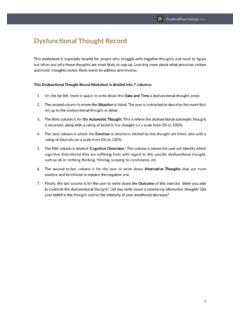
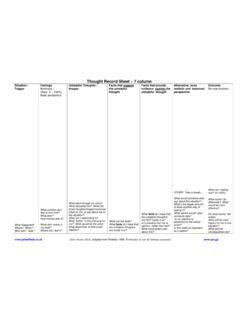
Transcription of THOUGHT RECORD SIDE ONE: WORKSHEET
1 Remember, thoughts may be 100% true, 0% true or somewhere in the middle. Spend just 5-10 minutes to complete the THOUGHT RECORD . Noe that not all questions will apply to every automatic THOUGHT . Here s what to do:1. When you notice your mood getting worse, or you find yourself engaging in unhelpful behavior, ask yourself, What s going through my mind right now? and as soon as possible, jot down the THOUGHT or mental image in the Automatic THOUGHT (s) The situation may be external (something that just happened or something you just did) or internal (an intense emotion, a painful sensation, an image, daydream, flashback or stream of thoughts , thinking about your future)3.
2 Then fill in the rest of the columns. You can try to identify cognitive distortions from the list below. More than one distortion may apply. Make sure to use the questions at the bottom of the WORKSHEET to compose the adaptive Spelling, handwriting and grammar don t It was worth doing this WORKSHEET if your mood improves by 10% or Distortions 2018. Adapted from J. Beck (2020) Cognitive Behavior Therapy: Basics and Beyond, 3rd RECORD SIDE ONE: WORKSHEETAll-or-nothing thinkingExample: If I m not a total success, I m a failure. Catastrophizing (fortune telling)Example: I ll be so upset, I won t be able to function at all. Disqualifying or discounting the positiveExample: I did that project well, but that doesn t mean I m competent; I just got lucky.
3 Emotional reasoningExample: I know I do a lot of things okay at work, but I still feel like I m a failure. LabelingExamples: I m a loser. He s no good. Magnification/minimizationExample: Getting a mediocre evaluation proves how inadequate I am. Getting high marks doesn t mean I m smart. Mental filter (selective abstraction)Example: Because I got one low rating on my evaluation [which also contained several high ratings], it means I m doing a lousy job. Mind readingExample: He s thinking that I don t know the first thing about this project. OvergeneralizationExample: Because I felt uncomfortable at the get-together, I don t have what it takes to make friends. PersonalizationExample: The repairman was curt to me because I did something wrong.
4 Should and must statementsExample: It s terrible that I made a mistake. I should always do my best. Tunnel vision My son s teacher can t do anything right. He s critical and insensitive and lousy at teaching. Beck Institute for Cognitive Behavior Therapy One Belmont Ave, Suite 700 Bala Cynwyd, PA 19004 BECAUSE YOU THINK SOMETHING, DOESN T NECESSARILY MEAN IT S TRUE. Beck Institute for Cognitive Behavior Therapy One Belmont Ave, Suite 700 Bala Cynwyd, PA 19004 2018. Adapted from J. Beck (2020) Cognitive Behavior Therapy: Basics and Beyond, 3rd RECORD : SIDE TWO WORKSHEETDate/timeSituation1. What event (external or internal) is associated with the unpleasant emotion?
5 Or what unhelpful behavior did you engage in?Automatic THOUGHT (s)1. What THOUGHT (s) and/or image(s) went through your mind (before, during or after the event or unhelpful behavior)?2. How much did you believe the THOUGHT (s)?Emotion(s)1. What emotion(s) (sad/anxious/ angry/etc.) did you feel (before, during or after the event or unhelpful behavior)? 2. How intense (0 100%) was the emotion?Adaptive Response1. (optional) What cognitive distortion did you make?2. Use questions below to compose a response to the automatic THOUGHT (s). Indicate how much you believe each How much do you now believe each automatic THOUGHT ?2. What emotion(s) do you feel now? How intense (0 100%) is the emotion?
6 3. What would be good to do? Questions to help compose an alternative response: (1) What is the evidence that the automatic THOUGHT is true? Not true? (2) Is there an alter-native explanation? (3) If the worst happened, how could I cope? What s the best that could happen? What s the most realistic outcome? (4) What s the effect of my believing the automatic THOUGHT ? What could be the effect of my changing my thinking? (5) If [person s name] was in this situation and had this THOUGHT , what would I tell them? (6) What would be good to do?