Example: quiz answers
Time-series Generative Adversarial Networks - NeurIPS
forecasting, this approach is fundamentally deterministic, and is not truly generative in the sense that ... TimeGAN is a generative time-series model, trained adversarially and jointly via a learned embedding space with both supervised and unsupervised losses. As such, our approach straddles the intersection ...
Tags:
Information
Domain:
Source:
Link to this page:
Documents from same domain
Semi-supervised Learning with Deep Generative Models
proceedings.neurips.ccapproximately invariant to local perturbations along the manifold. The idea of manifold learning ... We show for the first time how variational inference can be brought to bear upon the prob- ... probabilities are formed by a non-linear transformation, with parameters , of a set of latent vari-ables z. This non-linear transformation is ...
Generative Adversarial Imitation Learning
proceedings.neurips.ccnetworks [8], a technique from the deep learning community that has led to recent successes in modeling distributions of natural images: our algorithm harnesses generative adversarial training to fit distributions of states and actions defining expert behavior. We test our algorithm in Section 6, where
Spatial Transformer Networks - NeurIPS
proceedings.neurips.ccConvolutional Neural Networks define an exceptionally powerful class of models, ... localisation, semantic segmentation, and action recognition tasks, amongst others. ... can take any form, such as a fully-connected network or a convolutional network, but should include a final regression layer to produce the transformation ...
Visualizing the Loss Landscape of Neural Nets
proceedings.neurips.cctask that is hard in theory, but sometimes easy in practice. Despite the NP-hardness of training general neural loss functions [3], simple gradient methods often find global minimizers (parameter configurations with zero or near-zero training loss), even when data and labels are randomized before training [43].
Prototypical Networks for Few-shot Learning
proceedings.neurips.cc˚: RD!RMwith learnable parameters ˚. Each prototype is the mean vector of the embedded support points belonging to its class: c k= 1 jS kj X (x i;y i)2S k f ˚(x i) (1) Given a distance function d: R M R 
Inductive Representation Learning on Large Graphs
proceedings.neurips.ccnode classification, clustering, and link prediction [11, 28, 35]. ... (e.g., citation data with text attributes, biological data with functional/molecular markers), our approach can also make use of structural features that are present in all graphs (e.g., node degrees). ... through theoretical analysis, that GraphSAGE is capable of learning ...
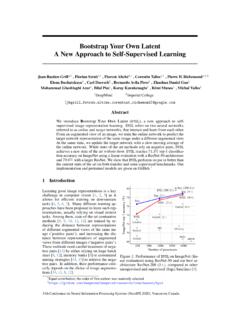
Bootstrap Your Own Latent A New Approach to Self ...
proceedings.neurips.ccmining strategies [14, 15] to retrieve the nega-tive pairs. In addition, their performance criti-cally depends on the choice of image augmenta- ... to prevent collapsing while preserving high performance. To prevent collapse, a straightforward solution …
Unsupervised Learning of Visual Features by Contrasting ...
proceedings.neurips.ccpseudo-labels to learn visual representations. This method scales to large uncurated dataset and can be used for pre-training of supervised networks [7]. However, their formulation is not principled and recently, Asano et al. [2] show how to cast the pseudo-label assignment problem as an instance of the optimal transport problem.
PyTorch: An Imperative Style, High-Performance Deep ...
proceedings.neurips.ccFacebook AI Research benoitsteiner@fb.com Lu Fang Facebook lufang@fb.com Junjie Bai Facebook jbai@fb.com Soumith Chintala Facebook AI Research soumith@gmail.com Abstract Deep learning frameworks have often focused on either usability or speed, but not both. PyTorch is a machine learning library that shows that these two goals
InfoGAN: Interpretable Representation Learning by ...
proceedings.neurips.ccof the digit (0-9), and chose to have two additional continuous variables that represent the digit’s angle and thickness of the digit’s stroke. It would be useful if we could recover these concepts without any supervision, by simply specifying that an MNIST digit is generated by an 1-of-10 variable and two continuous variables.
Related documents

Time Series: Autoregressive models AR, MA, ARMA, ARIMA
people.cs.pitt.eduThe procedure of using known data values to t a time series with suitable model and estimating the corresponding parameters. It comprises methods that attempt to understand the nature of the time series and is often useful for future forecasting and simulation. There are several ways to build time series forecasting models,

TYPES OF FORECASTING METHODS - uCoz
mech.at.uaQUANTITATIVE FORECASTING METHODS Time series models look at past TIME SERIES MODELS Model Description Naïve Uses last period’s actual value as a forecast Simple Mean (Average) Uses an average of all past data as a forecast Simple Moving Average Uses an average of a specified number of the most ...
Introduction to Time Series and Forecasting, Second Edition
www.ccs.fau.eduIntroduction to time series and forecasting / Peter J. Brockwell and Richard A. Davis.—2nd ed. p. cm. — (Springer texts in statistics) Includes bibliographical references and index. ISBN 0-387-95351-5 (alk. paper) 1. Time-series analysis. I. Davis, Richard A. II. Title. III. Series. QA280.B757 2002 519.5 5—dc21 2001049262 Printed on acid ...
Introduction to Time Series Analysis. Lecture 1.
www.stat.berkeley.eduTime Series Modelling 1. Plot the time series. Look for trends, seasonal components, step changes, outliers. 2. Transform data so that residuals are stationary. (a) Estimate and subtract Tt,St. (b) Differencing. (c) Nonlinear transformations (log, √ ·). 3. Fit model to residuals. 42
![Google Cloud AI, USA arXiv:1912.09363v3 [stat.ML] 27 Sep 2020](/cache/preview/6/0/3/f/9/8/e/6/thumb-603f98e66448be95dc0f14f9f102a043.jpg)
Google Cloud AI, USA arXiv:1912.09363v3 [stat.ML] 27 Sep 2020
arxiv.orgKeywords: Deep learning, Interpretability, Time series, Multi-horizon forecasting, Attention mechanisms, Explainable AI. 1. Introduction Multi-horizon forecasting, i.e. the prediction of variables-of-interest at mul-tiple future time steps, is a …
Spatio-Temporal Graph Convolutional Networks: A Deep ...
www.ijcai.orgmajor representatives of data-driven methods. In time-series analysis, autoregressive integrated moving average (ARIMA) and its variants are one of the most consolidated approaches based on classical statistics[Ahmed and Cook, 1979; Williams and Hoel, 2003]. However, this type of model is limited by the stationary assumption of time sequences
![[TS] Time Series - Stata](/cache/preview/f/9/9/c/5/9/9/f/thumb-f99c599f9adc31cbb3de3d6ed398bf7c.jpg)
[TS] Time Series - Stata
www.stata.comAfter this entry,[TS] time series provides an overview of the ts commands. The other parts of this manual are arranged alphabetically. If you are new to Stata’s time-series features, we recommend that you read the following sections first: [TS] time series Introduction to time-series commands [TS] tsset Declare a dataset to be time-series data

Seasonal Dummy Model
www.ssc.wisc.eduSeasonal Dummy Model • Deterministic seasonality S t can be written as a function of seasonal dummy variables • Let s be the seasonal frequency – s =4 for quarterly – s =12 for monthly • Let D 1t, D 2t, D 3t,…, D st be seasonal dummies – D 1t = 1 …