Example: bankruptcy
Towards End-to-End License Plate Detection and …
Towards End-to-EndLicense Plate Detection and Recognition: A Large Dataset and Baseline Zhenbo Xu1,2[0000−0002−8948−1589], Wei Yang 1( )[0000−0003−0332−2649], Ajin Meng1,2, Nanxue Lu1,2, Huan Huang2, Changchun Ying2, and Liusheng Huang1 1 School of Computer Science and Technology, University of Science and Technology of China, Hefei, China
Tags:
Information
Domain:
Source:
Link to this page:
Documents from same domain
Frustum PointNets for 3D Object Detection From RGB-D Data
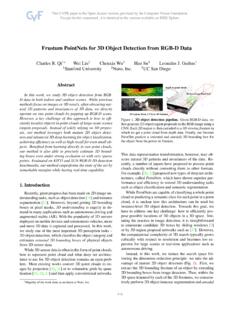
openaccess.thecvf.comFrustum PointNets for 3D Object Detection from RGB-D Data Charles R. Qi1∗ Wei Liu2 Chenxia Wu2 Hao Su3 Leonidas J. Guibas1 1Stanford University 2Nuro, Inc. 3UC San Diego Abstract In this work, we study 3D object detection from RGB-D data in both indoor and outdoor scenes.
Finding Tiny Faces in the Wild With Generative Adversarial ...
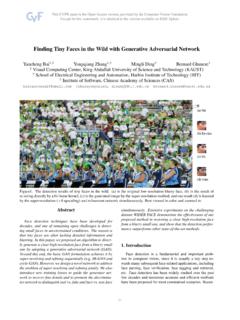
openaccess.thecvf.comfaces, which are unfriendly for the face classifier. Toward-s this end, we design a refinement sub-network to recover some detailed information. In the discriminator network, the basic GAN [17, 12, 8] is trained to distinguish the real and fake high resolution images. To classify faces or non-
ESRGAN: Enhanced Super-Resolution Generative Adversarial ...
openaccess.thecvf.comESRGAN: EnhancedSuper-Resolution Generative Adversarial Networks Xintao Wang 1, Ke Yu , Shixiang Wu2, Jinjin Gu3, Yihao Liu4, Chao Dong 2, Yu Qiao , and Chen Change Loy5 1 CUHK-SenseTime Joint Lab, The Chinese University of Hong Kong 2 Shenzhen Institutes of Advanced Technology, Chinese Academy of Sciences 3 The Chinese University of Hong Kong, …
What Have We Learned From Deep Representations for …
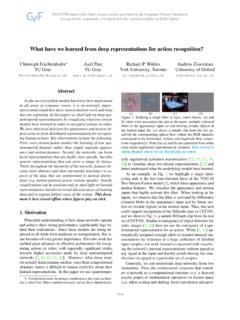
openaccess.thecvf.comwhat these powerful models actually have learned. In this paper we shed light on deep spatiotemporal net-works by visualizing what excites the learned models us-ing activation maximization by backpropagating on the in-put. We are the first to visualize the hierarchical features
Squeeze-and-Excitation Networks - openaccess.thecvf.com
openaccess.thecvf.comSqueeze-and-Excitation Networks Jie Hu1∗ Li Shen2∗ Gang Sun1 hujie@momenta.ai lishen@robots.ox.ac.uk sungang@momenta.ai 1 Momenta 2 Department of Engineering Science, University of Oxford Abstract Convolutional neural networks are built upon the con-
RegularFace: Deep Face Recognition via Exclusive ...
openaccess.thecvf.comRegularFace: Deep Face Recognition via Exclusive Regularization Kai Zhao Jingyi Xu Ming-Ming Cheng ∗ TKLNDST, CS, Nankai University kaiz.xyz@gmail.com cmm@nankai.edu.cn
Protecting World Leaders Against Deep Fakes
openaccess.thecvf.comProtecting World Leaders Against Deep Fakes Shruti Agarwal and Hany Farid University of California, Berkeley Berkeley CA, USA {shrutiagarwal, hfarid}@berkeley.edu
Auto-DeepLab: Hierarchical Neural Architecture Search for ...
openaccess.thecvf.comAuto-DeepLab: Hierarchical Neural Architecture Search for Semantic Image Segmentation Chenxi Liu1∗, Liang-Chieh Chen 2, Florian Schroff2, Hartwig Adam2, Wei Hua2, Alan Yuille1, Li Fei-Fei3 1Johns Hopkins University 2Google 3Stanford University Abstract Recently, NeuralArchitectureSearch(NAS)hassuccess-
PointNet: Deep Learning on Point Sets ... - CVF Open Access
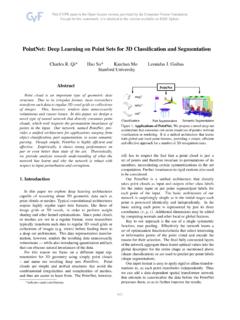
openaccess.thecvf.comPointNet: Deep Learning on Point Sets for 3D Classification and Segmentation Charles R. Qi* Hao Su* Kaichun Mo Leonidas J. Guibas Stanford University
Class-Balanced Loss Based on Effective Number of Samples
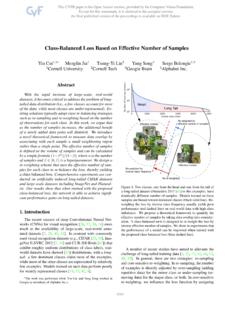
openaccess.thecvf.comand large-scale datasets including ImageNet and iNatural-ist. Our results show that when trained with the proposed class-balanced loss, the network is able to achieve signifi-cant performance gains on long-tailed datasets. 1. Introduction The recent success of deep Convolutional Neural Net-works (CNNs) for visual recognition [26, 37, 38, 16] owes
Related documents

Faster R-CNN: Towards Real-Time Object Detection with ...
papers.nips.ccFaster R-CNN: Towards Real-Time Object Detection with Region Proposal Networks Shaoqing Ren Kaiming He Ross Girshick Jian Sun Microsoft Research fv-shren, kahe, rbg, jiansung@microsoft.com Abstract State-of-the-art object detection networks depend on region proposal algorithms to hypothesize object locations. Advances like SPPnet [7] and Fast R ...

You Only Look Once: Unified, Real-Time Object Detection
pjreddie.comized sensors, enable assistive devices to convey real-time scene information to human users, and unlock the potential for general purpose, responsive robotic systems. Current detection systems repurpose classifiers to per-form detection. To detect an object, these systems take a classifier for that object and evaluate it at various locations

You Only Look Once: Unified, Real-Time Object Detection
www.cv-foundation.orgized sensors, enable assistive devices to convey real-time scene information to human users, and unlock the potential for general purpose, responsive robotic systems. Current detection systems repurpose classifiers to per-form detection. To detect an object, these systems take a classifier for that object and evaluate it at various locations
Abstract
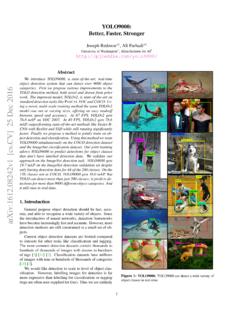
arxiv.orgonly having detection data for 44 of the 200 classes. On the 156 classes not in COCO, YOLO9000 gets 16.0 mAP. But YOLO can detect more than just 200 classes; it predicts de-tections for more than 9000 different object categories. And it still runs in real-time. 1. Introduction General purpose object detection should be fast, accu-
![Abstract arXiv:2103.02603v2 [cs.CV] 9 May 2021](/cache/preview/d/8/6/f/9/d/e/2/thumb-d86f9de271f3e441368a928ac5b32a7a.jpg)
Abstract arXiv:2103.02603v2 [cs.CV] 9 May 2021
arxiv.orgknowledge base. This would define a smart object detection system, and ours is an effort towards achieving this goal. The key contributions of our work are: •We introduce a novel problem setting, Open World Object Detection, which models the real-world more closely. •We develop a novel methodology, called ORE, based on

EfficientDet: Scalable and Efficient Object Detection
openaccess.thecvf.comtowards more accurate object detection; meanwhile, state-of-the-art object detectors also become increasingly more expensive. For example, the latest AmoebaNet-based NAS-FPN detector [42] requires 167M parameters and 3045B FLOPs (30x more than RetinaNet [21]) to achieve state-of-the-art accuracy. The large model sizes and expensive com-

Florence: A New Foundation Model for Computer Vision
arxiv.orgcation) to fine-grained (e.g. object detection), 2) Time: from static (e.g. images) to dynamic (e.g. videos), and 3) Modal-ity: from RGB only to multiple senses (e.g. captioning and depth). Due to the diversity nature of visual understanding, we …

Time of Flight Principles, Challenges, and Performance …
www.st.comTime of Flight Basics Active illumination system: • Laser emits light (photons) towards a target • Light (partially) reflected from the target • Sensor area determines when light (photons) arrives • ToF is translated into distance Distance Value = Photon travel time/2 x by speed of light