Transcription of TRAINING GUIDE - Concept2
1 TRAINING GUIDE . OARS | INDOOR ROWER | SKIERG TRAINING GUIDE 1. Getting Started This GUIDE will help you to: 1. Set your goals. 2. Understand the types of workouts you can do to achieve your goals. 3. Determine the number of workouts of each type that you should do per week. 4. Get started and track your progress. 5. Evaluate your progress and adjust your plan as needed. Consult a physician before performing any exercise program, including the programs at or in this TRAINING GUIDE . It is your responsibility to evaluate your own medical and physical condition, or that of your clients, and to independently determine whether to perform, use or adapt any of the information or content at Any exercise program may result in injury.
2 By voluntarily undertaking any exercise displayed at , you assume the risk of any resulting injury. Setting Goals and Choosing Workouts What do you want to achieve with your rowing and/or skiing? And what are the types of workouts that will help you achieve those goals? 1. Achieve and maintain general fitness: Use a variety of workout types, including intervals. Gradually increase your total workout time and/or intensity to keep improving. Aim for a workout frequency of at least every other day and preferably 5-6 days per week (this can include other types of exercise).
3 2. Lose weight and keep it off: Aim for at least one workout per day, with a rest day each week as needed. Consider completing two short workouts in one day instead of one long one, since each workout raises your metabolic rate for a period of time after the exercise. Burn more calories in two ways: go longer or go harder. We recommend some of each. Use a variety of workouts to keep it interesting. 3. Train or condition for another sport: Build general aerobic fitness to support your more sport-specific TRAINING .
4 Design your workouts based on the work you do in your primary sport, such as short, hard sprints for tennis, steady 10k pieces for running, etc. 4. Train for competitive rowing or skiing: Take advantage of the fact that the indoor rower and SkiErg are both powerful TRAINING tools for their respective sports because they provide a means for accurately monitoring TRAINING progress, while offering a high quality workout at the same time. Test yourself at race distances to determine your athletic potential or to rank members of a crew.
5 Supplement other TRAINING modalities such as roller-skiing and running with the SkiErg. Workouts can also be incorporated into strength TRAINING to maintain specific strength. When the weather is bad or the days get short, it's a great indoor option. Use your coach's TRAINING plan, if available. Without formal coaching, we suggest a combination of workout types for a total of 8-11 workouts per week, depending on your goals, current level of fitness, and available time. At least three of these workouts should be strength or cross- TRAINING sessions.
6 2. 5. Rehab from injury: Please don't undertake a rehab program without input and approval from your medical advisors. Take advantage of the fact that both the indoor rower and the SkiErg offer an impact free, user- controlled motion. The SkiErg can be adapted for use with minimal or no leg involvement, making it a great TRAINING tool for those with lower body injuries or issues. You can use a stool or other seat, or pull a wheelchair up to the SkiErg. Review the adaptations available for using the indoor rower (available at: ).
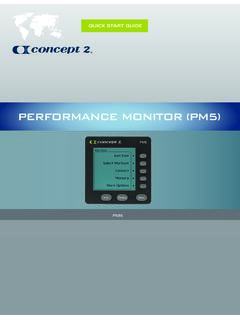
7 The indoor rower allows rowing with full or partial leg compression or even arms only if desired. Be sure to start easily and build slowly. Types of Workouts A wide variety of workouts can be done on the indoor rower and SkiErg, from long steady pieces to any kind of interval. The Performance Monitor offers extensive flexibility for setting up these workouts, displaying performance data during the workout, and saving your results for later review and analysis. Interval workouts are composed of alternating periods of work and rest (or very easy effort).
8 Both work time and rest time may be varied as desired. Here are some common types of intervals, along with a collection of workouts to choose from. Long intervals 4 minutes in length and longer: 4 x 4 minutes, with 2-4 minutes rest 4 x 5 minutes, with 3 minutes rest 3 x 1500 meters, with 3-5 minutes rest 2 x 2000 meters, with 4-6 minutes rest Short intervals less than 4 minutes in length: 1 minute hard/1 minute easy 6 x 500 meters, with 2 minutes rest 5 x 3 minutes, with 2-3 minutes rest 30 seconds hard/1:30 easy Short rest intervals rest interval is very short, in the range of 10-30 seconds.
9 This allows the body to clear some of the lactate, but the heart rate stays pretty high: (1:40 hard/:20 easy) x 10. 1 minute hard/30 seconds easy 20 strokes hard, 5 strokes easy 8 x (:20 hard/:10 easy). Also known as Tabata intervals. Variable length intervals pyramids, step-ups, step-downs. There are any number of creative possibilities! 1-2-3-4-3-2-1 minutes hard, with rest equal to the work time 5 minutes, 4 minutes, 3 minutes, 2 minutes, 1 minute hard, with 2 minutes rest in between 500 meters, 1000 meters, 1500 meters, 1000 meters, 500 meters, with 2-4 minutes rest in between work intervals 3x500m; 3x250m, with 2 minutes rest in between TRAINING GUIDE 3.
10 Long, steady workouts emphasize continuous work with minimal rest. The level of intensity may vary from an easy conversational pace to an intensity where you really don't feel like talking but can just maintain the effort for the planned distance or time. Your pace for long, steady work will be lower than what you can do in an interval workout. Steady state long, steady exercise, with no (or short) breaks: 30 minutes steady 5000 meters 20 minutes, 1 minute break, 20 minutes 10,000 meters Variable/alternating: 5000 meters, taking 20 harder strokes at the beginning of each 1000 meters (3 minutes @ 22-24 spm, moderate steady pace, 2 minutes @ 25-27 spm increasing your effort, 1 minute @ 28-30 spm and higher intensity) and repeat 5-8 times.