Transcription of Transmittal of Fiscal Year (FY) 2021 Income Limits for the ...
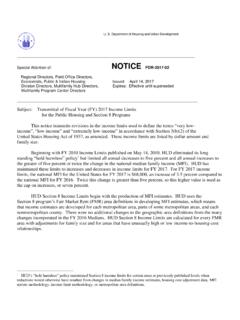
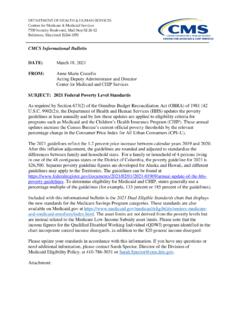
1 U. S. Department of Housing and Urban Development _____ Special Attention of: NOTICE PDR-2021-02 Regional Directors, Field Office Directors, Economists, Public & Indian Housing Issued: April 1, 2021 Division Directors, Multifamily Hub Directors, Expires: Effective until superseded Multifamily Program Center Directors _____ Cross References: _____ Subject: Transmittal of Fiscal Year (FY) 2021 Income Limits for the Public Housing and Section 8 Programs This notice transmits Income Limits used to define the terms very low- Income , low- Income and extremely low- Income in accordance with Section 3(b)(2) of the United states Housing Act of 1937, as amended.
2 These Income Limits are listed by dollar amount and family size, and they are effective on the later of April 1, 2021 or the date issued. Since FY 20101 HUD has limited all annual Income limit decreases to five percent and all annual increases to the greater of five percent or twice the change in the national median family Income . HUD has maintained these Limits to increases and decreases in Income Limits for FY 2021. HUD has maintained these Limits to increases and decreases in Income Limits for FY 2021. The national median family Income for the United states for FY 2021 is $79,900, an increase of almost two percent over the national median family Income of $78,500 in FY 2020. Twice this change is percent which is less than five percent, so for FY 2021 Income Limits the cap is five percent. HUD Section 8 Income Limits begin with the calculation of median family incomes for each area.
3 HUD uses the Section 8 program s Fair Market Rent (FMR) area definitions in developing medians, which means that median family incomes are developed for each metropolitan area, parts of some metropolitan areas, and each nonmetropolitan county. For FY 2021, the geographic definitions incorporate all changes published by the Office of Management and Budget through the April 10, 2018 bulletin. A new metropolitan area was formed in 2018, Twin Falls, ID MSA, which means that the two nonmetropolitan counties in this MSA (Jerome County and Twin Falls County) are now metropolitan counties and identified by HUD as HUD Metro FMR Areas (HMFAs). HUD Section 8 Income Limits are calculated for every FMR area with adjustments for family size and for areas that have unusually high or low Income -to-housing-cost relationships. 1 Prior to FY 2010, HUD maintained a hold harmless policy, whereby Section 8 Income Limits for certain areas were held at previously published levels when reductions would otherwise have resulted from changes in housing cost, median Income , or Income limit methodologies, or changes in metropolitan area definitions.
4 2 HUD uses the 2018 American Community Survey (ACS) and Puerto Rico Community Survey (PRCS) median family Income data (as opposed to household Income data) as the basis of FY 2021 Income Limits for all areas of geography, except for the Virgin Islands and Guam, American Samoa, and the Northern Marianas (the Pacific Islands). HUD uses the Consumer Price Index (CPI) forecast published by the Congressional Budget Office (CBO) in February 2021 to bring the ACS and PRCS data forward from mid-2018 to the mid-point of the Fiscal year, April 2021. HUD bases the median family incomes and Income Limits for the Virgin Islands and the Pacific Islands on 2010 Decennial Census data which is the most current information available. The decennial data for the Virgin Islands and the Pacific Islands reports 2009 median family incomes. HUD trends these incomes forward using the change in national median family incomes between 2009 and 2018 (from the ACS).
5 HUD then applies the same CBO forecast from 2018 to the mid-point of the Fiscal year, April 2021. Last year HUD discussed considering a change that would replace the CBO forecast with the economic forecast of the Office of Management and Budget (OMB), beginning with the calculation of the FY 2021 Medians. This OMB forecast would have matched the economic assumptions used in the calculation of HUD median family Income estimates with assumptions used in the formulation of the Administration s Budget and with the economic assumptions used in the calculation of Fair Market Rents (FMRs). However, HUD did not use the OMB economic assumptions in the calculation of the FY 2021 FMRs in the summer of 2020. HUD used CBO forecast assumptions because they were based on more recent economic data that measured early economic impacts of the pandemic. HUD will still consider using OMB forecasts instead of CBO next year.
6 Public Housing/Section 8 Income Limits are used to determine the Income eligibility of applicants for Public Housing, Section 8, and other programs subject to 42 USC 1437a(b)(2). The Income Limits are calculated from the HUD medians for FY 2021. The most important statutory provisions relating to Income Limits are as follows: - very low- Income family is defined as low- Income families whose incomes do not exceed 50 percent of the median family Income for the area, subject to specified adjustments for areas with unusually high or low incomes relative to housing costs; - low- Income family is defined as those families whose incomes do not exceed 80 percent of the median family Income for the area, subject to adjustments for areas with unusually high or low incomes or housing costs; - extremely low- Income family is defined as a very low- Income family whose Income does not exceed the higher of the poverty guidelines as determined by the Department of Health and Human Services or 30 percent of the median family Income for the area.
7 - where the area Income limit is less than those derived from the state nonmetropolitan median, Income Limits are based on the state nonmetropolitan median; and, - Income Limits are adjusted for family size so that larger families have higher Income Limits . 3 Very Low- Income Limits : HUD calculates very low- Income Limits using a set of formulae as follows. The first step in calculating very low- Income Limits is to determine what they would be if the four-person limit is based on 50 percent of the median family Income . HUD then makes adjustments if this number is outside formula constraints. More specifically, HUD calculates the very low- Income limit for a four-person family as follows: (1) HUD calculates and sets 50 percent of the area median family Income as the preliminary four-person family Income limit; (2) HUD increases the four-person very low- Income limit if it would otherwise be less than the amount at which 35 percent of it equals 85 percent of the annualized two-bedroom FMR.
8 This adjusts Income Limits upward for areas where rental housing costs are unusually high in relation to the median family Income ; (3) HUD reduces the four-person very low- Income limit to the greater of 80 percent of the median family Income level, or the amount at which 30 percent of a four-person family s Income equals 100 percent of the two-bedroom FMR. This adjusts Income Limits downward for areas with unusually high median family Income ; (4) HUD increases the four-person Income limit if it is less than 50 percent of the relevant state nonmetropolitan median family Income level;2 and, (5) HUD raises any four-person Income limit that has declined by more than five percent to five percent below last year s Income limit and reduces any Income limit that has increased more than five percent to an increase of five percent over last year s Income limit, the remainder of this decrease/increase to be implemented next year if the underlying data warrant.
9 In any year that twice the national change in median family incomes is greater than five percent, Limits will be allowed to increase up to that level if so warranted by the local data. For FY 2021 Income Limits , twice the increase in the national median Income compared to the FY 2020 median Income is percent, so the cap on increases is set at five percent. 2 Under a Housing and Community Development Act of 1987 amendment, nonmetropolitan area Income Limits should never be set lower than the State nonmetropolitan median family Income level. In implementing this provision, HUD used its discretion to apply this policy to metropolitan areas as well. Doing so avoids the anomaly of assigning higher Income Limits to a nonmetropolitan county than are assigned to a metropolitan area where the median family Income is less than the State non-metro level but above the level for the non-metro county.
10 4 Low- Income Limits : Most four-person low- Income Limits are the greater of 80 percent of the median family Income , or 80 percent of the state nonmetropolitan median family Income . Because HUD does not always base the very low- Income Limits on 50 percent of median, however, calculating low- Income Limits as 80 percent of median would produce anomalies inconsistent with statutory intent ( , very low- Income Limits could be higher than low- Income Limits ). To eliminate this problem, HUD s normal calculation is to set the four-person low- Income limit at ( , 80 percent/50 percent) times the relevant four-person very low- Income limit. The two exceptions to this practice are that the four-person low- Income limit may not exceed the median family Income ($79,900 for FY 2021) except when justified by high housing costs; and once adjusted, HUD Limits decreases in the four-person low- Income limit to five percent, and caps increases at the greater of five percent or twice the national change in median Income (which is percent for FY 2021).