Example: confidence
TRANSPORTING INFECTIOUS SUBSTANCES SAFELY
DIVISION 6.2 INFECTIOUS SUBSTANCE A Division 6.2 infectious substance is a material known or reasonably expected to contain a pathogen. A pathogen is a micro-organism (including bacteria, viruses, rickettsia, parasites, fungi) or other agent, such as a proteinaceous infectious particle (prion), that can cause disease in humans or animals ...
Tags:
Information
Domain:
Source:
Link to this page:
Documents from same domain

Guidelines for Hazardous and Prevention/Mitigation Training
www.phmsa.dot.gov2016 Guidelines for Hazardous Materials Response, Planning and Prevention/Mitigation Training Introduction – Page iv Guidelines Overview The Guidelines is designed to be used as a working reference manual by public sector managers of hazardous materials training.

APR 2012 - phmsa.dot.gov
www.phmsa.dot.gov1200 New Jersey Avenue, SE Washington, D.C. 20590 This is in response to your January 17, 2012letter concerning how to describe and transport disposal and recycling products, including sharps, used by medical facilities to treat human ... 866-436-9264 (WCMI) • www.wastewise.com .

Billing Code: 4910-60-P DEPARTMENT OF TRANSPORTATION ...
www.phmsa.dot.govOn July 29, 2016, PHMSA, in consultation with FRA, published a Notice of Proposed Rulemaking (NPRM) under the same title as this final rule (81 FR 50068).
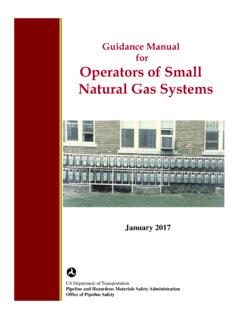
Guidance Manual for Operators of Small Natural Gas Systems
www.phmsa.dot.govGuidance Manual for Operators of Small Natural Gas Systems US Department of Transportation Pipeline and Hazardous Materials Safety Administration Office of Pipeline ...

Requalification Guidance for Propane Cylinders - PHMSA
www.phmsa.dot.govPropane cylinders have identifying marks on the cylinder neckring (collar), or cylinder shoulder depending on the cylinder type. The diagram below depicts examples of several of the required markings.
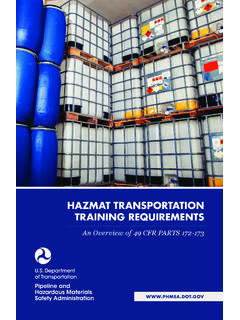
Hazmat Transportation Training Requirements - …
www.phmsa.dot.govphmsa pipeline and hazardous materials safety administration 1 hazmat transportation training requirements an overview of 49 cfr parts 172-173 www.phmsa.dot.gov
THIS DOCUMENT SHOULD NOT BE USED TO DANGEROUS …
www.phmsa.dot.govPage 4 saFETy prEcauTions rEsisT rushing in! approach cauTiousLy From UPWIND, UPHILL or UPSTREAM: • Stay clear of Vapor, Fumes, Smoke and Spills • Keep vehicle at a safe distance from the scene sEcur E T hE sc EnE:

172.101 App A Appendix A to §172.101 - List of Hazardous ...
www.phmsa.dot.gov172.101 App A Appendix A to §172.101 - List of Hazardous Substances and Reportable Quantities 1. This Appendix lists materials and their corresponding reportable quantities (RQ's) that are listed or designated as "hazardous
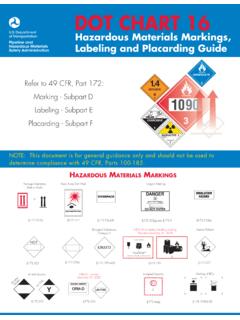
DOT CHART 16 Hazardous Materials Markings,Labeling and ...
www.phmsa.dot.govOct 24, 2017 · §172.436, §172.438, §172.440, §172.441 For Regulated Medical Waste (RMW), an Infectious Substance label is not required on an outer packaging if the OSHA Biohazard marking is used as prescribed in 29 CFR 1910.1030(g). A bulk package of RMW must display a BIOHAZARD marking. §172.323, §172.405(c), §172.429, §172.430, §172.432 §172.450
Pipeline Corrosion Report - FINAL
www.phmsa.dot.govcomprehensively addressing corrosion of offshore pipelines, this study does highlight aspects of corrosion in offshore pipelines in various sections and is specific in reference when discussed. 1.1 Corrosion Overview Corrosion is one of the leading causes of failures in onshore transmission pipelines (both gas and
Related documents
Data Security and Confidentiality Guidelines
www.cdc.govDivision of Viral Hepatitis (DVH), Division of STD Prevention (DSTDP), and Division of TB Elimination (DTBE). The work was informed by consultation with state and local public health leaders and public health organizations representing HIV, viral hepatitis, STD and TB disease disciplines (see Acknowledgements section).
WHOQOL - WHO | World Health Organization
www.who.intHIV/AIDS. Administration of the WHOQOL instruments The national versions of the WHOQOL The WHOQOL instruments are available in over 20 different languages. The appropriate language version, and permission for using it, ... Division of Mental …

THE HEALTH ASSESSMENT QUESTIONNAIRE?
www.chcr.brown.eduDivision of Immunology & Rheumatology INTRODUCTION The Health Assessment Questionnaire (HAQ) was originally developed in 1978 by James F. Fries, MD, and colleagues at Stanford University. It was one of the first self-report functional status (disability) measures and has become the dominant instrument in many disease areas, including arthritis.

PATIENT AUTHORIZATION FOR RELEASE OF MEDICAL …
www.mountsinai.orgauthorization. If you experience discrimination because of the release or disclosure of HIV-related information, you may contact the New York State Division of Human Rights at (800) 523-2437/ (212) 480-2493 or the New York City Commission on Human Rights at (212) 306-7450.

COVID-19 ORAL ANTIVIRAL TREATMENTS AUTHORIZED AND …
www.mssnyenews.org• Paxlovid may lead to a risk of HIV-1 developing resistance to HIV protease inhibitors in patients with uncontrolled or undiagnosed HIV-1 infection. Patients on ritonavir- or cobicistat-containing HIV or HCV regimens should continue their treatment as indicated.

Know how COVID-19 spreads - New York City
www1.nyc.govHIV, STI and contraception services: • Call the Sexual Health Clinic Hotline at 347-396-7959 (Monday to Friday, 9 a.m. to 3:30 p.m.) to talk to a health care provider. • Visit nyc.gov/health/clinics or call 311 for Sexual Health Clinic hours and services.

Oral Sex and HIV Risk
www.cdc.govHIV from oral sex. Oral sex involves using the mouth to stimulate the penis (fellatio), vagina (cunnilingus), or anus (anilingus). Risk of HIV The chance an HIV-negative person will get HIV from oral sex with an HIV-positive partner is extremely low.