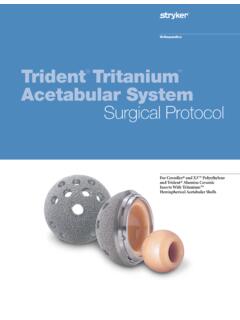
Transcription of Trident Acetabular System PSL Surgical Protocol
1 Trident Acetabular System . PSL Surgical Protocol Trident Acetabular System . PSL Surgical Protocol Indications for Trident Ceramic Indications for Trident See package insert for warnings, Insert with Ceramic Head Polyethylene Insert with Metal or precautions, adverse effects, information Primary or revision hip arthroplasty Ceramic Head for patients and other essential product due to: Painful, disabling joint disease of the hip information. Non-inflammatory degenerative resulting from: degenerative arthritis, Before using instrumentation, verify: arthritis (osteoarthritis, avascular rheumatoid arthritis, post-traumatic arthritis or late stage avascular necrosis. Instruments have been properly necrosis, traumatic arthritis, slipped disassembled prior to cleaning and capital epiphysis, pelvic fracture, failed Revision of previous unsuccessful sterilization;. fracture fixation, or diastrophic variant), femoral head replacement, cup or arthroplasty or other procedure.
2 Instruments have been properly assembled post-sterilization;. Inflammatory joint disease. Clinical management problems where arthrodesis or alternative reconstructive Instruments have maintained design techniques are less likely to achieve integrity; and, Contraindications for Trident Ceramic Insert with Ceramic Head satisfactory results. Proper size configurations are available. Any active or suspected latent infection Where bone stock is of poor quality or For Instructions for Cleaning, Sterili- in or about the hip joint. inadequate for other reconstructive zation, Inspection and Maintenance of Any mental or neuromuscular disorder techniques as indicated by deficiencies of Orthopaedic Medical Devices, refer to which would create an unacceptable risk the acetabulum. LSTPI-B, and the following GreatBatch of prosthesis instability, prosthesis IFUs: MAN-000020, and MAN-000026. fixation failure, or complications in Contraindications for Trident postoperative care.
3 Polyethylene Insert with Metal or Ceramic Head Bone stock compromised by disease, infection, or prior implantation which Any active or suspected latent infection cannot provide adequate support and/or in or about the hip joint. fixation to the prosthesis. Any mental or neuromuscular disorder Skeletal immaturity. which would create an unacceptable risk of prosthesis instability, prosthesis fixation failure, or complications in postoperative care. Bone stock compromised by disease, infection or prior implantation which cannot provide adequate support and/or fixation to the prosthesis. Skeletal immaturity. Trident PSL. For Trident Polyethylene and Alumina Ceramic Inserts with PSL Acetabular Shells Acknowledgements Stryker Orthopaedics would like to thank the following principal investigators for their clinical expertise in the development of the Stryker Orthopaedics Ceramic Acetabular System . Study Co-Chairs: William N. Capello, MD.
4 Indiana University Medical Center Indianapolis, IN. James A. D'Antonio, MD. Greater Pittsburgh Orthopaedics Assoc. Moon Township, PA. James R. Roberson, MD. Benjamin E. Bierbaum, MD Emory Sports Medicine & Spine Center New England Baptist Hospital Decatur, GA. Boston, MA. Sean P. Scully, MD, PhD. Clifford W. Colwell, MD Duke University Scripps Clinic Durham, NC. LaJolla, CA. Scott Siverhus, MD. Joseph H. Dimon, III, MD Flower Hospital Peachtree Orthopaedic Clinic Sylvania, OH. Atlanta, GA. Robert Zann, MD. William Hozack, MD Orthopaedic Surgery Associates Rothman Institute Boca Raton, FL. Philadelphia, PA. Stryker Orthopaedics extends their William L. Jaffe, MD appreciation to the following independent Hospital for Joint Diseases radiographic reviewers for this study: New York, NY. Daniel J. Berry, MD. Ormonde Mahoney, MD Mayo Clinic Athens Orthopedic Clinic, PA Rochester, MN. Athens, GA. Peter Bonutti, MD. Kenneth E. Marks, MD Bonutti Clinic Cleveland Clinic Foundation Effingham, IL.
5 Cleveland, OH. Special Thanks to: J. Wesley Mesko, MD. Ingham Medical Center John Andronaco, MD. Lansing, MI Hackensack University Medical Center Hackensack, NJ. for instrumentation evaluation and Surgical Protocol clinical review. This publication sets forth detailed recommended procedures for using Stryker Orthopaedics devices and instruments. It offers guidance that you should heed, but, as with any such technical guide, each surgeon must consider the particular needs of each patient and make appropriate adjustments when and as required. 1. Trident Acetabular System PSL Surgical Protocol Introduction The Trident Acetabular System utilizes the CuttingEdge Total The Trident Acetabular System utilizes the patented Innerchange Hip Acetabular Instrumentation. This Surgical technique is a Locking Mechanism. This unique locking mechanism helps guide to preparing the acetabulum for the Trident PSL Acetabular provide a secure interface between the ceramic or polyethylene System Implants utilizing a single set of Acetabular instruments.
6 Insert and the shell. The Trident PSL Acetabular System is a two-piece component Trident Alumina Ceramic Inserts gain fixation within the shell design that is assembled during surgery. Trident PSL HA Acetabular by means of mating tapers. Rotational stability between the Shells provide a peripheral press-fit. The true Trident components is achieved when the shell's anti-rotational barbs PSL shape is designed to achieve a interference fit. interlock with the insert scallops. The Trident Alumina Ceramic Trident PSL shells have a oversize periphery ( , 52mm Inserts must exclusively be used with Stryker Orthopaedics shell = periphery at the rim of the shell). Alumina Heads. Reference the Trident Acetabular System Compatibility Table The Trident Polyethylene Inserts lock into the shell by means for sizing options (TABLE 1). of a circumferential ring that engages the shell's mating groove. Rotational stability is achieved when the shell's anti-rotational barbs interlock with the insert scallops.
7 TABLE 1: Compatibility Table Femoral Head, X3 Liner and Cup Compatibility Chart Shell Size, Liner Alpha Code, and Liner Thickness (mm) for Standard Liners Trident PSL Shell 40 42 44 46, 48 50, 52 54, 56 58, 60 62, 64 66, 68 70, 72. Trident Hemispherical Shell 42 44 46 48, 50 52, 54 56, 58 60, 62 64, 66 68, 70 72, 74. Tritanium Hemispherical Shell 44 46 48 50, 52 54, 56 58, 60 62, 64 66, 68 70, 72 74 - 80. Liner Alpha Code A B C D E F G H I J. Anatomic 44mm Femoral 40mm Heads 36mm 32mm Femoral 28mm Heads 26mm 22mm Trident PSL Acetabular Shell Trident Trident Trident Trident Eccentric Alumina Trident Trident 0 Trident 10 . Alpha PSL HA 0 , 10 0 , 10 0 Inserts Elevated Rim Constrained Constrained Code Shell Size (mm) Inserts (mm) Inserts (mm) (mm) Inserts (mm) Inserts (mm) Inserts (mm). A 40 22, 28** . B 42 22, 28**, 32** 28* . C 44 22, 26, 28, 32** 28 28 . D 46, 48 22, 26, 28, 32, 36** 28, 32 28 28 22 . E 50, 52 22, 26, 28, 32, 36, 40** 28, 32, 36 32 28, 32, 36 22 22.
8 F 54, 56 22, 26, 28, 32, 36, 40**, 44** 28, 32, 36 32 28, 32, 36 28 22. G 58, 60 22, 26, 28, 32, 36, 40**, 44** 28, 32, 36 36 28, 32, 36 28 28. H 62, 64 22, 26, 28, 32, 36, 40**, 44** 28, 32, 36 36 28, 32, 36 32 28. I 66, 68 22, 26, 28, 32, 36, 40**, 44** 28, 32, 36 36 28, 32, 36 32 28. J 70, 72 22, 26, 28, 32, 36, 40**, 44** 28, 32, 36 28, 32, 36 32 28. NOTE: Refer to Tritanium Primary Acetabular System Surgical Protocol , TRITAN-SP-2, * Available in 0 only. ** Available in X3 only and 0 only. when implanting Tritanium Primary Hemispherical Acetabular Shells. 2. Trident PSL. Trident PSL HA X3 Polyethylene LFIT CoCr BIOLOX delta BIOLOX delta Trident Alumina Alumina Ceramic Acetabular Shell Insert Femoral Ceramic Anatomic Ceramic Ceramic Insert Femoral Head Head Femoral Head Femoral Head with Universal Adapter Sleeve For use with Polyethylene Inserts only Step 1: Preoperative Planning and X-ray Evaluation Preoperative planning and X-ray evaluation aids in the selection of the most favorable implant style and optimal size for the Figure 1.
9 Patient's anatomy and hip pathology. Selecting potential implant styles and sizes can facilitate operating room preparation and assure availability of an appropriate size selection. X-ray evaluation may also help detect anatomic anomalies that could prevent the intraoperative achievement of the established preoperative goals. James A. D'Antonio, Tip: Templating is an important step in the procedure because it allows surgeons to estimate the size of the implant to be used. Assess the center of rotation and offset of the hip to determine inferior location of the Acetabular component relative to the tear drop.. Step 2: Acetabular Preparation The acetabulum is prepared by the release and removal of soft tissue using the surgeon's preferred technique to gain adequate exposure for reaming. Excision of the labrum and osteophytes allows for proper visualization of the bony anatomy and improves ease of reaming. Note: Careful identification and removal of osteophytes can help reduce the possibility of bone-to-bone or component-to-bone impingement.
10 Stryker Orthopaedics' Femoral and Wing Retractors can be utilized to gain Acetabular exposure (Figure 1). With the acetabulum exposed, bony defects can be identified. If necessary, bone grafting options may be considered prior to reaming. 3. Trident Acetabular System PSL Surgical Protocol Step 3a: Spherical Reaming Caution: Only the CuttingEdge Spherical Reamer should be used to prepare the acetabulum for Trident Acetabular components. To obtain optimal component positioning in the reaming process, a 45/20 Abduction/Anteversion Alignment Guide can be attached to the CuttingEdge Reamer Handle (Figure 2). Figure 2. The alignment guide, when perpendicular to the long axis of the patient, will orient the reamer handle at 45 of abduction, thereby placing the axis of the spherical reamer at 45 of inclination (Figure 3). The reamer handle may be positioned at 20 of anteversion by aligning the left/right anteversion rod on the alignment guide so that it is parallel to the long axis of the patient.