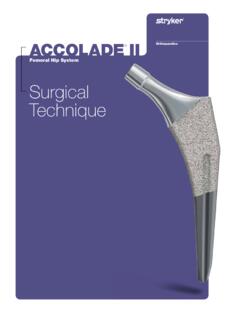
Transcription of Trident Tritanium Acetabular System Surgical Protocol
1 OrthopaedicsTrident Tritanium Acetabular SystemSurgical ProtocolFor Crossfire and X3 Polyethyleneand Trident Alumina CeramicInserts With Tritanium Hemispherical Acetabular Shells1 OrthopaedicsTrident Tritanium Acetabular SystemSurgical ProtocolIndications Painful, disabling joint disease of the hipresulting from: degenerative arthritis,rheumatoid arthritis, post-traumaticarthritis or late stage avascular necrosis. Revision of previous unsuccessfulfemoral head replacement, cuparthroplasty or other procedure. Clinical management problems wherearthrodesis or alternative reconstructivetechniques are less likely to achievesatisfactory results.
2 Where bone stock is of poor quality or isinadequate for other reconstructivetechniques as indicated by deficienciesof the Any active or suspected latent infectionin or about the hip joint. Any mental or neuromuscular disorderwhich would create an unacceptable riskof prosthesis instability, prosthesisfixation failure, or complications inpostoperative care. Bone stock compromised by disease,infection or prior implantation whichcannot provide adequate support and/orfixation to the prosthesis. Skeletal Crossfire and X3 Polyethyleneand Trident Alumina CeramicInserts With Tritanium Hemispherical Acetabular ShellsThis publication sets forth detailed recommended procedures for using Stryker Orthopaedics devices and instruments.
3 It offers guidance that you should heed, but,as with any such technical guide, each surgeon must consider the particular needs of each patient and make appropriate adjustments when and as required. Seepackage insert for warnings, precautions, adverse effects and other essential product Trident Tritanium Acetabular System provides surgeonswith a highly porous ingrowth Trident Tritanium Acetabular System hemisphericalshells are manufactured from Commercially Pure Trident Tritanium shells utilize the screw hole patternand locking mechanism from the Trident Acetabular shells are available in sizes 48mm-80mm, and offer theoption of Alumina Ceramic or Crossfire or X3 polyethyleneinserts.
4 Refer to Table 1for insert and shell compatibility andsizing Alumina Ceramic Inserts gain fixation within the shellby means of mating tapers. Rotational stability between thecomponents is achieved when the shell s anti-rotational barbsinterlock with the insert s Trident AluminaCeramic Inserts must be used with Stryker OrthopaedicsAlumina Trident Polyethylene Inserts lock into the shell by meansof a circumferential ring that engages the shell s mating stability is achieved when the shell s anti-rotationalbarbs interlock with the insert s Trident Tritanium Acetabular System utilizes theCuttingEdge Total Hip Acetabular Instrumentation.
5 Thissurgical technique is a guide to preparing the acetabulum for theTrident Tritanium Hemispherical Acetabular Tritanium Acetabular ShellCrossfire PolyethyleneInsert and X3 PolyethyleneInsert LFIT IonImplanted CoCrFemoral HeadTrident AluminaInsertAluminaFemoral HeadBiolox deltaFemoral HeadTrident Tritanium Acetabular SystemSurgical Protocol3 TABLE 1: Trident Product Compatibility22mm Femoral Head , , , , , , , 76, 78, i d e n t Tritanium HemisphericalShell SizeAlphaCodeTrident X3 Crossfire 0 , 10 InsertPoly Thickness(mm)Eccentric InsertPoly Thickness(mm)Elevated RimInsert PolyThickness (mm)Tr i d e n t Alumina Ceramic 0 Inserts (mm)26mm Femoral Head , , , , , , , 76, 78, i d e n t Tritanium HemisphericalShell SizeAlphaCodeTrident X3 Crossfire 0 , 10 InsertPoly Thickness(mm)Eccentric InsertPoly Thickness(mm)
6 Elevated RimInsert PolyThickness (mm)Tr i d e n t Alumina Ceramic 0 Inserts (mm)28mm Femoral Head , , , , , , , 76, 78, i d e n t Tritanium HemisphericalShell SizeAlphaCodeTrident X3 Crossfire 0 , 10 InsertPoly Thickness(mm)Eccentric InsertPoly Thickness(mm)Elevated RimInsert PolyThickness (mm)Tr i d e n t Alumina Ceramic 0 Inserts (mm)32mm Femoral Head Diameter50, , , , , , , 76, 78, i d e n t Tritanium HemisphericalShell SizeAlphaCodeTrident X3 Crossfire 0 , 10 InsertPoly Thickness(mm)Eccentric InsertPoly Thickness(mm)Elevated RimInsert PolyThickness (mm)Tr i d e n t Alumina Ceramic 0 Inserts (mm)36mm Femoral Head Diameter54, , , , , , 76, 78, i d e n t Tritanium HemisphericalShell SizeAlphaCodeTrident X3 Crossfire 0 , 10 InsertPoly Thickness(mm)Eccentric InsertPoly Thickness(mm)Elevated RimInsert PolyThickness (mm)
7 Tr i d e n t Alumina Ceramic 0 Inserts (mm)10 ConstrainedInser t (mm)10 ConstrainedInsert OuterBearing Thickness (mm)10 ConstrainedInsertTotal Range of Motion10 ConstrainedInsert OuterBearing Thickness (mm)10 ConstrainedInsert OuterBearing Thickness (mm)10 ConstrainedInsert OuterBearing Thickness (mm)10 ConstrainedInsertTotal Range of Motion10 ConstrainedInsertTotal Range of Motion10 ConstrainedInsertTotal Range of Motion10 ConstrainedInsertTotal Range of Motion10 ConstrainedInser t (mm)10 ConstrainedInser t (mm)10 ConstrainedInser t (mm)10 ConstrainedInser t (mm)10 ConstrainedInsert OuterBearing Thickness (mm)4 Trident Tritanium Acetabular SystemSurgical ProtocolFigure 1 Preoperative Planning and X-ray EvaluationPreoperative planning and X-ray evaluation aids in the selectionof the most favorable implant style and optimal size for thepatient s hip pathology.
8 Selecting potential implant styles andsizes can facilitate operating room preparation and assureavailability of an appropriate size selection. X-ray evaluationmay also help detect anatomic anomalies that could prevent theintraoperative achievement of the established preoperative a revision of an existing Acetabular shell is required, thesurgeon s preferred technique for removing the Acetabular shellshould be PreparationThe acetabulum is prepared by the release and removal of softtissue using the surgeon s preferred technique to gain adequateexposure for reaming.
9 Excision of the labrum and osteophytesallows for proper visualization of the bony anatomy, andimproves ease of Orthopaedics Retractors can be utilized to gainacetabular exposure (Figure 1).With the acetabulum exposed, bony defects, can be necessary, bone grafting options may be considered prior to ReamingTo obtain congruity in the reaming process, an optional 45/20 Abduction/Anteversion Alignment Guide can be attached to theCuttingEdge Reamer Handle (Figure 2). The alignment guide,when perpendicular to the long axis of the patient, will orientthe reamer handle at 45 of abduction, thereby placing the axisof the spherical reamer at 45 of inclination (Figure 3).
10 Thereamer handle may then be positioned at 20 of anteversion byaligning the left/right anteversion rod on the alignment guide so that it is parallel to the long axis of the is recommended that initial reaming begin with a CuttingEdge Spherical Reamer that is 4mm smaller than the templated orgauged size. The reamer is attached to the reamer handle bypushing down and applying a quarter-turn to lock in progresses in 1mm increments until final desired sizingis to the porous nature of the Tritanium coating, the outer diameter may be larger than the sizeindicated.