Example: confidence
Typical Progression: Cardinality and Counting - NCETM
Early Years Typical Progression Chart with additional guidance for practitioners December 2018 Cardinality and Counting The cardinal value of a number refers to the quantity of things it represents, e.g. the numerosity, ‘howmanyness’, or ‘threeness’ of three.
Tags:
Information
Domain:
Source:
Link to this page:
Documents from same domain

Number: Addition and Subtraction with Reasoning
www.ncetm.org.uksolve addition and subtraction multi -step problems in contexts, deciding which operations and methods to use and why solve simple problems in a practical context involving addition and subtraction of money of the same unit, including giving change (copied from Measurement) Solve problems involving addition, subtraction, multiplication and division

Mastery approaches to mathematics and the new national ...
www.ncetm.org.ukMastery approaches to mathematics and the new national curriculum ... The focus is on the development of deep structural knowledge and the ability to make connections. Making connections in mathematics deepens knowledge of ... In highly successful systems, teachers are clear that their role is to teach in a
Mathematics glossary for teachers in Key Stages 1 to 3
www.ncetm.org.ukpublication Mathematics glossary for teachers in key stages 1 to 4 published by the Qualifications and Curriculum Authority in 2003. It is intended to be used alongside the 2014 National Curriculum for teachers to check the meaning of the terms. This glossary is part of a wider suite of support of materials from the

Questions, tasks and activities to support assessment
www.ncetm.org.ukOngoing assessment as an integral part of teaching The questions, tasks, and activities that are offered in the materials are intended to be a useful vehicle for assessing whether pupils have mastered the mathematics taught. However, the best forms of ongoing, formative assessment arise from well-structured classroom
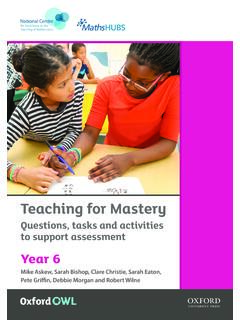
Questions, tasks and activities to support assessment
www.ncetm.org.ukdeveloping mastery of the content laid out for each year. Schools, however, are only ‘required to teach the relevant programme of study by the end of the key stage. Within each key stage, schools therefore have the flexibility to introduce content earlier or later than set out in the programme of study’ (National curriculum page 4).

Number: Number and Place Value
www.ncetm.org.ukwhole numbers , including through zero use negative numbers in context, and calculate ... Writing Numbers)find the effect of dividing a one recognise and use thousandths and relate them to tenths, hundredths and ... round decimals with two decimal places to the nearest whole number and to one

The Essence of Maths Teaching for Mastery
www.ncetm.org.ukThe Essence of Maths Teaching for Mastery ... leads back and forth interaction, including questioning, short tasks, explanation, demonstration, and discussion. ... Significant time is spent developing deep knowledge of the key ideas that are needed to underpin future learning. The structure and connections within the

Number: Multiplication and Division with Reasoning
www.ncetm.org.ukNumber: Multiplication and Division with Reasoning ... formal written methods (appears also in Written Methods) together three numbers Use a fact 20 x 3 = 60. ... (copied from Addition and Subtraction) estimate and use inverse operations to check answers to a calculation

Questions, tasks and activities to support assessment
www.ncetm.org.ukQuestions, tasks and activities to support assessment Year 5 Mike Askew, Sarah Bishop, Clare Christie, Sarah Eaton, Pete Gri˜ n and Debbie Morgan

Number: Number and Place Value with Reasoning
www.ncetm.org.ukthe value of each digit (appears also in Reading and Writing Numbers) find the effect of dividing a -or two digit number by 10 and 100, identifying the value of the digits in the answer as units, tenths and from F ractions) identify the value of each digit to three decimal places and multiply and divide numbers by 10, 100 and 1000 where the ...
Related documents
Questions, tasks and activities to support assessment - NCETM
www.ncetm.org.ukwww.ncetm.org.uk www.oxfordowl.co.uk Ongoing assessment as an integral part of teaching The questions, tasks, and activities that are offered in the materials are intended to be a useful vehicle for assessing whether pupils have mastered the mathematics taught. However, the best forms of ongoing, formative
Checklist Instructions for Licensure by Endorsement as a ...
www.license.dhp.virginia.govNational Certification Exam Results (NCETM or NCETMB) – Official exam results must be sent directly to the Virginia Board of Nursing . directly from the National Certification board for Therapeutic Massage & Bodywork (NCBTMB). (Please contact the NCBTMB at 1(800) 296-0664 or at info@ncbtmb.org, so this request can be processed to avoid any ...
Mathematics guidance: key stages 1 and 2 (covers years 1 to 6)
assets.publishing.service.gov.ukDr Debbie Morgan (Director for Primary Mathematics, NCETM); Clare Christie (Maths Consultant and Lead Practitioner, Ashley Down Primary School); Professor Anne Watson (Emeritus Professor in Mathematics Education, University of Oxford); Dr Yvette Sturdy (Development Editor, DiGiV8 Ltd.); Jalita Jacobson (Editor and Illustrator); Steve Evans
Mathematics programmes of study: key stage 4
assets.publishing.service.gov.ukMathematics is a creative and highly inter-connected discipline that has been developed over centuries, providing the solution to some of history’s most intriguing problems.