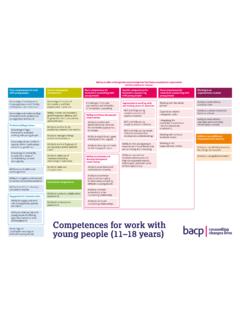
Transcription of Underpinning knowledge Core Competences Metacompetences
1 Telephone and E-CounsellingSupervision of telephone & e-counsellingMetacompetences for providing telephone & e-counsellingMetacompetencesAbility to provide Telephone and E-counsellingCore CompetencesAbility to assess suitability for telephone & e-counsellingAbility to identify and manage risk when telephone/e-counsellingAbility to communicate with clients when telephone/e-counsellingAbility to establish ground rules and boundaries when telephone/e-counsellingAbility to direct clients to supplementary online therapeutic resourcesAbility to conclude the therapeutic relationshipUnderpinning knowledgeKnowledge of psychological processes relevant to offering telephone and e-counsellingBack to map1 Telephone and E-CounsellingKnowledge of psychological processes relevant to offering telephone and e-counsellingManaging the impact of disinhibitionAn ability to draw on knowledge that people may behave differently online/when using other media to the ways in which they might interact in face-to-face situations, and that these differences have important implications for the therapeutic processAn ability to draw on knowledge that disinhibition can be encouraged by features of the online/other media environment : having the sense of being anonymous and invisible not seeing (and therefore not experiencing) other people s reactions to what is saidexperiencing an absence of external authority in the online/other media environmentnot experiencing others as real An ability to draw on knowledge that disinhibition can be a common feature of online/other media interactions, and that where this occurs it will have a significant impact on the therapeutic process.
2 Inappropriately rapid disclosure of sensitive information that risks leaving the client feeling overwhelmedan inappropriately rapid development of intimacy, sometimes followed by withdrawal or distancing difficulty in pacing sessions because clients have disclosed more information than they had intended clients coming to regret having made an uninhibited disclosure clients disclosing issues they would not address had they been in face-to-face therapythe uninhibited expression of anger, hatred, criticismAn ability to help clients who may be disinhibited pace their communications in a manner that makes it more likely that they are able to process material they are disclosing, :interjecting to summarise what the client has been saying asking the client how they feel about what they have saidAn ability to draw on knowledge that therapists can also experience disinhibition, leading to their making unhelpful interventions ( that are too direct, forthright or insensitive)An ability to draw on knowledge that (without face-to-face reality checking) both clients and therapists can more easily develop inaccurate fantasies about each other An ability to rectify inappropriate assumptions by the therapist or the client by reality checking any fantasies that each has developed about the other.
3 Asking for (and offering) clarification where it becomes apparent that assumptions may have been made asking the client what assumptions they hold about the therapistBack to map2 Telephone and E-CounsellingUsing writing as the medium for telephone and e-counsellingAn ability to draw on knowledge that the written word can have a different impact to oral communication because: it can acquire a sense of permanence it can appear more authoritative than the spoken wordits meaning cannot be moderated by contextual features (such as non-verbal communication)An ability to modulate the potential impact of the written word (for example, by taking care to express views tentatively) An ability to draw on knowledge that clients may find the act of writing therapeutic in itself ( as a means of self-expression and self-reflection) An ability to detect and to comment on shifts in the client s style of written communication that could be indicative of psychological changes in the clientAn ability to draw on knowledge that using written language may help clients stay in control of the feelings they express Managing attachment and rejection in the context of telephone and e-counsellingAn ability to draw on knowledge that telephone and e-counselling can promote phenomena (such as transference and projection) in which fantasy and speculation about the therapist are to the foreAn ability to draw on knowledge of the ways that transference and countertransference issues can be activated when e-counselling.
4 The absence of a prompt response from the counsellor may evoke feelings of rejection or abandonment in the clientthe client may perceive the therapist to be constantly available to them ( at the flick of a switch )An ability to manage issues of transference and countertransference ;by negotiating and agreeing clear boundaries with the clientby checking perceptions and understandingby engaging in meta-communication (discussing how client and therapist are communicating and relating to each other) knowledge of the culture of internet communitiesAn ability to draw on knowledge of the characteristics of internet communities ( transient relationships, false identities, playing out of fantasies) and the implications these have for the therapeutic relationshipBack to map3 Telephone and E-CounsellingAbility to assess suitability for telephone and e-counsellingAn ability to draw on knowledge that a client s ability to make use of therapy at a distance should be assessed before therapy and periodically during the intervention An ability to draw on knowledge of factors that may be relevant when assessing suitability for telephone and e-counselling.
5 The client s preference regarding the type of technology to be used the client s competence in using differing technologieshow comfortable the client is when communicating using particular technologiesthe client s ability to express their feelings and experience using particular technologiesthe client s likely ability to engage in a therapeutic relationship mediated by technologyany potential benefits for the client in using particular technologiesAn ability to assess the client s understanding of, and attitudes towards telephone and e-counselling, in order to judge whether this is likely to be an appropriate therapeutic medium for themAn ability to assess when supplementary modes of communication are needed in order to gain a fuller picture of the client and their problems ( adding a phone conversation to an online discussion) an ability to determine when the time and resources required for a comprehensive assessment are justified (for example, by the complexity of a client s presentation)An ability to discuss with the client the advantages of working therapeutically when telephone/e-counselling, for example:that it is accessible ( for people with disabilities, where people have limited access to transport or where people travel extensively as part of their work) that sessions can be scheduled flexibly ( arranged around working commitments and/or caring roles) that therapy can be accessed in people s own homesthat the absence of a face-to-face relationship can feel less inhibitingAn ability to discuss with the client the potential disadvantages of telephone and e-counselling.
6 That therapy can be disrupted by technical problemsthat telephone and e-counselling raise issues of data securitythat without visual contact (and hence reduced opportunity for non-verbal communication) it can be harder to assure mutual understandingthat communicating only by text can be experienced as lacking in spontaneityBack to map4 Telephone and E-CounsellingAssessing psychological suitabilityAn ability to assess psychological difficulties and presenting problems that may make it harder for clients to make effective use of telephone and e-counselling, :clients who need a high level of care and support clients who are struggling to functionclients who present a high level of risk ( suicide/self-harm) evidence of poor reality-testingevidence of strong transference reactions that may be difficult to containevidence of a tendency to challenge boundaries and/or present in a fragmented and inconsistent manner across time or medium of communication Assessing suitability for working onlineAn ability to evaluate the client s ability to work online, with the specific aim of detecting whether their skills and knowledge are sufficient for them to make effective use of the medium : whether they can communicate quickly and efficiently whether they can express themselves effectivelyAn ability to identify and help the client trouble-shoot practical issues that may limit their ability to make effective use of communications technology.
7 Where the client is unable to access the internet in a private and secure environment where technological factors limit internet access (such as firewalls or out-of-date browsers) An ability to assess the client s familiarity with working online, with the aim of detecting their likely capacity to make effective use of the medium, identifying: their experience of communicating using the internet their use of social mediawhether they already have online relationships or belong to online groupsthe nature, length and quality of any online relationships An ability to draw on knowledge that the client s attitude to telephone and e-counselling will be influenced by:previous experiences of therapy, either online, via other media or face-to-faceconcurrent therapy, either online, via other media or face-to-faceAn ability to identify any physical and medical factors that may affect online/other media therapy, such as visual or motor disabilitiesAn ability to recommend appropriate support software for clients with a disability ( voice recognition software )Back to map5 Telephone and E-CounsellingAssessing suitability for text-based therapyAn ability to assess the client s suitability for text-based therapy, : the ease with which they use the medium to express themselvesAn ability to assess the client s preference for synchronous or asynchronous text-based communication.
8 Where a client may prefer to write spontaneously and find it difficult to tolerate the lack of immediate response where a client may prefer to compose, edit and reflect on their communication before sendingAn ability to suggest alternative sources of support where clients are assessed as not suitable for telephone and e-counsellingBack to map6 Telephone and E-CounsellingAbility to identify and manage risk when telephone and e-counsellingAn ability to draw on knowledge that telephone and e-counselling (particularly when using written text) does not provide access to the non-verbal cues that can help signal increasing distress or vulnerabilityAn ability to draw on knowledge that appraising risk when telephone and e-counselling can be more challenging than when working face-to-face :limited information can make it harder to judge the severity of risk it can be harder to verify whether risk is genuine or when (for whatever reason) the client is misrepresenting the level of riskit can be harder to judge the level of support available to the client through their social and family networksAn ability to draw on knowledge that although clients who show disinhibition when telephone/e-counselling may be more likely to report risk issues, these reports should still be evaluated carefullyAn ability to have in place procedures for dealing with risk issues that emerge when telephone/e-counselling and to be able to communicate these to clientsAn ability to draw on knowledge that telephone and e-counselling limit how far a therapist can intervene in cases where risk issues emergeAn ability, when contracting with a client, to gather relevant information that will support risk management.
9 Requesting details of GP/friend/family member who may be contacted in times of crisisrequesting the client s postal address and telephone number for use should it be necessary to contact the emergency services or crisis supportAn ability to monitor the form and content of clients communications in order to identify risk issues when these emerge, either directly or indirectly :where a client reports engaging in risky behaviourwhere a client reports becoming actively suicidalwhere a client reports increased levels of hopelessness and despairwhere a client describes a third party being at riskwhere a client behaves uncharacteristically online/via other mediawhere routine outcome measures ( CORE, PHQ-9) indicate elevated levels of riskBack to map7 Telephone and E-CounsellingAn ability to act on risk issues : by directing the client to sources of emergency support and other resources, including face-to-face and telephone counsellingby offering additional contact between sessionsin cases where a client is actively suicidal, by keeping contact with the client until appropriate support arrivesAn ability to help clients identify sources of additional support in cases of elevated risk ( by listing resources on the therapist s website)An ability to identify when risk issues warrant the breaking of confidentiality, contacting GP/social services/police/family memberManaging the counsellor s anxiety in relation to riskAn ability for the counsellor to recognise and to manage the emotional impact of holding risk issues when telephone/e-counselling.
10 By seeking appropriate, advice, supervision and/or supportBack to map8 Telephone and E-CounsellingAbility to communicate with clients when telephone/e-counsellingAn ability to draw on knowledge that (because communicating when telephone/e-counselling may carry a greater risk of misunderstanding than face-to-face communication) there is a