Transcription of understanding blindness in cats
1 Irish Veterinary Journal Volume 63 Number 12760continuing educationIrish Veterinary Journal Volume 63 Number 12 INtroductIoNVision is an importance sense for cats, used for navigation, orientation, hunting and interaction with other cats. Loss of vision can occur due to disease, trauma , toxins or dietar y deficiency. As vets, we need to provide rapid and accurate diagnosis, with appropriate treatment for the underlying condition, making the cat as comfortable as possible. However, it is also important to be able to provide support to the owners who will be upset for the cat and unsure how to care for of blINdNeSSThe owners may present the cat for evaluation of vision loss because they have noticed changes in behaviour or changes to the appearance of the eyes.
2 Their obser vations will include some of the following:The cat is walking in a crouched position, holding their body low to the groundWalking around the edge of the room or garden rather than through the middle The cat walks into things, such objects which are not normally in that positionReluctance to jump down, although they may be still able to jump onto thingsThere may be a difference in the confidence of the cat depending on the lighting conditions the cat may be understanding blindness in catsNatasha Mitchell, MVB CertVOphthal MRCVSEye Vet, Crescent Veterinary Clinic, Dooradoyle Road, Limerick. Eye Vet offers a comprehensive referral service in the medical and surgical treatment of a wide range of ophthalmic disorders.
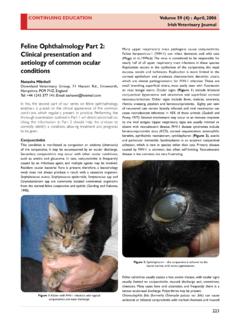
3 AbStrActBlind cats can have a ver y happy and fulfilled life, with a little help from their owners and vet. The signs of blindness include a change in personality, a change in the appearance in the eye and the cat walking in a crouched position closer to the ground. Causes of blindness include systemic hypertension, cataracts, trauma , glaucoma, uveitis and birth defects. Caring for a blind cat depends on whether the blindness has been a gradual experience or 76001/12/2010 14:23:08 Irish Veterinary Journal Volume 63 Number 12 Irish Veterinary Journal Volume 63 Number 12 CoNtiNUiNG edUCatioN761less confident in dim lightThe personality may change, with the cat being more quiet or fear fulA change in the appearance of the eye it may be red, cloudy or glazedThere is an increased green shine to the eye, in other words, increased tapetal hyper-reflectivity and dilated pupilsFigure 1.
4 Hyphaema in the right eye and mydriasis and tapetal hyper-reflectivity in the left oF blindness IN CAtsThere are many different reasons why a cat may become blind, which may be considered when evaluating the blind cat. A full histor y, along with a thorough ocular and physical examination may reveal the cause or may lead to further diagnostic tests being indicated. The most common causes of blindness in cats are summarised:1. Systemic hypertension Hypertension is an under-diagnosed condition of older cats, and it is the most common cause of blindness . Typically, an older cat presents with blindness , widely dilated pupils, some blood in the anterior chamber or vitreous, and multifocal retinal haemorrhages, oedema and/or detachment (figures 2 and 3).
5 The retinal changes are bilateral but not symmetrical. Hypertension may be primar y, or secondar y to systemic conditions including chronic renal disease, hyperthyroidism and hyperaldosteronism. Following treatment it is possible for the cat to regain some vision, but this depends on various factors for example the length of time the retina is detached. Blood pressure should be measured (Figure 4), and, if the facilities are not available, the cat should be 4. Measuring blood pressure in a cat using a Doppler ultrasound. The cat is gently restrained, and headphones are used to prevent sounds which may disturb the cat, falsely elevating the blood CataractsA cataract is an opacity of the lens. They are not ver y common in cats but most often occur as a result of penetrating lens injur y or blunt trauma (Figure 5), secondar y to uveitis (see below), or ver y occasionally they may be congenital (Figure 6).
6 Recently, the parasite Encephalitozoon cuniculi has been implicated in the pathogenesis of feline cataracts. In some instances the cataracts may be suitable for surgical removal using 5. Hypermature cataract in the left eye presumed to be secondary to previous trauma , and evidence of previous trauma in the right eye also as there is a corneal scar and anterior synechia in this rescued 6. Bilateral congenital cataracts in a one-year-old catFigures 2 and 3. Both fundus photos show pre-retinal haemorrhage, bullous retinal detachment and blood vessel abnormalities in these cats suffering with systemic 76101/12/2010 12:27:21 Irish Veterinary Journal Volume 63 Number 12762 CoNtiNUiNG edUCatioNIrish Veterinary Journal Volume 63 Number 123.
7 TraumaThrough a variety of mechanisms, ocular or head trauma can lead to blindness . The most common forms of injur y a cat sustains are blunt trauma such as road traffic accidents, or sharp penetrating trauma such as cat claw injur y or gun shot pellets (Figures 7-10). This can result in globe rupture, retinal detachment, lens luxation, cataract, hyphaema, and may lead to secondar y glaucoma or phacoclastic uveitis. Hyphaema obscures the view of the internal structures of the eye, and can lead to secondar y glaucoma or induce retinal detachment. Figures 7 and 8. Left and right eye of a cat which went missing for a couple of days and returned blind. There was a corneal wound in the left eye along with vitreal haemorrhage, and a wound above the right eye along with vitreal haemorrhage.
8 Figures 9 and 10. Radiographs of the same cat featured in figures 7 and 8. It was clear that the misfortunate cat was the victim of a shot gun GlaucomaGlaucoma is the result of raised intraocular pressure. An obstruction to the drainage of aqueous humour can result in increased pressure. The high pressure damages the delicate retinal ganglion cells and their axons, making vision poorer until it eventually causes blindness . Glaucoma in cats is most often caused by uveitis (see below). Other causes include trauma , hyphaema or ocular neoplasia. Even though glaucoma is a painful condition, the cat may display only subtle signs. There will be var ying degrees of episcleral congestion, pupil dilation (Figure 11), poor pupillar y light reflex (PLR) or hydrophthalmos (enlarged globe, Figure 12).
9 The only reliable way to diagnose glaucoma is by tonometr y. If glaucoma is suspected and the clinic does not have a tonometer, referral is advisable. 5. UveitisUveitis is inflammation of the uveal tract, which comprises the iris, the ciliar y body and the choroid. Anterior uveitis (inflammation of the iris) is the most common type of uveitis which is diagnosed. Signs of uveitis include conjunctival hyperaemia, moderate blepharospasm and epiphora, keratic precipitates on the ventral aspect of the corneal endothelium (Figure 13), fibrin in the anterior chamber (Figure 14), a change in iris colour (may become muddy brown or hyperaemic), and occasionally photophobia and corneal oedema. Causes of uveitis in cats include: trauma damaging the lens (phacoclastic uveitis) immune-mediated disease causing lymphocytic- plasmacytic uveitisinfectious agents such as feline infectious peritonitis (FIP), toxoplasmosis, feline immunodeficiency virus (FIV), or feline leukaemia virus (FeLV).
10 Corneal disease including corneal ulcers can cause reflex trigeminal neuritis which manifests as uveitis. Laborator y tests for an underlying cause are indicated, including haematology, biochemistr y, urinalysis, FIV, FeLV, titres for corona virus and Toxoplasma IgG Figure 12. The left eye is enlarged (hydrophthalmos), the cornea has scarring centrally, there is miosis and cataract in this cat with chronic glaucoma due to previous ocular 13. There are multifocal opacities visible on the corneal endothelium which are keratic precipitates in this kitten with 14. There is episcleral congestion, a fibrin clot in the anterior chamber, hyperaemia of the iris and dyscoria (distorted pupil) in this FIV-positive 11. Episcleral congestion, precipitates on the corneal endothelium, iris hyperaemia, mydriasis and dyscoria in this cat with glaucoma secondary to 76201/12/2010 12:27:24 Irish Veterinary Journal Volume 63 Number 12 Irish Veterinary Journal Volume 63 Number 12 CoNtiNUiNG edUCatioN763and IgM.