Transcription of User Guide - Harvard University
1 CENTRICON.. centrifugal Filter Devices user Guide Centricon centrifugal filter devices with 10,000 NMWL, 30,000 NMWL, 50,000 NMWL, and 100,000 NMWL Ultracel YM membranes are approved for in-vitro diagnostic use. Centricon centrifugal filter devices with 3,000 NMWL Ultracel YM. membranes are for research use only and are not for use in diagnostic procedures. Notice The information in this document is subject to change without notice and should not be construed as a commitment by Millipore Corporation. Millipore Corporation assumes no responsibility for any errors that may appear in this document. This manual is believed to be complete and accurate at the time of publication. In no event shall Millipore Corpora- tion be liable for incidental or consequential damages in connection with or arising from the use of this manual.
2 99259, Rev. Y, 03/05. 2005 Millipore Corporation. All rights reserved. Printed in . B I O S E P A R A T I O N S. Millipore, Amicon, Centricon and Ultracel are registered trademarks of Millipore Corporation. Contents Introduction .. 1. Intended Use .. 2. Applications .. 3. Equipment Required .. 3. Usage Guidelines .. 3. Maximum centrifugal Force .. 3. Rotor Compatibility .. 4. To Convert Relative centrifugal Force to Revolutions Per Minute .. 4. Prerinsing .. 4. Chemical Compatibility .. 4. How to Use Centricon centrifugal Filter Devices .. 5. Device Storage .. 7. Performance .. 8. Flow Rate .. 8. Retention and Recovery .. 10. Centrifugation Guidelines for Nucleic Acids .. 11. Purification of PCR Fragments Using 50,000 NMWL Centricon Device .. 12. Biological Activity .. 12. Low Solute Recovery .. 13. Membrane Appearance.
3 13. Desalting .. 13. Specifications .. 14. Materials of Construction .. 15. Product Ordering Information .. 16. Technical Assistance .. 17. Support Documents on the Internet .. 17. Standard Warranty .. 18. Introduction Centricon centrifugal filter devices provide fast, efficient concentra- tion and desalting of macromolecular solutions by ultrafiltration us- ing Millipore's Ultracel YM regenerated cellulose membranes. De- signed for use in centrifuges with fixed-angle rotors, they can pro- vide up to 80-fold sample enrichment with minimal solute loss by adsorption. The Centricon product line currently includes devices with: Ultracel YM-3 membrane 3,000 NMWL. Ultracel YM-10 membrane 10,000 NMWL. Ultracel YM-30 membrane 30,000 NMWL. Ultracel YM-50 membrane 50,000 NMWL. Ultracel YM-100 membrane 100,000 NMWL. Concentration is achieved by ultrafiltering the sample solution through an anisotropic membrane.
4 centrifugal force drives solvents and low molecular weight solutes through the membrane into the filtrate vial. Retained macrosolutes are above the membrane inside the sample reservoir. As the sample volume is diminished, retained solute concentration increases. For recovery, the sample is trans- ferred to the retentate vial by placing the vial over the sample res- ervoir, inverting the device, then centrifuging briefly. This mini- mizes adsorptive losses to the membrane and the reservoir wall. 2 Introduction, continued Centricon centrifugal filter devices are designed for use only in centrifuges with fixed-angle rotors. This results in a force vector that is at a constant angle to the membrane surface. As sample con- centration progresses, retained material slides outward and gathers at the edge of the membrane.
5 As a result, the filtration rate remains consistently high. In a swinging-bucket rotor, the horizontal angle would force the retentate layer to accumulate over the entire mem- brane surface, significantly reducing solvent flow. The membrane support contains a circular outlet with ducts for sol- vent flow. Filtration stops when the solvent meniscus reaches the outer edge of the outermost duct. This deadstop prevents concen- tration to dryness. Rotor angle determines final deadstop volume, as outlined in the Specifications section. Intended Use Centricon centrifugal filter devices containing Ultracel YM-10, YM- 30, YM-50, and YM-100 membranes are for in vitro diagnostic use and are intended for concentrating serum, urine, cerebrospinal fluid and other body fluids before analysis. Centricon devices containing Ultracel YM-3 membranes are for re- search use only and are not approved for use in diagnostic proce- dures.
6 For in vitro diagnostic use For research use only Millipore cat. no. Millipore cat. no. 4241 4208 4225 4240. 4205 4209 4244 4202. 4206 4210 4211 4203. 4207 4243 4212. 4242AM 4224 4213. Centricon centrifugal Filter Devices 3. Applications Concentration of biological samples containing antigens, anti- bodies, enzymes, nucleic acids, microorganisms and other mac- romolecular material. Purification of macromolecular components found in tissue cul- ture extracts and cell lysates. Recovery of oligonucleotides and peptides. Filtration of substances with MW below the nominal molecular weight limit (NMWL). Equipment Required Any centrifuge with fixed-angle rotor adaptors or carriers accepting 17 100 mm tubes and capable of 1000 7500 g. Millipore recom- mends using a covered rotor. Usage Guidelines Centricon components are not autoclavable.
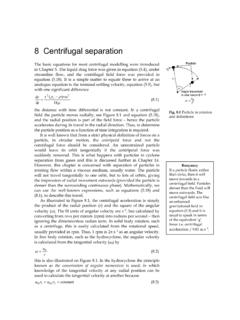
7 Do not operate above the following limits. Excessive g-force may result in leakage or damage to the device. Maximum centrifugal Force Centricon filter devices with Ultracel YM-3 membranes: without retentate vial: 6500 g with retentate vial: 7500 g during prerinsing: 5000 g Centricon filter devices with Ultracel YM-10, YM-30, and YM-50 membranes: 5000 g Centricon filter devices with Ultracel YM-100 membranes: 5000 g for proteins;. 2000 g for nucleic acids (adjust the sample to 2 mL with TE or other appropriate buffer prior to centrifugation). 4 Rotor Compatibility Visit for centrifuge and rotor com- patibility for Millipore centrifugal separation devices. To Convert Relative centrifugal Force (RCF) to Revolutions Per Minute (RPM): Determine the centrifuge's radius of rotation by measuring the dis- tance from the center of the centrifuge spindle to the bottom of the device when it is inserted into the rotor.
8 Relative centrifugal force can be calculated using the formula: RCF = 10-5 radius (RPM)2. radius = distance in centimeters from the center of rotation to the base of the filtrate vial RPM = revolutions per minute Prerinsing The ultrafiltration membranes in Centricon centrifugal filter devices contain trace amounts of glycerine (approx. 2 L per device). If these materials interfere with analysis, fill the device with 2 mL of buffer or deionized water and spin until at least half the rinse passes into the filtrate vial then invert the device and spin at 300 1000 g for two minutes to remove the remaining rinse. If interference con- tinues, repeat with a second spin of buffer or deionized water. CAUTION: Do not allow the membrane in Centricon filter devices to dry out once wet. If you are not using the device immediately after prerinsing, leave fluid on the mem- brane until the device is used.
9 Chemical Compatibility Centricon centrifugal filter devices are intended for use with bio- logical fluids and aqueous solutions. Before use, check the sample for chemical compatibility with the device. The chemical compat- ibility list can be found at Centricon centrifugal Filter Devices 5. How to Use Centricon centrifugal Filter Devices 1. Insert sample reservoir into filtrate vial as shown. 2. Add solution to sample reservoir (2 mL maximum volume). Do not touch membrane with pipette tip. If possible, use a covered rotor in order to minimize sample evaporation. Or, seal the device by attaching the retentate vial to the sample reservoir. The rotor adapter must accept a minimum length of 137 mm. CAUTION: Obstructions could damage the centrifugal device during centrifugation. Check clearance. 3. Place covered device and attached filtrate vial into the centri- fuge rotor; counterbalance with a similar device.
10 6 How to Use Centricon centrifugal Filter Devices, continued 4. Spin as follows until desired concentration is achieved: Centricon devices with Ultracel YM-3 membrane: 4000 7500 g with retentate vial in place;. 4000 6500 g without retentate vial Centricon devices with Ultracel YM-10, YM-30, and YM-50. membranes: 1000 5000 g Centricon devices with Ultracel YM-100 membrane: 5000 g for proteins;. 2000 g for nucleic acids (adjust the sample to 2 mL with TE or other appropriate buffer prior to centrifugation). CAUTION: Do not exceed the recommended centrifugation speed. 5. Remove centrifugal filter assembly from centrifuge; then sepa- rate filtrate vial from membrane support base. For filtration applications, reserve filtrate. For concentration applications, filtrate may either be discarded or left in the filtrate vial.