Transcription of User guide - ResMed
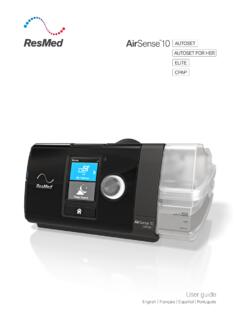
1 User guideEnglish | Fran ais | Espa ol | Portugu sUser guideii132(a)(b)(c)Fitting / Mise en place / Colocaci n / Coloca oAdjustment / Ajustement / Ajuste / Ajusteiii123 Removal / Retrait / Remoci n / Remo oDisassembly / D montage / Desmontaje /Desmontagemiv123618264 621/08/2013 11:38:40 AMReassembly / Remontage / Montaje / RemontagemEnglish 1 ENGLISH AirFit P10 Nasal Pillows System Thank you for choosing the AirFit P10. This document provides the user instructions for the AirFit P10 and AirFit P10 for Her masks referred to collectively as AirFit P10 throughout this manual.
2 AirFit P10 has blue headgear while AirFit P10 for Her has pink headgear. Note your headgear may come with or without a buckle. Using this guide Please read the entire guide before use. When following instructions, refer to the images at the front and back of the guide . Intended use The AirFit P10 channels airflow noninvasively to a patient from a positive airway pressure (PAP) device such as a continuous positive airway pressure (CPAP) or bilevel device. The AirFit P10 is: to be used by patients (> 66 lb (30 kg)) for whom positive airway pressure has been prescribed intended for single-patient re-use in the home environment and multi-patient re-use in the hospital/institutional environment.
3 GENERAL WARNINGS The mask must be used under qualified supervision for users who are unable to remove the mask by themselves. The mask may not be suitable for those predisposed to aspiration. The vent must be kept clear. The mask should only be used with CPAP or bilevel devices recommended by a physician or respiratory therapist. The mask should not be used unless the device is turned on. Once the mask is fitted, ensure the device is blowing air. Explanation: CPAP and bilevel devices are intended to be used with special masks (or connectors) which have vent holes to allow continuous flow of air out of the mask.
4 When the device is turned on and functioning properly, new air from the device flushes the exhaled 2 air out through the mask vent holes. However, when the device is not operating, insufficient fresh air will be provided through the mask, and the exhaled air may be rebreathed. Rebreathing of exhaled air for longer than several minutes can, in some circumstances, lead to suffocation. This applies to most models of CPAP or bilevel devices. Follow all precautions when using supplemental oxygen. Oxygen flow must be turned off when the CPAP or bilevel device is not operating, so that unused oxygen does not accumulate within the device enclosure and create a risk of fire.
5 Oxygen supports combustion. Oxygen must not be used while smoking or in the presence of an open flame. Only use oxygen in well ventilated rooms. At a fixed rate of supplemental oxygen flow, the inhaled oxygen concentration varies, depending on the pressure settings, patient breathing pattern, mask, point of application and leak rate. This warning applies to most types of CPAP or bilevel technical specifications of the mask are provided for your clinician to check that they are compatible with the CPAP or bilevel device. If used outside specification or if used with incompatible devices, the seal and comfort of the mask may not be effective, optimum therapy may not be achieved, and leak, or variation in the rate of leak, may affect the CPAP or bilevel device function.
6 Discontinue using this mask if you have ANY adverse reaction to the use of the mask, and consult your physician or sleep therapist. Using a mask may cause tooth, gum or jaw soreness or aggravate an existing dental condition. If symptoms occur, consult your physician or dentist. As with all masks, some rebreathing may occur at low CPAP pressures. Refer to your CPAP or bilevel device manual for details on settings and operational information. The mask is not intended to be used simultaneously with nebulizer medications that are in the air path of the mask/tube Remove all packaging before using the mask.
7 Using your mask When using your mask with ResMed CPAP or bilevel devices that have mask setting options, refer to the Technical specifications section in this user guide for mask selection options. English 3 For a full list of compatible devices for this mask, see the Mask/Device Compatibility List at Notes: This mask is not compatible for use with ResMed AutoSet CS 2 and VPAP Adapt SV devices. SmartStart may not operate effectively when using this mask with some CPAP or bilevel devices that have this feature. If you experience nasal dryness or irritation, using a humidifier is recommended.
8 Fitting 1. Hold the pillows away from your nose ensuring that the pillow size (eg, M) with the left (L) and right (R) indicators are correctly facing towards you then guide the nasal pillows into your nostrils (L into your left nostril, R into your right nostril). Pull the headgear over your head by holding the bottom band and stretching it around the back of your head. The top band should sit comfortably on top of your head. Tip! There are raised logos on top of the frame so you can feel the correct way up when fitting in the dark. 2. Move the mask away from your face then place it back to get a comfortable fit.
9 Ensure the nasal pillows fit securely into your nostrils with both pillows positioned upright. 3. Finally, connect the end of the mask tubing into your device air tubing. Your mask is now fitted and ready to use. When the device is running, a light breeze should be felt through the vent. To inspect the vent place a finger close but not over the entire vent area. Adjustment To achieve a comfortable fit, adjust the split bands by spreading them apart to loosen or draw them closer together to tighten. If your headgear comes with a buckle, adjust the headgear by pulling the headgear through the buckle to fix mask leaks.
10 Adjust only enough for a comfortable seal and do not overtighten. You may need to adjust the headgear as it stretches over time. 4 Removal To take off your mask system, pull the mask and headgear by the split-band, up and over your head. Disassembly 1. Holding the top of the mask tubing, squeeze and pull the pillows away from the mask frame. 2. Unhook the headgear from the stabilizer by pulling on the end cap to reveal the buttonhole. 3. Slide the headgear off the end of the stabilizer. Reassembly 1. With the gray side facing out, insert each end of the headgear band over the stabilizers through the buttonholes.