Transcription of var — Vector autoregressive models
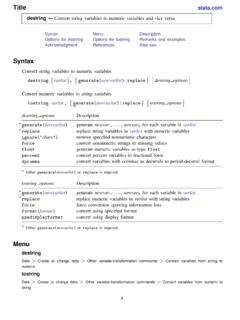
1 Vector autoregressive modelsSyntaxMenuDescriptionOptionsRemark s and examplesStored resultsMethods and formulasAcknowledgmentReferencesAlso seeSyntaxvardepvarlist[if] [in] [,options]optionsDescriptionModelnoconst antsuppress constant termlags(numlist)use lagsnumlistin theVARexog(varlist)use exogenous variablesvarlistModel 2constraints(numlist)apply specified linear constraintsnologsuppressSURE iteration logiterate(#)set maximum number of iterations forSURE; default isiterate(1600)tolerance(#)set convergence tolerance ofSURE noisureuse one-stepSURE dfkmake small-sample degrees-of-freedom adjustmentsmallreport small-sampletandFstatisticsnobigfdo not compute parameter Vector for coefficients implicitlyset to zeroReportinglevel(#)set confidence level; default islevel(95)lutstatsreport L utkepohl lag-order selection statisticsnocnsreportdo not display constraintsdisplayoptionscontrol column formats, row spacing, and line widthcoeflegenddisplay legend instead of statisticsYou musttssetyour data before usingvar; see [TS] contain time-series operators; see[U] Time-series ,fp,rolling,statsby, andxiare allowed.
2 See[U] Prefix not appear in the dialog [U] 20 Estimation and postestimation commandsfor more capabilities of estimation >Multivariate time series> Vector autoregression (VAR)12 var Vector autoregressive modelsDescriptionvarfits a multivariate time-series regression of each dependent variable on lags of itself and onlags of all the other dependent fits a variant of Vector autoregressive (VAR) modelsknown as theVARX model , which also includes exogenous variables. See [TS]var introfor a list ofcommands that are used in conjunction model noconstant; see [R]estimation (numlist)specifies the lags to be included in the model . The default islags(1 2).
3 This optiontakes anumlistand not simply an integer for the maximum lag. For example,lags(2)wouldinclude only the second lag in the model , whereaslags(1/2)would include both the first andsecond lags in the model . See[U] numlistand[U] Time-series varlistsfor morediscussion of numlists and (varlist)specifies a list of exogenous variables to be included in theVAR. model 2 constraints(numlist); see [R]estimation the log from the iterated seemingly unrelated regression algorithm. By default, theiteration log is displayed when the coefficients are estimated through iterated seemingly unrelatedregression. When theconstraints()option is not specified, the estimates are obtained viaOLS,andnologhas no effect.
4 For this reason,nologcan be specified only whenconstraints()isspecified. Similarly,nologcannot be combined (#)specifies an integer that sets the maximum number of iterations when the estimatesare obtained through iterated seemingly unrelated regression. By default, the limit is 1,600. Whenconstraints()is not specified, the estimates are obtained usingOLS, anditerate()has noeffect. For this reason,iterate()can be specified only whenconstraints()is ,iterate()cannot be combined (#)specifies a number greater than zero and less than 1 for the convergence tolerance ofthe iterated seemingly unrelated regression algorithm. By default, the tolerance is1e-6. When theconstraints()option is not specified, the estimates are obtained usingOLS, andtolerance()has no effect.
5 For this reason,tolerance()can be specified only whenconstraints()isspecified. Similarly,tolerance()cannot be combined that the estimates in the presence of constraints be obtained through one-stepseemingly unrelated regression. By default,varobtains estimates in the presence of constraintsthrough iterated seemingly unrelated regression. Whenconstraints()is not specified, theestimates are obtained usingOLS, andnoisurehas no effect. For this reason,noisurecan bespecified only whenconstraints()is that a small-sample degrees-of-freedom adjustment be used when estimating , the errorvariance covariance matrix. Specifically, 1/(T m)is used instead of the large-sample divisor1/T, wheremis the average number of parameters in the functional form forytover report small-sampletandFstatistics instead of the large-sample normal andchi-squared Vector autoregressive models 3nobigfrequests thatvarnot save the estimated parameter Vector that incorporates coefficients thathave been implicitly constrained to be zero, such as when some lags have been omitted from (bf)is used for computing asymptotic standard errors in the postestimation commandsirf createandfcast compute; see [TS]irf createand [TS]fcast compute.
6 Therefore, specifyingnobigfimplies that the asymptotic standard errors will not be available fromirf createandfcast compute. SeeFitting models with some lags excluded. Reporting level(#); see [R]estimation that the L utkepohl (2005) versions of the lag-order selection statistics be and formulasin [TS]varsocfor a discussion of these ; see [R]estimation :vsquish,cformat(%fmt),pformat(%fmt),sfo rmat(%fmt), andnolstretch;see [R]estimation following option is available withvarbut is not shown in the dialog box:coeflegend; see [R]estimation and are presented under the following headings:IntroductionFitting models with some lags excludedFitting models with exogenous variablesFitting models with constraints on the coefficientsIntroductionAVARis a model in whichKvariables are specified as linear functions ofpof their own lags,plags of the otherK 1variables, and possibly exogenous variables.
7 AVAR withplags is usuallydenoted aVAR(p). For more information, see [TS]var 1: VAR modelTo illustrate the basic usage ofvar, we replicate the example in L utkepohl (2005, 77 78). Thedata consists of three variables: the first difference of the natural log of investment,dlninv; thefirst difference of the natural log of income,dlninc; and the first difference of the natural log ofconsumption,dlnconsump. The dataset contains data through the fourth quarter of 1982, thoughL utkepohl uses only the observations through the fourth quarter of use (Quarterly SA West German macro data, Bil DM, from Lutkepohl 1993 Table ). tssettime variable: qtr, 1960q1 to 1982q4delta: 1 quarter4 var Vector autoregressive models .
8 Var dln_inv dln_inc dln_consump if qtr<=tq(1978q4), lutstats dfkVector autoregressionSample: 1960q4 - 1978q4 No. of obs = 73 Log likelihood = (lutstats) AIC = = HQIC = (Sigma_ml) = SBIC = Parms RMSE R-sq chi2 P>chi2dln_inv 7 .046148 7 .011719 7 .009445 Std. Err. z P>|z| [95% Conf. Interval] .1254564 .1249066 ..5456664 .5345709.
9 6643086 .6650949 .0172264 ..0318592 ..0317196 ..1385702 ..1357525 ..168699 ..1688987 ..0043746 .0071932 ..0256763 ..0255638 ..1116778 .005929 ..1094069 .1404798 ..1359595 ..1361204 ..0035256 .0060157 .0198358var Vector autoregressive models 5 The output has two parts: a header and the standard Stata output table for the coefficients, standarderrors, and confidence intervals. The header contains summary statistics for each equation in theVARand statistics used in selecting the lag order of theVAR.
10 Although there are standard formulas for allthe lag-order statistics, L utkepohl (2005) gives different versions of the three information criteria thatdrop the constant term from the likelihood. To obtain the L utkepohl (2005) versions, we specifiedthelutstatsoption. The formulas for the standard and L utkepohl versions of these statistics aregiven inMethods and formulasof [TS] specifies that the small-sample divisor 1/(T m)be used in estimating insteadof the maximum likelihood (ML) divisor 1/T, wheremis the average number of parameters includedin each of theKequations. All the lag-order statistics are computed using theMLestimator of .Thus, specifyingdfkwill not change the computed lag-order statistics, but it will change the estimatedvariance covariance matrix.