Transcription of WATER TREATMENT - Vecom
1 Vecom Marine is a joint venture of Vecom Group & Unimarine Group - Version - Chapter 11 - Page 2 Vecom Marineclean ships - clean seasThis information is not to be taken as a warranty or repre-sentation for which we assume legal responsibility, nor as a permission, inducement or recommendation to practice any patented invention without a license. The information is offered solely for your consideration, investigation and NEED FOR CONTROLW hether distilled or raw (city) WATER is used for boiler make-up, chemical TREATMENT is necessary to counteract harmful substances which are present.
2 Particularly, the contaminants present in raw WATER are inorganic sodium compounds of chloride, sulfate and carbonate and the hardness (calcium and magnesium) compounds of these same materials. Gases such as oxygen and carbon dioxide are present in feed WATER , distilled or row WATER . Marine evaporators do not remove all of the salts and minerals from seawater. Minute particles are carried over from the evaporator in the WATER vapor and are present in the distillate. Any leaks in the distiller, condensers or any part of the feed system which is sea WATER cooled will add solids and further magnify the existing IMPURITIES FOUND IN WATERCALCIUM CARBONATE (CaCO3)Calcium carbonate precipitates from calcium bicarbonate, a much more soluble form, at the boiling point of WATER .
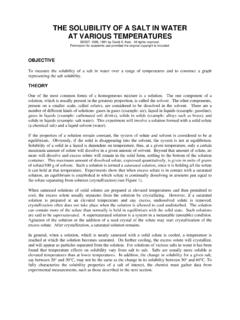
3 But as calcium carbonate it has a measurable solubility in WATER of approximately 19 PPM. This solubility is sufficient to cause it to form scale; the insoluble precipitate is in equilibrium with that which is in solution, some therefore dissolving, while some comes out of solution. In so crystallizing, it cements other free particles of matter not otherwise scale forming, including precipitated calcium SULFATE (CaSO4)Calcium sulfate precipitates forming a hard scale if the solubility at a given temperature is exceeded. For example, at 104 F the solubility is 1551 PPM; at 212 F the solubility is 1246 PPM; and 40 PPM at 428 F.
4 Calcium sulfate has inverse solubility (becomes less soluble as the temperature increases) causing deposition problems. This negative solubility characteristic makes it more prone to crystallize where the heat is greatest; principally in the fire box where the highest heat concentration occurs. Normal acids have no effect in dissolving this SULFATE (MgSO4)Magnesium Sulfate is one of the most soluble of salts, having a solubility of 20% in cold WATER and 42% in boiling WATER . It exists only in WATER of low is introduced into the system by corrosion of copper piping and copper alloys.
5 In cooling systems this may be caused by excessive use of WATER TREATMENT , causing highly alkaline boilers, the source of this corrosion is excessive use of hydrazine, or leaking internal de-super-heater elements in boiler drums, which allow alkaline boiler WATER to enter the de-super-heater steam system and corrode copper and copper alloys, bringing the copper to the boiler. Copper in the boiler displaces tube steel or plates out . This condition frequently takes place under scale or sludge deposits and is often described as under deposit corrosion . Copper deposits are a serious problem on new high-pressure (Si02)Silica is not generally found in Marine Boilers except in minute quantities.
6 Silica will produce a very hard scale and may be admitted to systems only if severe carry-over has occurred from evaporators distilling WATER from rivers BOILER WATER TREATMENTWATER TREATMENTV ecom Marine is a joint venture of Vecom Group & Unimarine Group - Version - Chapter 11 - Page 3 WATER TREATMENTBOILER WATER TREATMENT where the silica content is high, or if feed WATER is taken from cement washed tanks. In certain cases, when row WATER is evaporated and is high in silica, carry-over may admit silica into the distilled WATER system. On some new vessels where silicate coatings hove been used in distilled WATER storage tanks, initial silica readings may be high and should be tested often and controlled by blowdown.
7 Silica may cause difficulty in cooling WATER systems by forming calcium and magnesium silicate OXIDES (FeO-Fe2O3-Fe3O4)Iron may enter the boiler as a result of corrosion in the pre-boiler sections or ports of the feed system, or may redeposit as a result of corrosion in the boiler itself. Often, iron oxide will deposit and retard heat transfer within a boiler tube, sometimes resulting in tube failure. When iron is not present in the row WATER feed, its presence in the boiler or cooling system indicates active corrosion, a more serious problem than its presence in scale in which it appears by occlusion. Rust, the reddish form, is fully oxidized.
8 More often, in a boiler with limited oxygen, it is in the reduced or black form (Fe3O4). Fe3O4 is magnetic and can be readily detected with a prevent oil from entering condensate and feedwater systems, certain safety equipment is generally incorporated to remove or arrest such contamination if this should arise. There are certain occasions due to mechanical failure (for example, faulty oil deflectors at turbine glands passing lube oil to gland seal condensers and main condensers, etc., or leaks at tank heating coils) causing oil to enter a oil film on internal heating surfaces is dangerous, impairing heat transfer drastically to the extent that comparable heat retarding effects can be likened to considerable dense scale build-up.
9 Oil films therefore cause overheating of tube metal, resulting in tube blistering and failure, or cracking of engine parts. If oil contamination is suspected, immediate action must be undertaken for its removal. A simple test explained in this book indicates how emulsified oil in WATER can be detected. Depending upon the degree of contamination, corrective measures can be adopted using LIQUID COAGULANT or other Vecom products as ALKALINE CLEANER (ALKACLEAN) or an GASESD issolved Gases are present in distilled WATER in the form of oxygen and carbon dioxide. Each enters the condensate system from leaks in the vacuum side or open exposure to the atmosphere, the atmospheric drain tank, surge tank, or feed filter tank.
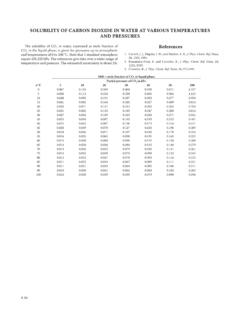
10 Due to chemical reactions in WATER , carbon dioxide can form carbonic acid (H2Co3), lowering the pH of the condensate, making it is highly corrosive causing localized pitting and attack of boiler metal. Mechanical deaerating equipment, if installed, is designed to remove the majority of these dissolved gases. However, the most efficient deaerating equipment still passes about 5 parts per billion of dissolved Gases. Chemical TREATMENT is required to render these gases Marine is a joint venture of Vecom Group & Unimarine Group - Version - Chapter 11 - Page 4 WATER TREATMENTBOILER WATER TREATMENTACIDITy, NEUTRALITy AND ALKALINITy:All WATER can be classified into one of these categories.