Transcription of Westlake High School IB Diploma Programme Coordinator
1 Thank you for your interest in the International Baccalaureate Program housed at Westlake high School ! This packet will provide you with the following information: The International Baccalaureate Mission Statement, Philosophy, Learner Profile, and Approaches to Teaching and Learning An information sheet describing the Diploma Programme at Westlake high School A description of the IB Diploma Programme Consortium Model A research brief showing the advantages IB students have when transitioning to university A sampling of results from a global survey of IB students that shows intended fields of study, scores on ACT and SAT exams, and award packages from selected universities A grid showing the recognition policies of IB courses at Ohio institutions of higher learning The IB Diploma Programme offers students a unique opportunity to study academic subjects in an integrated fashion while allowing for personal choice in several aspects of their own education.
2 It focuses on developing several aspects of the learner intellectual, physical, emotional, ethical, and social. It gathers effective educational techniques and philosophies from around the globe to develop effective methods of teaching and learning. It prepares students to be successful once they transition to university and to be productive members of a global society. We are proud to offer the IB Diploma Programme at Westlake high School as part of a consortium of schools that includes Avon Lake high School , Berea-Midpark high School , and Rocky River high School . We are dedicated to providing opportunities for all students to achieve excellence. We encourage you to carefully consider whether it is right for you. Please contact me with you have any questions regarding preparation, application, enrollment or course choices. Thank you again for your interest in the International Baccalaureate Diploma Programme housed at Westlake high School .
3 Please contact me if you have any further questions. Matthew Planisek Westlake high School IB Diploma Programme Coordinator x2837 2 | P a g e What is an IB Education? The International Baccalaureate Organization (known as the IB) offers four high -quality and challenging educational programmes for a worldwide community of schools aiming to create a better and more peaceful world. Westlake City Schools currently offers the Primary Years Programme (PYP) at all four of our elementary schools and the Diploma Programme (DP) at Westlake high School . IB Mission Statement The International Baccalaureate aims to develop inquiring, knowledgeable and caring young people who help to create a better and more peaceful world through intercultural understanding and respect. To this end the organization works with schools, governments and international organizations to develop challenging programmes of international education and rigorous assessment.
4 These programmes encourage students across the world to become active, compassionate and lifelong learners who understand that other people, with their differences, can also be right. The IB Learner Profile The intent of all IB programmes is to develop internationally minded people who, recognizing the common humanity and shared guardianship of the planet, help to create a better and more peaceful world. The IB Learner Profile represents ten attributes valued by IB World Schools. We believe these attributes, and others like them, can help individuals become responsible members of local, national and global communities. IB learners strive to be: Inquirers: They develop their natural curiosity. They acquire the skills necessary to conduct inquiry and research and show independence in learning. They actively enjoy learning and this love of learning will be sustained throughout their lives. Knowledgeable: They explore concepts, ideas and issues that have local and global significance.
5 In so doing, they acquire in-depth knowledge and develop understanding across a broad and balanced range of disciplines. Thinkers: They exercise initiative in applying thinking skills critically and creatively to recognize and approach complex problems, and make reasoned, ethical decisions. Communicators: They understand and express ideas and information confidently and creatively in more than one language and in a variety of modes of communication. They work effectively and willingly in collaboration with others. Principled: They act with integrity and honesty, with a strong sense of fairness, justice and respect for the dignity of the individual, groups and communities. They take responsibility for their own actions and the consequences that accompany them. 3 | P a g e Open-minded: They understand and appreciate their own cultures and personal histories, and are open to the perspectives, values and traditions of other individuals and communities.
6 They are accustomed to seeking and evaluating a range of points of view, and are willing to grow from the experience. Caring: They show empathy, compassion and respect towards the needs and feelings of others. They have a personal commitment to service, and act to make a positive difference to the lives of others and to the environment. Risk-takers: They approach unfamiliar situations and uncertainty with courage and forethought, and have the independence of spirit to explore new roles, ideas and strategies. They are brave and articulate in defending their beliefs. Balanced: They understand the importance of intellectual, physical and emotional balance to achieve personal well-being for themselves and others. Reflective: They give thoughtful consideration to their own learning and experience. They are able to assess and understand their strengths and limitations in order to support their learning and personal development. Approaches to Teaching and Learning (ATL) in the International Baccalaureate (IB) Diploma Programme Teaching students how to learn has always been a part of IB teaching.
7 IB provides support and expectations for teachers and students to achieve this goal. ATL are deliberate strategies, skills and attitudes that permeate the IB teaching and learning environment and supports the belief that a large influence on a student s education is not only what you learn but also how you learn IB Approaches to Learning IB believes that in order for students to become lifelong learners, they must develop a skill set. These skills include: 1. Thinking skills 2. Communications skills 3. Social skills 4. Self-management skills 5. Research skills The IB Approaches to Teaching Assisting students in their journey to becoming lifelong learners requires good teaching. IB believes that good teaching 1. based on inquiry 2. focused on conceptual understanding 3. developed in local and global contexts 4. focused on effective teamwork and collaboration 5. differentiated to meet the needs of all learners 6. informed by formative and summative assessment 4 | P a g e What is the International Baccalaureate Diploma Programme ?
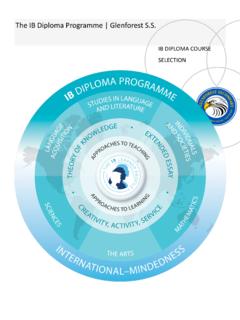
8 The Diploma Programme is an intensive, two-year academic program taken during the junior and senior years that offers students the opportunity to increase the breadth and depth of their knowledge, flourish intellectually, physically, emotionally, and ethically while exploring the nature of knowledge itself. Students will study six academic content areas, as shown below. In addition to completing coursework and assessments (both internal and external), Diploma Candidates will also have to complete three core requirements: Theory of Knowledge (TOK) Course: The TOK course is an inquiry into different kinds of knowledge while questioning how we know what we claim to know. Students explore the nature of knowledge while applying the topics to academic subject areas. The course is taken at School during the junior year and will require a small amount of independent work early in the senior year. Language Acquisition Acquisition of sociocultural competencies / Full length literary works / Fluency and Accuracy Studies in Language and Literature Survey of texts from multiple perspectives / Literature from across cultures (in translation) / Writing and reflection - Creative, analytical, research based Individuals and Societies Course based on a comparative approach to history.
9 Historical events are examined with respect to perspective, change, continuity, causation, consequence, and significance Sciences Application of knowledge to devise and perform investigations / implications of science in society The Arts Studio based 2D & 3D art / independently motivated / Research history and practice of chosen art form Mathematics Algebra, Functions and Equations, Circular Functions, Trigonometry, Vectors, Statistics and Probability, Calculus 5 | P a g e Creativity, Activity, Service (CAS) Requirement: CAS activities foster awareness and appreciation of life outside of the academic arena. The activities help students recognize the importance of educational experiences that take place outside the classroom. Students develop a greater level of self-awareness while increasing their understanding of the needs of others. The activities are completed outside of School during the junior and senior years. Extended Essay: The extended essay is a 4000 word (15-20 page) research project developed by the student with assistance from a team of teachers.
10 It requires an in-depth investigation of a topic of special interest to the student and helps them develop independent research and writing skills. The essay is completed outside of School (with assistance) during the junior and senior years. Why should a student pursue an IB education? The IB Diploma Programme is an ideal preparation for university study. It produces confident, independent learners that are trained to critically think and explore connections between different areas of the curriculum. It develops writing skills while requiring students to balance obligations in and out of the classroom. IB students report increased academic opportunities over non-IB students. IB graduates are accepted to universities at a higher rate than non-IB graduates. IB students have opportunities to earn college credit and receive scholarships, including up to a full year s worth of credit at some institutions. IB students also graduate from college within four years of entrance at a higher rate than non-IB students.