Example: dental hygienist
What is the difference between weather and climate?
climate is what you typically expect the weather in a specific location to be like for this time of year. Weather is the condition of Earth’s atmosphere at a particular time and place. We generally think of weather as the combination of temperature, humidity,
Tags:
Information
Domain:
Source:
Link to this page:
Documents from same domain
Geographical Influences on Climate - Teacher Guide
gpm.nasa.govlocation –elevation, lakes or oceans, wind direction compared to oceans or mountains, latitude, etc. After students have time to complete the front side of the capture sheet, they will compare their data to that of other cities in a relevant grouping. Each group of three cities focuses on one key aspect of geographical influences on climate –
Climate Change Inquiry Labs - Teacher Guide
gpm.nasa.govfactors in global warming. Reducing the level of climate change and reducing human vulnerability to whatever climate changes do occur depend on the understanding of climate science, engineering capabilities, and other kinds of knowledge, such as understanding of human behavior and on applying that knowledge wisely in decisions and activities.

Exploring the Water Cycle Teacher’s Guide
gpm.nasa.govthat a water molecule can take through the water cycle. 1. They have the following choices in order to demonstrate their understanding: Make a mini-poster with a diagram of the water cycle. (8.5” X 11” maximum) The diagram should not look just like the one we used in class. It should have the water molecule moving from one step to another.

Heating Earth’s Surfaces: Land Versus Water Lab ...
gpm.nasa.gov3 Graphing Title (This should follow a format of Dependent vs. Independent) 48 44 40 36 32 28 24 20 16 12 8 4 Analyze and Conclude 1. Calculate the total change in temperature for each material. Sand/Soil: heated by _____ degrees in 10 minutes; cooled by _____ degrees in 10 minutes

Creating Models of Landforms and Water - NASA
gpm.nasa.govLesson Overview: The purpose of this lesson is to provide students with experience creating models of landforms and bodies of water. Before students begin by playing an active game to review the types of characteristics of basic landforms and bodies of water, they look at some images of Earth taken from space.
Related documents

Creating Futures – Lesson 1: Climate and weather
www.trocaire.orgClimate and weather 05 LeSSOn PLan (continued) 5. Children explore the differences between weather and climate The class discusses how weather describes the short-term temperature, rainfall, wind, etc., and climate describes the average over a long period of time.

IGCSE Geography Unit 4: Weather, Climate and Vegetation
papers.xtremepape.rsUnit 4: Weather, Climate and Vegetation Recommended Prior Knowledge An understanding of the aspects of weather and how they are measured. An appreciation of how climate changes across the world and its impact upon vegetation type. A good general knowledge, particularly of environmental issues such as tropical rainforest destruction and ...
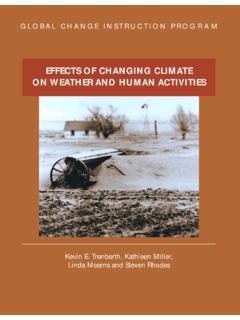
Effects Of Changing Climate On Weather And Human …
www.cgd.ucar.eduweather occurs, interacts with the oceans, the land surface and its vegetation, and land and sea ice within the climate system is a key to understanding how influences external to …
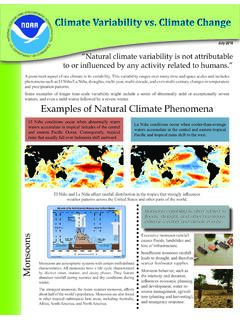
Examples of Natural Climate Phenomena - National …
www.weather.govextreme weather and climate events. Excessive monsoon rainfall causes floods, landslides and loss of infrastructure. Insufficient monsoon rainfall leads to drought, and therefore scarcer freshwater supplies. Monsoon behavior, such as the intensity and duration, influences economic planning and development, water re-source management, agricul-
Weather and Climate Worksheets - Campbell County Schools
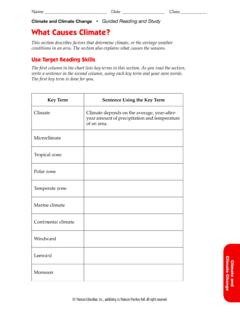
www.campbellcountyschools.orgClimate is the average, year-after-year conditions of temperature, precipitation, winds, and clouds in an area. The climate of a region is determined by two main factors: temperature and precipitation. The same factors that affect climate regions also affect small areas. Microclimates are small areas with climate conditions that differ from those
Climate-Smart Agricultutre training manual
www.fao.orgCLIMATE-SMART AGRICULTURE TRAINING MANUAL iv Exercises Exercise A.1 Introduction to the training course 18 Exercise A.2 Weather and climate 18 Exercise A.3 Global Warming 18 Exercise A.4 Changes in rainfall 18 Exercise A.5 The greenhouse effect 19 Exercise A.6 Climate change in your area 19 Exercise B.1 Understanding the effects of future climate change 43

Weather and Climate Lesson Plan - Legends of Learning
www.legendsoflearning.comAn earth science lesson plan to teach your students will learn the difference between weather and climate, and the characteristics that affect them both. Keywords: earth science, lesson plan, weather, climate, currents, solar energy, atmosphere, temperature, density, salinity, precipitation, greenhouse gas, seasons, air pressure Created Date

Weather and Climate Notes - Weebly
blackmathandscience.weebly.comWeather and Climate Weather the condition of the Earth’s atmosphere at a particular time and place Climate the average year-after-year conditions of temperature, precipitation, winds and clouds in an area Atmosphere the envelope of gases that surrounds the planet. Air Pressure a column of air that extends upward through the entire atmosphere.

Washington D.C. Temperatures *** PLEASE NOTE *** Climate …
www.weather.govwashington d.c. temperatures year jan feb mar apr may jun jul aug sep oct nov dec ann winter spring summer autumn 1st half 2nd half 1897 31.0 36.6 46.0 52.9 62.4 69.6 76.9 73.4 68.2 58.0 46.0 38.1 54.9 34.4 53.8 73.3 57.4 49.8 60.1
Climate Change and Cities - Jeff Raven
jeffraven.comSummary for City Leaders of the Urban Climate Change Research Network (UCCRN) Second Assessment Report on Climate Change and Cities (ARC3.2) (Figure 1). UCCRN is dedicated to providing the information that city leaders—from