Example: confidence
WORKPLACE STRESS: a collective challenge
between the perceived demands and the perceived resources and abilities of ... job content, organizational conditions and workers’ capacities, needs, culture, personal extra-job considerations that may, ... Fatigue, diseases caused by overload; Diseases due to psychosocial risks or work-related stress.
Tags:
Information
Domain:
Source:
Link to this page:
Documents from same domain

PROJECT DESIGN - International Labour Organization
www.ilo.orgIII Project Design Manual A Step-by-Step Tool to Support the Development of Cooperatives and Other Forms of Self-Help Organization 2010 COOPAFRICA
Social security: Issues, challenges and prospects
www.ilo.orgII Social security: Issues, challenges and prospects ISBN 92-2-111961-0 ISSN 0074-6681 First published 2001 The designations employed in ILO publications, which are in conformity with United Nations practice, and
SOUTH AFRICA Country Profile Decent Work
www.ilo.orgThe Decent Work Country Profile for South Africa analyses progress and challenges across the ten internationally agreed thematic areas of decent

EMPLOYMENT Working Paper No. 194
www.ilo.orgDevelopment and Investment Branch Employment Intensive Investment Programme EMPLOYMENT Working Paper No. 194 Employment Policy Department 2015 Nite Tanzarn, Maria Teresa Gutierrez
Código de Trabajo de la República de El Salvador
www.ilo.orgCódigo de Trabajo de la República de El Salvador Edición rubricada y concordada con las Normas Internacionales del Trabajo Versión actualizada

Guidelines for a just transition - copyrighted
www.ilo.orgGuidelines for a just transition towards environmentally sustainable economies and societies for all
7. PROJECT EVALUATION - International Labour …
www.ilo.org7. PROJECT EVALUATION ♦ Project monitoring focusing on activities and outputs and their contribution to outcomes. Monitoring is the continuous observation of a project’s progress by systematically gathering key performance data for …
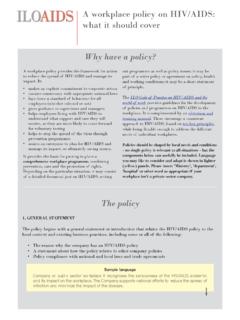
Workplace policy on HIV/AIDS - what it should cover
www.ilo.orgThe purpose of this policy is to ensure a consistent and equitable approach to the prevention of HIV/AIDS among employees and their families, and to …
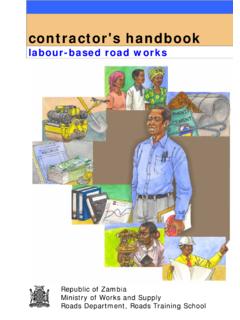
labour-based road works - International Labour …
www.ilo.orgContractor’s Handbook for Labour-Based Road Works Republic of Zambia Ministry of Works and Supply Roads Department Roads Department Training School
Inequality in Southern Africa
www.ilo.orgIntroduction and Background The Southern African region is characterised by unacceptable high levels of unemployment, poverty and inequality. In …
Related documents

EXPOSURE TO STRESS
www.cdc.gov# Job or task demands (work overload, lack of task control, role ambiguity) 2 ... influence the perceived stress of job pressures and workload because higher quality care maybe reflected in ... # An organizational culture that supports stress in-terventions

Bullying has no place in health care - Joint Commission
www.jointcommission.orgbullying is that it is perceived as a hostile act by the target. ... work overload, stress, lack of autonomy and a lack of organizational fairness.6,7. ... Nurses tend to accept nurse-on-nurse bullying as part of the job, particularly the new or novice nurse, thus the …

Organizational and environmental factors that affect ...
www.premiersafetyinstitute.orgresulting job burnout have poor coping responses and lack of job satisfaction, which often erode commit-ment to the organization and lead to higher turnover. 2 Lack of coworker and supervisor support contributes to perceived stress and resulting burnout. 26,27 In one study of performance among nurses by Salyer,25 a

A STUDY ON STRESS MANAGEMENT AMONG THE …
voiceofresearch.org(2010) Job or occupational stress is mismatch between the individual capabilities and organizational demands. Employees often experience stress because of work overload, an expected work pace, difficult work schedules, role conflict, uncertainty regarding job security, poor interpersonal relationships and unpleasant working

Stress and Coping Strategies used by Special Education and ...
files.eric.ed.govwork overload, lack of perceived success, frequency of direct contact with children, staff-child ratio, program structure, and responsibility for others (Johnson, 1990). Teaching is not an easy, straightforward job; it ranks as one of the most complex occupations. This very complexity makes it a demanding profession.
Effects of Job Stress on Employees Job Performance A Study ...
iosrjournals.orgover the employees job performance, and the organizations in Uk are trying to cope with this scenario, (R. Anderson, 2003). Eleven forces are used as an antecedents of stress by researches (Overload, Role vagueness, Role conflict, Responsibility for people, Participation, Lack of …
Organisational Climate And Its Effects On Employee …
www.ijiras.comcontributes greatly to the development of job related stress which leads to health problems of absenteeism and turnover on the work (Smith and Hemingway, 1999). Furthermore, work pressure, lack of autonomy, peer cohesion and supervisor support has been considered by the employees as stressors in their working environment.

The occupational stress and risk of it among the employees
mpra.ub.uni-muenchen.derelationships, work-life balance, overload, job security, control, resources and communication, pay and benefits, as well as an evaluation of the employee’s perception of the potential sources of stress that relate to the fundamental nature of the job itself named Aspects of the Job.