Transcription of Your Baby at 4 Months
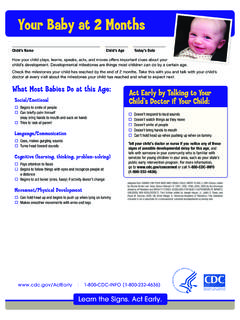
1 Your baby at 4 Months Child's Name Child's Age Today's Date Milestones matter! How your child plays, learns, speaks, acts, and moves offers important clues about his or her development. Check the milestones your child has reached by 4 Months . Take this with you and talk with your child's doctor at every well-child visit about the milestones your child has reached and what to expect next. What Most Babies Do by this Age: You Know Your Child Best. Social/Emotional Act early if you have concerns about the way your child plays, o Smiles spontaneously, especially at people learns, speaks, acts, or moves, or if your child: o Likes to play with people and might cry when playing stops o Is missing milestones o Copies some movements and facial expressions, like smiling o Doesn't watch things as they move or frowning o Doesn't smile at people o Can't hold head steady Language/Communication o Doesn't coo or make sounds o Begins to babble o Doesn't bring things to mouth o Babbles with expression and copies sounds he hears o Doesn't push down with legs when feet are placed on o Cries in different ways to show hunger, pain, or being tired a hard surface o Has trouble moving one or both eyes in all directions Cognitive (learning, thinking, problem-solving) Tell your child's doctor or nurse if you notice any of these signs of possible developmental delay and ask for o Lets you know if she is happy or sad a developmental screening.
2 O Responds to affection o Reaches for toy with one hand If you or the doctor is still concerned o Uses hands and eyes together, such as seeing a toy 1. Ask for a referral to a specialist and, and reaching for it 2. Call your state or territory's early intervention program o Follows moving things with eyes from side to side to find out if your child can get services to help. Learn o Watches faces closely more and find the number at o Recognizes familiar people and things at a distance For more information, go to Movement/Physical Development DON'T WAIT. o Holds head steady, unsupported Acting early can make a real difference! o Pushes down on legs when feet are on a hard surface o May be able to roll over from tummy to back o Can hold a toy and shake it and swing at dangling toys o Brings hands to mouth o When lying on stomach, pushes up to elbows 1-800-CDC-INFO (1-800-232-4636).
3 Learn the Signs. Act Early. Help Your baby Learn and Grow You can help your baby learn and grow. Talk, read, sing, and play together every day. Below are some activities to enjoy with your 4-month-old baby today. What You Can Do for Your 4-Month-Old: o Hold and talk to your baby ; smile and be cheerful o Put toys near your baby so that she can reach for while you do. them or kick her feet. o Set steady routines for sleeping and feeding. o Put toys or rattles in your baby 's hand and help him to hold them. o Pay close attention to what your baby likes and doesn't like; you will know how best to meet o Hold your baby upright with feet on the floor, his needs and what you can do to make your and sing or talk to your baby as she stands . baby happy. with support. o Copy your baby 's sounds. o Act excited and smile when your baby makes sounds.
4 O Have quiet play times when you read or sing to your baby . o Give age-appropriate toys to play with, such as rattles or colorful pictures. o Play games such as peek-a-boo. o Provide safe opportunities for your baby to reach for toys and explore his surroundings. Milestones adapted from CARING FOR YOUR baby AND YOUNG CHILD: BIRTH TO AGE 5, Fifth Edition, edited by Steven Shelov and Tanya Remer Altmann 1991, 1993, 1998, 2004, 2009 by the American Academy of Pediatrics and BRIGHT FUTURES: GUIDELINES FOR HEALTH SUPERVISION OF INFANTS, CHILDREN, AND ADOLESCENTS, Third Edition, edited by Joseph Hagan, Jr., Judith S. Shaw, and Paula M. Duncan, 2008, Elk Grove Village, IL: American Academy of Pediatrics. This milestone checklist is not a substitute for a standardized, validated developmental screening tool. | 1-800-CDC-INFO (1-800-232-4636).
5 Learn the Signs. Act Early.