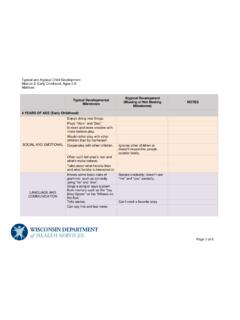
Transcription of Your Child at 1 Year
1 Your Child at 1 YearChild s NameChild s Age Today s DateMilestones matter! How your Child plays, learns, speaks, acts, and moves offers important clues about his or her development. Check the milestones your Child has reached by age 1. Take this with you and talk with your Child s doctor at every well- Child visit about the milestones your Child has reached and what to expect Most Children Do by this Age:Social/EmotionaloIs shy or nervous with strangersoCries when mom or dad leavesoHas favorite things and peopleoShows fear in some situationsoHands you a book when he wants to hear a storyoRepeats sounds or actions to get attentionoPuts out arm or leg to help with dressingoPlays games such as peek-a-boo and pat-a-cake Language/Communication oResponds to simple spoken requestsoUses simple gestures, like shaking head no or waving bye-bye oMakes sounds with changes in tone (sounds more like speech)
2 OSays mama and dada and exclamations like uh-oh! oTries to say words you sayCognitive (learning, thinking, problem-solving) oExplores things in different ways, like shaking, banging, throwingoFinds hidden things easilyoLooks at the right picture or thing when it s namedoCopies gesturesoStarts to use things correctly; for example, drinks from a cup, brushes hairoBangs two things togetheroPuts things in a container, takes things out of a containeroLets things go without helpoPokes with index (pointer) fingeroFollows simple directions like pick up the toy Movement/Physical Development oGets to a sitting position without helpoPulls up to stand, walks holding on to furniture ( cruising )oMay take a few steps without holding onoMay stand aloneYou Know Your Child Best.
3 Act early if you have concerns about the way your Child plays, learns, speaks, acts, or moves, or if your Child : oIs missing milestonesoDoesn t crawloCan t stand when supportedoDoesn t search for things that she sees you t say single words like mama or dada oDoesn t learn gestures like waving or shaking headoDoesn t point to thingsoLoses skills he once hadTell your Child s doctor or nurse if you notice any of these signs of possible developmental delay and ask for a developmental screening. If you or the doctor is still concerned1.
4 Ask for a referral to a specialist and, 2. Call your state or territory s early intervention program to find out if your Child can get services to help. Learn more and find the number at more information, go to DON T WAIT. Acting early can make a real difference!Learn the Signs. Act (1-800-232-4636)Help Your Child Learn and GrowYou can help your Child learn and grow. Talk, read, sing, and play together every day. Below are some activities to enjoy with your 1-year-old Child You Can Do for Your 1-Year-Old:oGive your Child time to get to know a new caregiver.
5 Bring a favorite toy, stuffed animal, or blanket to help comfort your response to unwanted behaviors, say no firmly. Do not yell, spank, or give long explanations. A time out for 30 seconds to 1 minute might help redirect your your Child lots of hugs, kisses, and praise for good a lot more time encouraging wanted behaviors than punishing unwanted behaviors (4 times as much encouragement for wanted behaviors as redirection for unwanted behaviors).oTalk to your Child about what you re doing.
6 For example, Mommy is washing your hands with a washcloth. oRead with your Child every day. Have your Child turn the pages. Take turns labeling pictures with your on what your Child says or tries to say, or what he points to. If he points to a truck and says t or truck, say, Yes, that s a big, blue truck. owhen she tries to copy your Child crayons and paper, and let your Child draw freely. Show your Child how to draw lines up and down and across the page. Praise your Child oPlay with blocks, shape sorters, and other toys that encourage your Child to use his small toys and other things and have your Child find your Child to label body parts or things you see while driving in the songs with actions, like The Itsy bitsy Spider and Wheels on the Bus.
7 Help your Child do the actions with your Child pots and pans or a small musical instrument like a drum or cymbals. Encourage your Child to make lots of safe places for your toddler to explore. (Toddler-proof your home. Lock away products for cleaning, laundry, lawn care, and car care. Use a safety gate and lock doors to the outside and the basement.)oGive your Child push toys like a wagon or kiddie push car. Milestones adapted from CARING FOR YOUR BABY AND YOUNG Child : BIRTH TO AGE 5, Fifth Edition, edited by Steven Shelov and Tanya Remer Altmann 1991, 1993, 1998, 2004, 2009 by the American Academy of Pediatrics and BRIGHT FUTURES: GUIDELINES FOR HEALTH SUPERVISION OF INFANTS, CHILDREN, AND ADOLESCENTS, Third Edition, edited by Joseph Hagan, Jr.
8 , Judith S. Shaw, and Paula M. Duncan, 2008, Elk Grove Village, IL: American Academy of Pediatrics. This milestone checklist is not a substitute for a standardized, validated developmental screening 1-800-CDC-INFO (1-800-232-4636)|Learn the Signs. Act Early.