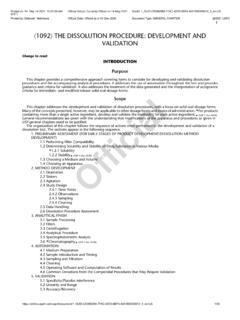
1092 THE DISSOLUTION PROCEDURE: DEVELOPMENT AND …
INTRODUCTION Purpose This chapter provides a comprehensive approach covering items to consider for developing and validating dissolution procedures and the accompanying analytical procedures. It addresses the use of automation throughout the test and provides guidance and criteria for validation.
Download 1092 THE DISSOLUTION PROCEDURE: DEVELOPMENT AND …

Information
Domain:
Source:
Link to this page:
Documents from same domain

USP <51> Antimicrobial Effectiveness Testing
latam-edu.usp.orgIf the diluted product exhibits antimicrobial properties, specific neutralizers may need to be incorporated into the diluents or the recovery media. The ability of the procedure to measure preservative efficacy may be compromised if the method suitability requires significant dilution (10 −2 or 10 −3) as this will affect the measured recovery
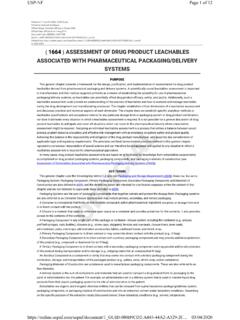
1664 〉〉〉〉 ASSESSMENT OF DRUG PRODUCT …
latam-edu.usp.orgadministration ports, overwraps, adminstration accessories, labels, cardboard boxes, and shrink wrap. A Primary Packaging Component is in direct contact or may come into direct contact with the product (e.g., IV bag). A Secondary Packaging Component is in direct contact with a primary packaging component and may provide additional protection

659 PACKAGING AND STORAGE REQUIREMENTS
latam-edu.usp.orgAncillary component:A component or entity that may come into contact with a Tertiary packaging component during the distribution, storage, and/or transportation of the packaged article (e.g., pallets, skids, and shrink wrap).
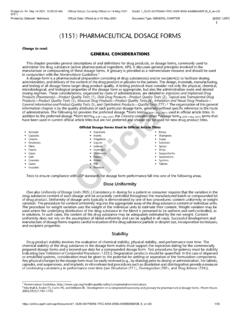
1151 PHARMACEUTICAL DOSAGE FORMS
latam-edu.usp.orgBioavailability (See also In Vitro and In Vivo Evaluation of Dosage Forms á1088ñ and Assessment of Solid Oral Drug Product Performance and Interchangeability, Bioavailability, Bioequivalence, and Dissolution á1090ñ.)Bioavailability is influenced by factors such as the

Module 08 USP 1115 Bioburden Control of Non-Sterile …
latam-edu.usp.orgUnlike aseptic processing for which facility requirements are generally uniform in specification and performance, nonsterile product manufacturing environments typically involve diverse products and microbial contamination control requirements. In general, liquid, cream, or ointment products require a greater level of

USP <71> Sterility Tests - United States Pharmacopeia
latam-edu.usp.orgThe view from USP <1211> Sterilization and Sterility Assurance of Compendial Articles : 6 ... For products containing a mercurial preservative that cannot be tested by the ... Used for sterility testing of viscous products and for devices having tubes with small lumen.

1117 MICROBIOLOGICAL BEST LABORATORY PRACTICES
latam-edu.usp.orgWhenever possible, sampling equipment should be loaded with its microbiological recovery media in the environment that is to be sampled. All testing in laboratories used for critical testing procedures, such as sterility testing of final dosage forms, bulk product, seed

71 〉〉〉〉 STERILITY TESTS
latam-edu.usp.orgof the test. Modify the conditions in order to eliminate the antimicrobial activity, and repeat the Method Suitability Test. This method suitability is performed (a) when the test for sterility has to be carried out on a new product; and (b) whenever there is a change in the experimental conditions of the test.

STERILIZATION OF COMPENDIAL ARTICLES
latam-edu.usp.orgFor steam and dry heat, the D-value is a function of temperature. In gas sterilization (ethylene oxide, ClO , or O ), D-values are a function of the chemical concentration, relative humidity, and temperature. Similarly, for liquid chemical sterilization the D-value is a function of the temperature and sterilant concentration.
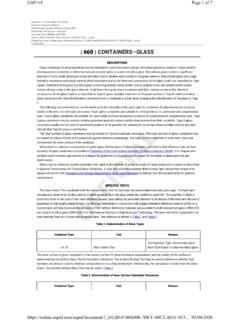
660 〉〉 CONTAINERS—GLASS
latam-edu.usp.orgglass containers will raise the hydrolytic resistance from a moderate to a high level, changing the classification of the glass to Type II. The following recommendations can be made as to the suitability of the glass type for containers for pharmaceutical products, based on the tests for hydrolytic resistance.
Related documents
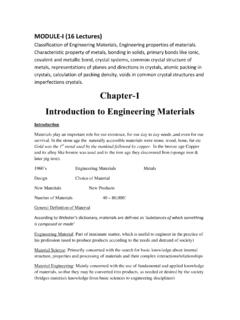
Chapter-1 Introduction to Engineering Materials
www.bput.ac.inChapter-1 Introduction to Engineering Materials Introduction Materials play an important role for our existence, for our day to day needs ,and even for our survival. In the stone age the naturally accessible materials were stone, wood, bone, fur etc Gold was the 1st metal used by the mankind followed by copper. In the bronze age Copper

1 Introduction to Catalysis - Wiley-VCH
application.wiley-vch.deIntroduction to Catalysis ... ciple, which we encounter in a more precise form in Chapter 2 and in detail in Sec-tion 6.5.3.5. Until now, the catalyst has been an unspecified, abstract body, so let us first look ... field where nanomaterials have been applied commercially for about a …

1 Lasers: Fundamentals, Types, and Operations
application.wiley-vch.deIntroduction of lasers, types of laser systems and their operating principles, meth-ods of generating extreme ultraviolet/vacuum ultraviolet (EUV/VUV) laser lights, properties of laser radiation, and modification in basic structure of lasers are the main sections of this chapter. 1.1 Introduction of Lasers 1.1.1 Historical Development
ME 355: Introduction to Manufacturing Processes
courses.washington.eduChapter I Introduction. Outline ... and introduction of the product to market ... – Nanomaterials, shape-memory alloys, metal foams, amorphous alloys, …
Advanced Inorganic Chemistry (Part 1) Basic Solid State ...
www.chemie-biologie.uni-siegen.de1. Introduction 2. Structure of solids 2.1 Basics of structures 2.2 Simple close packed structures: metals 2.3 Basic structure types (structure of simple salts) 2.4 More complex structures 2.5 Complex structures 2.6 Structure of nanomaterials Outline –– 15.10.04 Oxides...