5. Phase Transitions
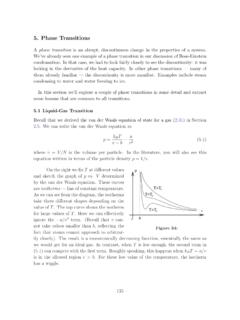
5. Phase Transitions A phase transition is an abrupt, discontinuous change in the properties of a system. We’ve already seen one example of a phase transition in our discussion of Bose-Einstein condensation. In that case, we had to look fairly closely to see the discontinuity: it was lurking in the derivative of the heat capacity.
Download 5. Phase Transitions

Information
Domain:
Source:
Link to this page:
Documents from same domain
Mathematical Methods - DAMTP
www.damtp.cam.ac.ukMathematical Methods University of Cambridge Part IB Mathematical Tripos David Skinner Department of Applied Mathematics and Theoretical Physics,
Electromagnetism - DAMTP
www.damtp.cam.ac.ukAt the atomic scale, electromagnetism (admittedly in conjunction with some basic quantum e ects) governs the interactions between atoms and molecules. It is the force that underlies the periodic table of elements, giving rise to all of chemistry and, through this, much of biology. It is the force which binds atoms together into solids and liquids.
Principles of Quantum Mechanics - DAMTP
www.damtp.cam.ac.ukPrinciples of Quantum Mechanics University of Cambridge Part II Mathematical Tripos David Skinner Department of Applied Mathematics and Theoretical Physics,
Part II Principles of Quantum Mechanics Michaelmas 2014
www.damtp.cam.ac.ukCONTENTS iii BOOKS E. Merzbacher Quantum Mechanics, 3rd edition. Wiley 1998 (various prices) B.H. Bransden and C.J. Joachain Quantum Mechanics, 2nd edition.
3. Quantum Gases - University of Cambridge
www.damtp.cam.ac.uk3. Quantum Gases In this section we will discuss situations where quantum effects are important. ... is the density of states: g(E)dEcounts the number of states with energy between E ... There is nothing particularly quantum mechanical about the density of states. In-deed, in the derivation above we have replaced the quantum sum with an ...
String Theory - University of Cambridge
www.damtp.cam.ac.ukString theory is a theory of quantum gravity String theory uni es Einstein’s theory of general relativity with quantum mechanics. Moreover, it does so in a manner …
Statistical Physics - DAMTP
www.damtp.cam.ac.ukContents 1. The Fundamentals of Statistical Mechanics 1 1.1 Introduction 1 1.2 The Microcanonical Ensemble 2 1.2.1 Entropy and the Second Law of Thermodynamics 5
Quantum Field Theory - DAMTP
www.damtp.cam.ac.ukRecommended Books and Resources M. Peskin and D. Schroeder, An Introduction to Quantum Field Theory This is a very clear and comprehensive book, covering everything in this course at the
TASI Lectures on Solitons - DAMTP
www.damtp.cam.ac.ukPreprint typeset in JHEP style - PAPER VERSION June 2005 TASI Lectures on Solitons Instantons, Monopoles, Vortices and Kinks David Tong Department of Applied Mathematics and Theoretical Physics,
Electromagnetism - DAMTP
www.damtp.cam.ac.ukLent Term, 2015 Electromagnetism University of Cambridge Part IB and Part II Mathematical Tripos David Tong Department of Applied Mathematics and Theoretical Physics,
Related documents

Lectrure Thermal Analysis
web.abo.fiPhase Diagram A phase diagram show conditions at which thermodynamically distinct phases can occur at equilibrium. It is determined experimentally by recording cooling rates over a range of compositions. Phase transitions occur along lines of equilibrium (=phase boundaries). Solidus = Temp. below which the substance is stable in the
First Order Phase Transitions
pmaweb.caltech.eduPhysics 127b: Statistical Mechanics Lecture 3: First Order Phase Transitions The van der Waals equation for a gas is h PC a V2 i [V−b] DNkBT: (1)(The variable ais proportional to N2 and bto N, i.e. aDN2aNand bDNbNwith a;NbNconstants). It can be motivated by rewriting it in the form
Helmholtz Free Energy - Home | USU
www.physics.usu.eduFree Energy. Thermodynamic Identities. Phase Transitions. So, for states which can be connected by a quasi-static, isothermal, isobaric process the change in the Gibbs free energy represents the non-compressional work done. For states which cannot be connected by a quasi-static process, (but assuming the process is isobaric and isothermal) we have
BPSK - BINARY PHASE SHIFT KEYING
eng.auburn.eduThe PHASE SHIFTER (set to the LO range with the on-board switch SW1) allows relative phase shifts. Watch the phase transitions in the BPSK output signal as this phase is altered. This PHASE SHIFTER can be considered optional. The digital DIVIDE-BY-FOUR sub-system within the LINE-CODE ENCODER is used
Chapter 6 Phase transitions - uni-frankfurt.de
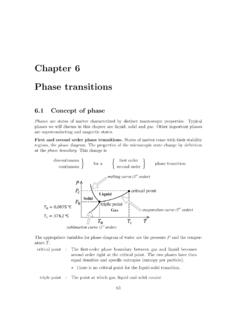
itp.uni-frankfurt.dePhase transitions in the P − T phase diagram are described by the Gibbs enthalpy G(T,P,N), as defined by (5.11), which is itself a function of the pressure P and of the temperature T. G(T,P,N) changes continuously across the phase boundary when the transition is of first order. The entropy S and volume V, which are given by

The Army Leader Transitions Handbook is designed to help
usacac.army.milThe Army Leader Transitions Handbook is designed to help leaders plan and execute a successful transition to a new lead-ership position. The intent is to provide a ready reference for all leaders: direct, organizational and strategic. The Army Leader Transitions Handbook offers a methodology to help

“Managing Transitions” by William Bridges
www.strategies-for-managing-change.com• The people most comfortable in one phase experience the most setbacks in the next phase • The things that made one phase the most successful are usually those that have to be let go in the next phase • When you see pain in an organization people are probably going through an organization transition • Don’t go half way