Chapter 11 Acids and Bases Practice Problems Section 11.1 ...
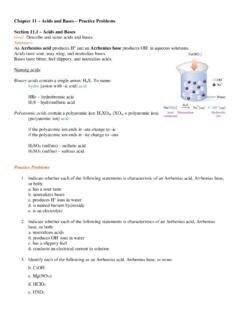
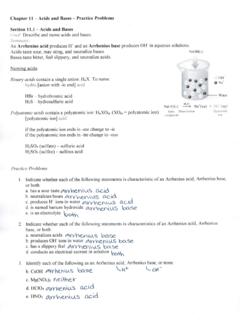
Chapter 11 – Acids and Bases – Practice Problems Section 11.1 – Acids and Bases Goal: Describe and name acids and bases. Summary: An Arrhenius acid produces H+ and an Arrhenius base produces OH-in aqueous solutions. Acids taste sour, may sting, and neutralize bases. Bases taste bitter, feel slippery, and neutralize acids.
Download Chapter 11 Acids and Bases Practice Problems Section 11.1 ...

Information
Domain:
Source:
Link to this page:
Documents from same domain
Chromosome 16: PV92 PCR - Utah State University
ion.chem.usu.eduChromosome 16: PV92 PCR A Bio-Rad Biotechnology Explorer™ Experiment Introduction to PCR—The Polymerase Chain Reaction You are about to perform a procedure known as PCR1—the amplification of a
Chapter 3 Protecting Groups - chem.usu.edu
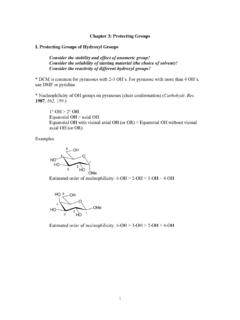
ion.chem.usu.eduChapter 3: Protecting Groups ... relatively strong acid (TFA) to remove * Stable in basic conditions * The reagent, MOMCl, is considered carcinogenic Reagent/Condition Reference MOMCl, NaH in THF or ... Protecting Groups of Amino Groups (i) Masking NH2 (amino) as N3 (azido)
The Central Science 9th Edition - Chemistry Department
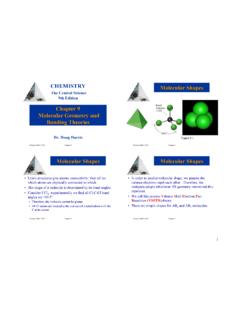
ion.chem.usu.edu• count the total number of electron pairs around the central atom, • arrange the electron pairs in one of the above geometries to minimize e − -e − repulsion, and count multiple bonds as one
Introduction to Organic Chemistry: Hydrocarbons
ion.chem.usu.eduOrganic Compounds Organic chemistry is the study of carbon compounds. An organic compound • Always contains carbon and hydrogen atoms • May also contain other nonmetals such as oxygen, nitrogen, phosphorus, or a halogen. • Organic compounds are found in: •Gasoline, medicines, shampoos, plastics, and perfumes •Carbohydrates, fats, and proteins
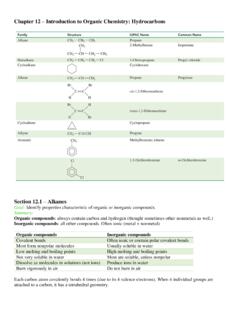
Chapter 12 Introduction to Organic Chemistry: Hydrocarbons
ion.chem.usu.eduChapter 12 – Introduction to Organic Chemistry: Hydrocarbons Section 12.1 – Alkanes Goal: Identify properties characteristic of organic or inorganic compounds. Summary: Organic compounds: always contain carbon and hydrogen (thought sometimes other nonmetals as well.) Inorganic compounds: all other compounds.Often ionic (metal + nonmetal) Organic …
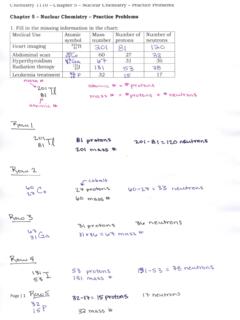
Utah State University Chemistry and Biochemistry | USU
ion.chem.usu.educnermstry 1 1 IU — unapter — Nuclear cnermstry — practice yrot)lerns 32. When a gamma ray is emitted from the nucleus of an atom, the nuclear mass A) increases by two units. B) decreases by one unit. C) increases by one unit. D decreases by two units. emains the same. 33. Radium-226 decays by alpha decay to A) barium-131. B) cobalt-60. C ...
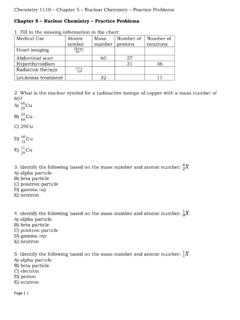
Nuclear Chemistry Practice Problems
ion.chem.usu.eduChemistry 1110 – Chapter 5 – Nuclear Chemistry – Practice Problems Page | 10 47. The half-life of a radioisotope is A) one-half of the time it takes for the radioisotope to completely decay to a nonradioactive isotope. B) the time it takes for the radioisotope to become an isotope with one-half of the atomic
Utah State University Chemistry and Biochemistry | USU
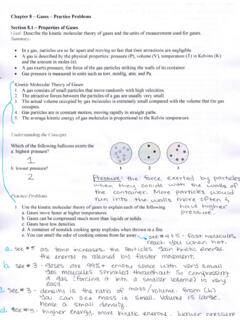
ion.chem.usu.eduExample: A sample of helium gas (He) has a volume 6.8 L and a pressure of 2.5 atm. What is the final volume, ... The volume is compressed to 2.0 L. b. The volume expands to 12 L. 9. A gas at a pressure of 2.0 atm is in a closed container. Indicate the changes (increases, decreases, or does
Utah State University Chemistry and Biochemistry | USU
ion.chem.usu.eduth1S IS a basic solution. !nderstanding the Concepts: Why are the concentrations ofH30 and OH- equal in pure water? One is + What is the meaning and value of Kw at 250C? In an acidic solution how does the concentration of 1-130 compare to the concentration of …
CH3 Practice Key Updates - Utah State University
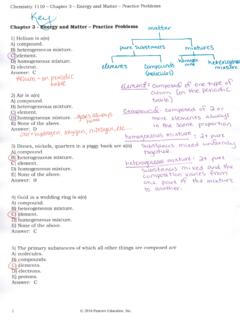
ion.chem.usu.eduChemistry 1 110 — Chapter 3 — Enerw and Matter — 26) 3.25 kcal is the same amount of enerw as Practice Problems A) 3.25 J. B) 0.777 J. C 777 J.
Related documents

CK-12 Chemistry
d3r1z7wkgqhj9d.cloudfront.neta.inorganic chemistry b.analytical chemistry c.organic chemistry d.physical chemistry 10.All of the following are body parts developed by chemists except a.hip replacement b.artificial skin c.plastic blood vessels d.artificial liver True/False: 11._____ Microscopic refers to the small particles that make up all matter. 12._____
Chapter 22. Nucleic Acids - latech.edu
www.chem.latech.eduChapter 22. Nucleic Acids 22.1 Types of Nucleic Acids 22.2 Nucleotides: Building Blocks of Nucleic Acids 22.3 Primary Nucleic Acid Structure 22.4 The DNA Double Helix 22.5 Replication of DNA Molecules 22.6 Overview of Protein Synthesis 22.7 Ribonucleic Acids Chemistry at a Glance: DNA Replication 22.8 Transcription: RNA Synthesis

Chapter 17: Alcohols and Phenols - College of Arts and Science
as.vanderbilt.eduChapter 17: Alcohols and Phenols phenol (aromatic alcohol) pKa~ 10 alcohol pKa~ 16-18 O C H C O CC H enol keto chemistry dominated by the keto form CO H sp3 O H Alcohols contain an OH group connected to a saturated carbon (sp3) Phenols contain an OH group connected to a carbon of a benzene ring 77 O H H RO R'

Chapter 23. Carbonyl Condensation Reactions
as.vanderbilt.eduChapter 23. Carbonyl Condensation Reactions As a result of the large dipole of the carbonyl group: 1. The carbonyl carbon is electrophilic and is the site of addition reactions by nucleophiles; 2. The α-protons are acidic and can be deprotonated by strong bases to give an enolate, which are nucleophiles and react with electrophiles. C CH O B ...
CHAPTER 19 TRANSITION METALS AND COORDINATION …
web.chem.ucsb.edu734 CHAPTER 19 TRANSITION METALS AND COORDINATION CHEMISTRY NH 3 NH 28. CN− is a weak base, so OH− ions are present. When the acid H 2S is added, OH − and CN− ions are removed as H2O and HCN.The hydrated Ni 2+ complex ion forms after the OH− and CN− ions are removed by addition of H2S.The two reactions are:
Ch 05 Carboxylic Acids and Esters - Angelo State University
www.angelo.eduChapter 5 Carboxylic Acids and Esters 27 Chemical Properties of Carboxylic Acids 28 Acids and Bases • Acids: – have a sour taste. – react with active metals to produce H2 gas. – turn blue litmus red. • Bases: – have a bitter taste and a slippery feel. – turn red litmus blue. • When they react with each other, acids and bases
Chapter 2 The Chemistry of Life Worksheets
www.cusd80.com2.1 Matter and Organic Compounds Lesson 2.1: True or False Name_____ Class_____ Date_____ Write true if the statement is true or false if the statement is false.

High School Chemistry Rapid Learning Series
www.rapidlearningcenter.comUnlike traditional textbooks, this Rapid Learning series will introduce you the chemistry via visual learning and smart teaching. There are total of 24 chapters in this course, each chapter will require the study of three components: core tutorial, problem drill and review sheet. Let us put some real effort to learn chemistry, one hour at a time.