
Chapter 14. CHEMICAL EQUILIBRIUM
Chapter 14 Equilibrium Notes page 1 of 6 Chapter 14. CHEMICAL EQUILIBRIUM 14.1 THE CONCEPT OF EQUILIBRIUM AND THE EQUILIBRIUM CONSTANT Many chemical reactions do not go to completion but instead attain a state of chemical equilibrium. Chemical equilibrium: A state in which the rates of the forward and reverse reactions ...
Download Chapter 14. CHEMICAL EQUILIBRIUM

Information
Domain:
Source:
Link to this page:
Documents from same domain
Chapter 14. CHEMICAL EQUILIBRIUM
web.gccaz.eduChapter 14. CHEMICAL EQUILIBRIUM 14.1 THE CONCEPT OF EQUILIBRIUM AND THE EQUILIBRIUM CONSTANT Many chemical reactions do not go to completion but instead attain a ...
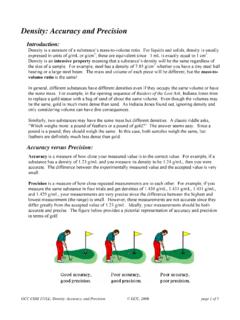
Density: Accuracy and Precision
web.gccaz.eduGCC CHM 151LL: Density: Accuracy, and Precision © GCC, 2008 page 4 of 5 glassware. ... 1. Obtain a set of 4 brass slugs and 1 aluminum slug. 2.
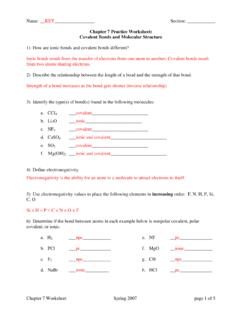
Chapter 7 Practice Worksheet: Covalent Bonds and Molecular ...
web.gccaz.eduChapter 7 Worksheet Spring 2007 page 1 of 5 Chapter 7 Practice Worksheet: Covalent Bonds and Molecular Structure 1) How are ionic bonds and covalent bonds different? ... f. Mg(OH) 2 ___ ionic and covalent _____ 4) Define electronegativity. Electronegativity is the ability for an atom in a molecule to attract electrons to itself. ...

Balancing Equations Worksheet KEY
web.gccaz.eduBalancing Equations Worksheet KEY 1. Zn (s) + 2 AgNO 3 (aq) ⇒ Zn(NO 3) 2 (aq) + 2 Ag (s) 2. N 2 (g) + 3 H 2 (g) ⇒ 2 NH 3 (g) 3. NaCl (aq) + AgC 2H 3O 2 (aq) ⇒ NaC 2H 3O 2 (aq) + AgCl (s) 4. 3 Mg(OH) 2 (aq) + 2 H 3PO 4 (aq) ⇒ 6 H 2O (l) + Mg 3(PO 4 ) 2 (aq) 5. 2 HNO 3 (aq) + Ni (s) ⇒ Ni(NO 3) 2 (aq) + H 2 (g) 6. Ba(HCO 3) 2 (s) ⇒ BaCO 3 (s) + H 2O (g) + CO
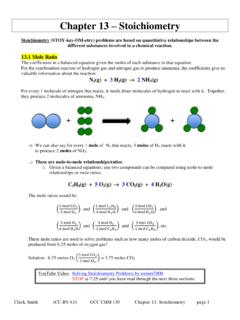
Chapter 13 Stoichiometry - Glendale Community College
web.gccaz.eduChapter 13 – Stoichiometry Stoichiometry (STOY-key-OM-etry) problems are based on quantitative relationships between the different substances involved in a chemical reaction.

Intermolecular and Ionic Forces - web.gccaz.edu
web.gccaz.eduIntermolecular and Ionic Forces ... general, intermolecular forces are much weaker than the ionic and covalent bonds that hold together the atoms and ions in a compound. ... compared in this lab. The alkane used in this activity is pentane, CH 3 CH 2 CH 2 CH 2 CH 3. Alcohols are

Marine Biology: Study Guide - web.gccaz.edu
web.gccaz.eduBIO145: Marine Biology 3 Study Guide Chapter 10 An Introduction to Ecology Ecology is the scientific study of the interactions between organisms and their environment that determine the distribution and abundance of organisms.

CHM 130LL: Electrolytes - Welcome to web.gccaz.edu
web.gccaz.edumainly in body fluids outside the cells. Human body fluids have almost the ... CHM 130LL: Electrolytes Lab . GCC CHM 130LL Spring 2016 page 2 of 7 Understanding ... This makes it possible to identify which substance is in which well (ex: A3 or C2). In your data table (on the next page), ...
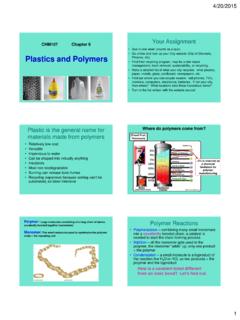
Polymers and Plastics - web.gccaz.edu
web.gccaz.edua chemical feedstock for polymer manufacturing Polymer: ... • Now back to polymers and plastics Given these monomers predict the structure of the polymer Ethylene Vinyl chloride ... recycle numbers are these plastics? • Plastic comes from oil – so less recycling means

CHM 130 Predicting Products Worksheet
web.gccaz.eduCHM 130 Predicting Products Worksheet Circle the appropriate reaction type for each, complete the reaction with products (remember to check charges for ionic compounds), include states, and finally balance each reaction.
Related documents
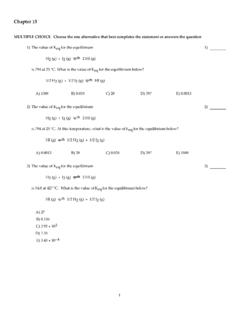
Chapter 15 Practice Questions
alpha.chem.umb.edu4) Consider the following chemical reaction: H2 (g) + I2 (g) 2HI (g) At equilibrium in a particular experiment, the concentrations of H2, I2, and HI were 0.15 M, 0.033 M, and 0.55 M, respectively. The value of Keq for this reaction is _____. A) 61 B) 9.0 × 10⁻³ C) 23 D) 111 E) 6.1 4)

Chapter 11 Density of States, Fermi Energy and Energy Bands
homepages.wmich.edu11-3 ! p k (11.6) Knowing the momentum p = mv, the possible energy states of a free electron is obtained m k m p E mv 2 2 2 1 2 2 ! (11.7) which is called the dispersion relation (energy or frequency-wavevector relation). Effective Mass In reality, an electron in a crystal …

CHAPTER 13 Chemical Equilibrium
www2.tku.edu.twc) The value of the equilibrium constant for a given reaction mixture is the same regardless of the direction from which equilibrium is attained. d) A system moves spontaneously toward a state of equilibrium. e) The equilibrium constant is independent of temperature. ANS: e) The equilibrium constant is independent of temperature. PAGE: 13.1,2 2.

Chapter 15: Chemical Equilibrium
personal.utdallas.eduChapter 15: Chemical Equilibrium Key topics: Equilibrium Constant Calculating Equilibrium Concentrations The Concept of Equilibrium Consider the reaction A ⌦ k1 k1 B At equilibrium there is no net change in [A] or [B], namely d[A] dt =0= d[B] dt But A molecules can react to form B, and B molecules can
Basic Principles and Calculations in Chemical Engineering
ptgmedia.pearsoncmg.com8.6 Multicomponent Vapor-Liquid Equilibrium 466 PART IV ENERGY 487 CHAPTER 9 ENERGY BALANCES 489 9.1 Terminology Associated with Energy Balances 491 9.2 Types of Energy to Be Included in Energy Balances 496 9.3 Energy Balances without Reaction 530 CHAPTER 10 ENERGY BALANCES: HOW TO ACCOUNT FOR CHEMICAL REACTION 597

Chapter 8, Acid-base equilibria
www.bu.eduThis equation is called the autoionization of water and its equilibrium constant is known as the water autoionization constant Kw. At 25°C it is equal to Kw =@H3O+D@OH-D=1.0μ10-14 Now, we have seen that the equilibrium constant of a sum of two reactions is the product of the equilibrium constants of the summed reactions.

Chemical Engineering Thermodynamics II - CPP
www.cpp.eduChapter 6: Chemical Equilibrium 6.1 Introduction 6-1 Example 6.1-1: Extent of reaction and fractional conversion 6-2 Example 6.1-2: Time to reach 90% conversion in a batch reactor 6-5 6.2 Chemical Reaction and Gibbs Energy 6-6 6.3 The Condition of Equilibrium for a …