
Chapter 14. CHEMICAL EQUILIBRIUM
Exothermic (∆H < 0) R Products + Heat Recall that both K c and the position of the equilibrium system will vary with temperature: • K c is larger when the reaction shifts right. This occurs if T is increased for an Endothermic Reaction or T is decreased for an Exothermic reaction. • K c is smaller when the reaction shifts left. This ...
Download Chapter 14. CHEMICAL EQUILIBRIUM

Information
Domain:
Source:
Link to this page:
Documents from same domain
Chapter 14. CHEMICAL EQUILIBRIUM
web.gccaz.eduChapter 14. CHEMICAL EQUILIBRIUM 14.1 THE CONCEPT OF EQUILIBRIUM AND THE EQUILIBRIUM CONSTANT Many chemical reactions do not go to completion but instead attain a ...
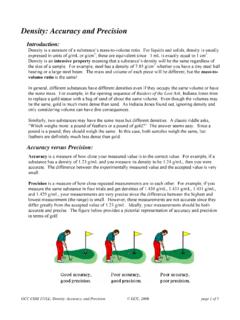
Density: Accuracy and Precision
web.gccaz.eduGCC CHM 151LL: Density: Accuracy, and Precision © GCC, 2008 page 4 of 5 glassware. ... 1. Obtain a set of 4 brass slugs and 1 aluminum slug. 2.
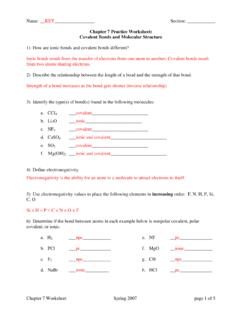
Chapter 7 Practice Worksheet: Covalent Bonds and Molecular ...
web.gccaz.eduChapter 7 Worksheet Spring 2007 page 1 of 5 Chapter 7 Practice Worksheet: Covalent Bonds and Molecular Structure 1) How are ionic bonds and covalent bonds different? ... f. Mg(OH) 2 ___ ionic and covalent _____ 4) Define electronegativity. Electronegativity is the ability for an atom in a molecule to attract electrons to itself. ...

Balancing Equations Worksheet KEY
web.gccaz.eduBalancing Equations Worksheet KEY 1. Zn (s) + 2 AgNO 3 (aq) ⇒ Zn(NO 3) 2 (aq) + 2 Ag (s) 2. N 2 (g) + 3 H 2 (g) ⇒ 2 NH 3 (g) 3. NaCl (aq) + AgC 2H 3O 2 (aq) ⇒ NaC 2H 3O 2 (aq) + AgCl (s) 4. 3 Mg(OH) 2 (aq) + 2 H 3PO 4 (aq) ⇒ 6 H 2O (l) + Mg 3(PO 4 ) 2 (aq) 5. 2 HNO 3 (aq) + Ni (s) ⇒ Ni(NO 3) 2 (aq) + H 2 (g) 6. Ba(HCO 3) 2 (s) ⇒ BaCO 3 (s) + H 2O (g) + CO
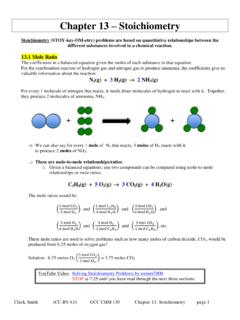
Chapter 13 Stoichiometry - Glendale Community College
web.gccaz.eduChapter 13 – Stoichiometry Stoichiometry (STOY-key-OM-etry) problems are based on quantitative relationships between the different substances involved in a chemical reaction.

Intermolecular and Ionic Forces - web.gccaz.edu
web.gccaz.eduIntermolecular and Ionic Forces ... general, intermolecular forces are much weaker than the ionic and covalent bonds that hold together the atoms and ions in a compound. ... compared in this lab. The alkane used in this activity is pentane, CH 3 CH 2 CH 2 CH 2 CH 3. Alcohols are

Marine Biology: Study Guide - web.gccaz.edu
web.gccaz.eduBIO145: Marine Biology 3 Study Guide Chapter 10 An Introduction to Ecology Ecology is the scientific study of the interactions between organisms and their environment that determine the distribution and abundance of organisms.

CHM 130LL: Electrolytes - Welcome to web.gccaz.edu
web.gccaz.edumainly in body fluids outside the cells. Human body fluids have almost the ... CHM 130LL: Electrolytes Lab . GCC CHM 130LL Spring 2016 page 2 of 7 Understanding ... This makes it possible to identify which substance is in which well (ex: A3 or C2). In your data table (on the next page), ...
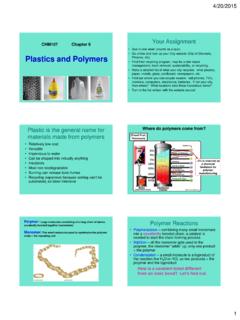
Polymers and Plastics - web.gccaz.edu
web.gccaz.edua chemical feedstock for polymer manufacturing Polymer: ... • Now back to polymers and plastics Given these monomers predict the structure of the polymer Ethylene Vinyl chloride ... recycle numbers are these plastics? • Plastic comes from oil – so less recycling means

CHM 130 Predicting Products Worksheet
web.gccaz.eduCHM 130 Predicting Products Worksheet Circle the appropriate reaction type for each, complete the reaction with products (remember to check charges for ionic compounds), include states, and finally balance each reaction.
Related documents
Lectrure Thermal Analysis
web.abo.fiReduction (endothermic) Break down reactions (endo – or exothermic) Chemisorption (exothermic) Solid state reactions (endo – or exothermic) Evaluation and interpretation of DTA curves T Sample –T Reference Temperature 5 K /min, 1.3 mg 5 K /min, 6, 3 mg 10 K /min, 6, 3 mg
Reactions of Aromatic Compounds - Rutgers University
crab.rutgers.eduCh17 Reactions of Aromatic Compounds (landscape).docx Page4 Bromide ion from the FeBr 4-can act as a weak base to remove the proton, thus generating the aromatic product, H-Br, and regenerating the catalyst (FeBr 3). The formation of the sigma complex is an endothermic and energetically unfavorable process - it is therefore the
Chemical Reactions of Copper and Percent Yield
teachnlearnchem.com5. Give criteria in terms of temperature changes for exothermic and endothermic reactions. Exothermic reactions - release heat and feel “hot” to the touch Endothermic reaction - gain heat and feel “cold” to the touch 6. If 1.65 g of Cu(NO 3) 2 are obtained from allowing 0.93 g of Cu to react with excess HNO 3, what is the percent
Reactions of Aromatic Compounds - Rutgers University
crab.rutgers.eduCh17 Reactions of Aromatic Compounds (landscape).docx Page5 Comparison with Alkenes Alkenes react spontaneously with bromine to give addition products. E.g. This reaction is exothermic by -29kcal/mol. An analogous addition reaction between benzene and bromine would be endothermic by +2kcal.
Endothermic Exothermic Reactions - Extension
extension.uga.eduEndothermic & Exothermic Reactions Written by Chris Papadopoulos This lesson focuses on the use of technology to collect, graph and analyze data from an exothermic and an endothermic reaction. Hypothesis Chemical reactions are systems that exchange heat/energy with their surroundings.

Reactions of Alkenes and Alkynes
pa01000125.schoolwires.netand the reaction is called exothermic. If the energy of the products is higher than that of the reactants, heat is absorbed and the reaction is called endothermic. The one-step reac-tion shown in Figure 5.1 is exothermic. A transition state is the point on the reaction coordinate at which the energy is at a maximum.
Topic 5.1 Exothermic and Endothermic Reactions Heat and ...
www.campbell.k12.ky.usExothermic and endothermic reactions When a chemical reaction happens, there can be a net transfer of energy from the reactants into the surroundings (e.g. air, water is in solution) or a net transfer of energy from the surroundings to the reactants causing a …
Steps to Predicting the Products of Chemical Reactions
www.oakparkusd.orgTYPES OF REACTIONS REVIEW ! 2 NaNO ... be spontaneous and exothermic ! Otherwise, it will not be spontaneous and will be endothermic (NO REACTION) PREDICTING REACTION PRODUCTS: SINGLE REPLACEMENT REACTIONS. Mg + AlCl 3 Al + MgCl 2 PREDICT IF THESE REACTIONS WILL OCCUR