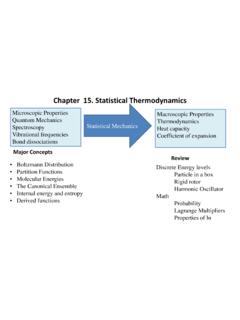
Chapter 15. Statistical Thermodynamics
Statistical Thermodynamics Statistical thermodynamics provides the link between the microscopic (i.e., molecular) properties of matter and its macroscopic (i.e., bulk) properties. It provides a means of calculating thermodynamic properties from the statistical relationship between temperature and energy.
Download Chapter 15. Statistical Thermodynamics

Information
Domain:
Source:
Link to this page:
Documents from same domain

Ziegler-Natta polymerization of olefins - …
www.chem.tamu.eduZiegler-Natta polymerization of olefins - stereoselectivity CHEM 462: Inorganic/Organometallic Chemistry Haomiao Xie & Xu Ye . …
Average, Standard Deviation and Relative Standard …
www.chem.tamu.eduAverage, Standard Deviation and Relative Standard Deviation How will your data compare with other people’s data? Let’s find out. We will do this by pulling together everybody’s

Selected Bond Energies and Bond Lengths
www.chem.tamu.eduSelected Bond Energies and Bond Lengths Arranged according to families. Energy (D) in kJ/mol. Bond length (r) in picometers. Hydrogen Compounds

Paramagnetism and Diamagnetism - Department of Chemistry
www.chem.tamu.edu1 Paramagnetism and Diamagnetism zAtoms with unpaired ↑electrons are called paramagnetic. • Paramagnetic atoms are attracted to a magnet. zAtoms with paired ↑↓electrons are called diamagnetic. • Diamagnetic atoms are repelled by a magnet.

NMR spectroscopy of paramagnetic complexes. Part 39 ...
www.chem.tamu.eduMAGNETIC RESONANCE IN CHEMlSTRY, VOL. 31, 2-6 (1993) NMR Spectroscopy of Paramagnetic Complexes Part 39*-Natural Abundance *H NMR of Paramagnetic Sandwich Compounds Janet Blumel, Peter Hofmann and Frank H. Kohlert Anorganisch-chemisches Institut, Technische Universitat Miinchen, D-8046 Garching, Germany
Chemistry 689 A Brief Introduction to Symmetry and Group ...
www.chem.tamu.eduA Brief Introduction to Symmetry and Group Theory in Chemistry Instructor: Dr. Timothy Hughbanks Time: TTh 12:45 - 2:00 PM; Room 2121 ... After a brief introduction to the abstract theory of groups is ... Franzen Physical Chemistry of Solids, Basic Principles …

Electron Paramagnetic Resonance: Hyperfine Interactions
www.chem.tamu.edu§ Abragam & Bleaney Electron Paramagnetic Resonance of Transition Ions; § Carrington & McLachlan, Introduction to Magnetic Resonance; § Wertz & Bolton, Electron Spin Resonance. 2. ... • Basic ideas from MO theory and ligand field theory must be familiar. 6. Experimental Aspects • EPR performed at fixed frequency (i.e., field is

Oxidation Numbers: Rules
www.chem.tamu.edu1 Oxidation Numbers: Rules 1) The oxidation number of the atoms in any free, uncombined element, is zero 2) The sum of the oxidation numbers of all atoms

CO2 Reduction Catalysts and Catalysis
www.chem.tamu.eduCO2 Reduction Catalysts and Catalysis CHEM 462 Kristina Goldstein . Soomin Park . 1

Coordination Chemistry Transition Metal Complexes
www.chem.tamu.eduCoordination Chemistry Transition Metal Complexes Direct Application of Lewis AB and Hard/Soft AB “Theories” A TEP (Thermal Ellipsoid Plot) of ... Metals may exhibit multiple oxidation states 3. Metals may exhibit paramagnetism dependent on …
Related documents
Chapter 20: Entropy and the Second Law of Thermodynamics
astro1.panet.utoledo.edu(statistical thermodynamics) Let’s bring the numbers down to illustrate the relationship between entropy and probability. Consider an insulated box containing six molecules (N=6). The box is divided into the left half and the right half. Let n 1 be the number of molecules in the left half and n 2 be the number of molecules in the right half ...
16 Statistical thermodynamics 1 - USTC
staff.ustc.edu.cnStatistical thermodynamics 1: the concepts Statistical thermodynamics provides the link between the microscopic properties of matter and its bulk properties. Two key ideas are introduced in this chapter. The first is the Boltzmann distribution, which is used to predict the populations of states in systems at thermal equilibrium.
Handout 7. Entropy - Stanford University
micro.stanford.eduIn thermodynamics, the equation of state is obtained from experiments: In statistical mechanics, we can derive S(N;V;E) from fundamental dynamics of the mi-croscopic particles. Other equation of state (e.g. pV = Nk BT) can be derived from this fundamental relation. Statistical Mechanics Microcanonical (N;V;E) ensemble. There are many ...
Thermodynamics - Texas A&M University
www.chem.tamu.eduThe Third Law of Thermodynamics . The entropies of all perfect crystals approach zero as the absolute temperature approaches zero . Statistical entropy . S = k ln(W), where W is the number of different microstates for the macrostate . The statistical definition of entropy is equivalent to that derived from macroscopic observations . Standard ...
Thermodynamics and Statistical Mechanics
farside.ph.utexas.eduClassical and Statistical Thermodynamics: A.S. Carter (Prentice-Hall, Upper Saddle River NJ, 2001). 1.3 Why Study Thermodynamics? In a nutshell, thermodynamics is the study of the internal motions of many-body systems. Virtu-allyall physicalentitiesthatwe encounterin everydaylife are many-bodysystemsof sometypeor
Statistical Physics - University of Cambridge
www.damtp.cam.ac.uk1. The Fundamentals of Statistical Mechanics 1 1.1 Introduction 1 1.2 The Microcanonical Ensemble 2 1.2.1 Entropy and the Second Law of Thermodynamics 5 1.2.2 Temperature 8 1.2.3 An Example: The Two State System 11 1.2.4 Pressure, Volume and the First Law of Thermodynamics 14 1.2.5 Ludwig Boltzmann (1844-1906) 16 1.3 The Canonical Ensemble 17

Thermodynamics & Statistical Mechanics
farside.ph.utexas.edu1.8 Thermodynamics and statistical thermodynamics In this course, we are going to develop some machinery for interrelating the sta-tistical properties of a system containing a very large number of particles, via a statistical treatment of the laws of …
A Crash Course in Statistical Mechanics - Harvard University
scholar.harvard.eduA Crash Course in Statistical Mechanics Noah Miller December 27, 2018 Abstract A friendly introduction to statistical mechanics, geared towards ... can let the second law of thermodynamics to do all the hard work, transferring energy into our …

Statistical Thermodynamics - lehman.edu
www.lehman.edustatistical thermodynamics as well. The formalism of statistical thermodynamics can be developed for both classical and quantum systems. The resulting energy distribution and calculating observables is simpler in the classical case. However, the very formulation of the

thermodynamics 2: applications - USTC
staff.ustc.edu.cn590 17 STATISTICAL THERMODYNAMICS 2: APPLICATIONS (a) The Helmholtz energy The Helmholtz energy, A, is defined as A =U −TS.This relation implies that A(0) = U(0), so substitution for U and S by using eqn 17.1 leads to the very simple expression A −A(0) =−kT ln Q (17.2) (b) The pressure By an argument like that leading to eqn 3.31, it follows from A = U − TS …