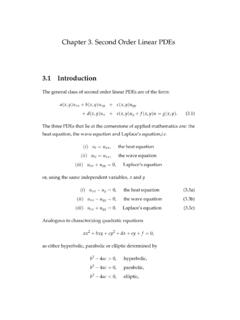
Chapter 3. Second Order Linear PDEs - UCA
Linear Second Order Equations 3.2.3 Modified Hyperbolic Form The modified hyperbolic canonical form is defined as urs +l.o.t.s. = 0, (3.27) noting that a = 0, b = 1 and c = 0 and that b2 ¡4ac > 0 still! In order to target the modified hyperbolic form, it is now necessary to choose ar2 x +brxry +cr 2 y = 0, (3.28a) as2 x +bsxsy +cs 2 y = 0 ...
Download Chapter 3. Second Order Linear PDEs - UCA

Information
Domain:
Source:
Link to this page:
Documents from same domain
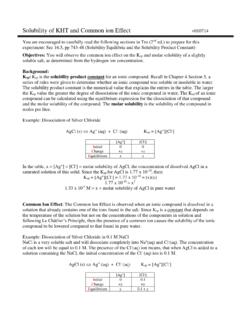
Solubility of KHT and Common ion Effect v010714
faculty.uca.edu1.33 x 10-5 M = x = molar solubility of AgCl in pure water Common Ion Effect : The Common Ion Effect is observed when an ionic compound is dissolved in a solution that already contains one of the ions found in the salt.

The Unit Circle - UCA
faculty.uca.eduThe Unit Circle Practice filling in this unit circle until you can complete it in 5 minutes. Place the degree angle measure of each angle in the dashed blanks inside the circle, and the radian measure of each angle in the solid blanks inside the circle. Place the …
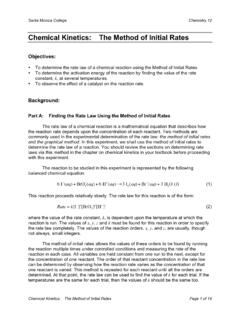
Chemical Kinetics: The Method of Initial Rates
faculty.uca.eduThe value of the rate constant, k, measured in Part A is dependent upon the temperature at which the reaction occurs according to the Arrhenius Equation: k € =Ae−E a/RT (5) where A is the frequency factor and is related to the number of properly aligned collisions that occur per second between reactant molecules; E a is the activation ...

THE THERMODYNAMICS OF POTASSIUM NITRATE …
faculty.uca.eduequilibrium constant (K sp) at different temperatures. BACKGROUND 1. Solubility product constant (see textbook: K sp, Sec. 16.5, page 743; solution Sec. 12.3-12.4, page 519) In a saturated potassium nitrate (KNO 3) solution in water (H 2 O), a dynamic equilibrium will be established and the reaction equation is shown in equation 1: KNO 3
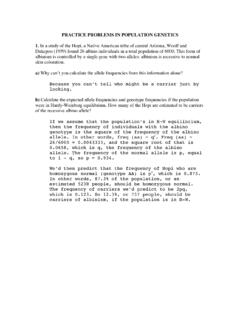
PRACTICE PROBLEMS IN POPULATION GENETICS 1. a) Why …
faculty.uca.eduCooke and Ryder (1971) studied the nestlings of Ross’s goose, a small Arctic nesting goose. Goslings (baby geese) exist in two color morphs, grey or yellow. Cooke and Ryder reported that a population of geese at Karrack Lake, Canada included 263 yellow goslings and 413 grey goslings (676 total). They assumed that color is controlled by two

Assignment Solutions of Partial Difierential Equations
faculty.uca.edu2.3.2. (d) Find the eigenvalues and the corresponding eigenfunctions of the eigenvalue prob-lem ...

First Law, Heat Capacity, Latent Heat and Enthalpy
faculty.uca.eduBasically, the pV term in enthalpy keeps track of expan-sion/compression related work for us. Starting from the first law in the form dU = d−Q− p4V 5 (Let’s call this the first law for hydrostatic processes) and the definition Cp =

Thermodynamic Potentials and Maxwell’s Relations
faculty.uca.eduThis result is called a Maxwell relation. By considering the other second partial derivatives, we find two other Maxwell relations from the energy representation of the fundamental thermodynamic identity. These are: ∂T ∂N! S,V = ∂µ ∂S! V,N and− ∂p ∂N! S,V = ∂µ ∂V! S,N. Similarly, in the entropy representation, starting from ...
Chapter 5. Separation of Variables - UCA | Faculty Sites ...
faculty.uca.edumain equations: the heat equation, Laplace’s equation and the wave equa-tion using the method of separation of variables. 4.1 The heat equation Consider, for example, the heat equation ... At this point, we recognize that we have a Fourier sine series and that the coefficients bn are chosen such that
Heat Capacity, Speciflc Heat, and Enthalpy
faculty.uca.eduHeat Capacity, Speciflc Heat, and Enthalpy Stephen R. Addison January 22, 2001 Introduction In this section we will explore the relationships between heat capacities and speciflc heats and internal energy and enthalpy. Heat Capacity The heat capacity of an object is the energy transfer by heating per unit tem-perature change. That is, C = Q 4T:
Related documents

Dolch Sight Words: Second Grade Alphabetical Order
www.uniqueteachingresources.comSecond Grade Word Lists 2nd Grade List A 2nd Grade List B 2nd Grade List C 2nd Grade List D 1. always 1. before 1. call 1. fast 2. gave 2. made 2. pull 2. sit 3. these 3. use 3. why 3. write 4. around 4. best 4. cold 4. first 5. goes 5. many 5. read 5. sleep 6. those 6. very 6. wish 6. your 7. because 7. both 7. does 7. five 8. green 8. off 8 ...
Transient Response of a Second-Order System
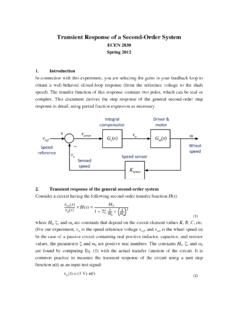
ecee.colorado.eduSecond-order system step response, for various values of damping factor ζ. Three figures-of-merit for judging the step response are the rise time, the percent overshoot, and the settling time. Percent overshoot is zero for the overdamped and critically damped cases. For the underdamped case, percent overshoot is defined as percent overshoot ...
Time Response of Second Order Systems - Mercer University
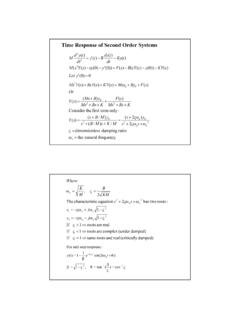
faculty.mercer.eduFor second order system, we seek for which the response remains within 2% of the final value. This occurs approximately when: Hence the settling time is defined as 4 time constants. T s δ T s n s n s T T T e n s ζω τ ζω ζω 4 4 Therefore: or: 4 0.02 ≅ = ≅ − < Explicit relations for and:
Second Order Differential Equations
epsassets.manchester.ac.uk1. Constant coefficient second order linear ODEs We now proceed to study those second order linear equations which have constant coefficients. The general form of such an equation is: a d2y dx2 +b dy dx +cy = f(x) (3) where a,b,c are constants. The homogeneous form of (3) is the case when f(x) ≡ 0: a d2y dx2 +b dy dx +cy = 0 (4)
Second Order Differential Equations
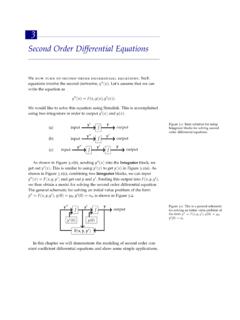
people.uncw.edusecond order differential equations 45 x 0 0.5 1 1.5 2 2.5 3 3.5 4 4.5 5 y 0 0.05 0.1 0.15 y(x) vs x Figure 3.4: Solution plot for the initial value problem y00+ 5y0+ 6y = 0, y(0) = 0, y0(0) = 1 using Simulink. Recall the solution of this problem is found by first seeking the
SECOND ORDER (inhomogeneous)
www.cse.salford.ac.ukThis Tutorial deals with the solution of second order linear o.d.e.’s with constant coefficients (a, b and c), i.e. of the form: a d2y dx2 +b dy dx +cy = f(x) (∗) The first step is to find the general solution of the homogeneous equa-tion [i.e. as (∗), except that f(x) = 0]. This gives us the “comple-mentary function” y …
1.2 Second-order systems - MIT OpenCourseWare
ocw.mit.edu1.2. SECOND-ORDER SYSTEMS 29 • First, if b = 0, the poles are complex conjugates on the imaginary axis at s1 = +j k/m and s2 = −j k/m.This corresponds to ζ = 0, and is referred to as the undamped case. • If b2 − 4mk < 0 then the poles are complex conjugates lying in the left half of the s-plane.This corresponds to the range 0 < ζ < 1, and is referred to as the underdamped case.
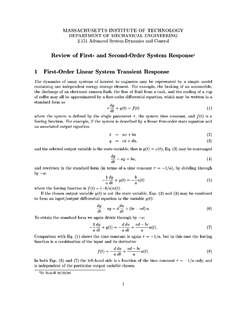
Review of First- and Second-Order System Response 1 First ...
web.mit.eduReview of First- and Second-Order System Response1 1 First-Order Linear System Transient Response The dynamics of many systems of interest to engineers may be represented by a simple model containing one independent energy storage element. For example, the braking of an automobile,

2014 REVISED The Ontario Curriculum Grades 9 to 12
www.edu.gov.on.caas a Second Language – Core, Extended, and Immersion French, Grades 11 and 12, 2000. Beginning in September 2015, all secondary French as a second language (FSL) courses ... In order to achieve the goals of the elementary and secondary FSL curriculum, students . need to:
Second Order Differential Equation Non Homogeneous
bionics.seas.ucla.eduSecond Order Linear Differential Equations – Homogeneous & Non Homogenous v • p, q, g are given, continuous functions on the open interval I