
Chapter 4, HEAT - JSUNIL TUTORIAL CBSE MATHS …
Chapter 4, HEAT NCERT Science Textbook Exercise (Solved) Q.1: State similarities and differences between the laboratory and clinical thermometer. Ans: Similarities: 1. Both consist of a long, narrow, uniform glass tube. 2. Both have a bulb containing mercury at the end of the tube. 3. Both are marked with Celsius scale on the glass tube.
Download Chapter 4, HEAT - JSUNIL TUTORIAL CBSE MATHS …

Information
Domain:
Source:
Link to this page:
Documents from same domain
Unfiled Notes Page 1 - JSUNIL TUTORIAL CBSE …
jsuniltutorial.weebly.comUnfiled Notes Page 4 . Unfiled Notes Page 5 . Unfiled Notes Page 6 ... Wednesday, March 09, 2011 12:04 PM Unfiled Notes Page 1 . Unfiled Notes Page 2 . Unfiled Notes Page 3 . Unfiled Notes Page 4 . Unfiled Notes Page 5 . Unfiled Notes Page 6 . Unfiled Notes Page 7 . Unfiled Notes Page 8 . Unfiled Notes Page 9 . Unfiled Notes Page …
Unfiled Notes Page 1 - jsuniltutorial.weebly.com
jsuniltutorial.weebly.comUnfiled Notes Page 26 . Unfiled Notes Page 27 . Unfiled Notes Page 28 . SUPPLEMENTARY TEXTUAL MATERIAL IN MATHEMATICS (CLASS Xl) CHAPTER 3 : CHAPTER 5 : CHAPTER 9 : CHAPTER 10 CHAPTER 13 CONTENT Trigonometric Functions Law of smes, and law of cosines Complex numbers and quadratic …
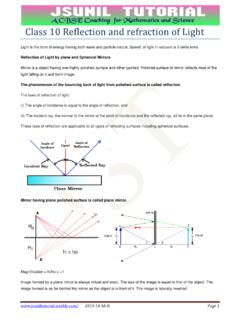
Class 10 Reflection and refraction of Light
jsuniltutorial.weebly.comThe laws of reflection of light: (i) The angle of incidence is equal to the angle of reflection, and (ii) The incident ray, the normal to the mirror at the point of incidence and the reflected ray, all lie in …

RAY OPTICS Introduction
jsuniltutorial.weebly.comRAY OPTICS Introduction ... In this chapter, we consider the phenomena of reflection, refraction and dispersion of light, using the ray picture of light. Using the basic laws of reflection and refraction, we shall study the image formation by ... due to refraction of light through the atmosphere. • The refractive index of air with respect to ...

CTET/ TET CHILD DEVELOPMENT AND PEDAGOGY Solved …
jsuniltutorial.weebly.comCTET/ TET CHILD DEVELOPMENT AND PEDAGOGY Solved Question Paper - 6 www.jsuniltutorial.weebly.com Page 1 1. You find a student to be intelligent. you will

Chapter: Light- Numerical Practice questions class 10 Paper- 4
jsuniltutorial.weebly.com1.An object 5.0 cm in length is placed at a distance of 10cm from a convex mirror of radius of curvature 150cm. Find the position, nature and size of the image. 2.Find the position, nature and size of image of an object 4cm high placed at a distance of …

Class IX Chemistry Chapter 4: Structure of the Atom
jsuniltutorial.weebly.comRutherford’s model of atom The results of α-ray scattering experiment were explained by Rutherford in 1911 and another model of the atom was proposed. According to Rutherford‟s model, Fig. 06(a). An atom contains a dense and positively charged region located at its centre; it was called as nucleus,

Solved Electricity numerical for class 10
jsuniltutorial.weebly.comSolved Electricity numerical for class 10 1. Question: Two bulbs have ratings 100 W, 220 V and 60 W, 220 V respectively. Which one has a greater resistance? Answer: P=VI= V2/R For the same V, R is inversely proportional to P. Therefore, the bulb 60 W, 220 V has a greater resistance. 2. Question: A torch bulb has a resistance of 1 Ω when cold.

Multiple Choice Questions for Class IX
jsuniltutorial.weebly.comZIET-BBSR/ MCQ for Class IX : Science (Biology) 2013 Page | 9 Answers Chapter: 5 Chapter: 6 Chapter: 7 Chapter: 13 Chapter: 14 Qn Ans Qn Ans Qn Ans Qn Ans Qn Ans 1 B 1 A 1 B 1 A 1 D 2 C 2 B 2 C 2 C 2 D 3 B 3 C 3 D 3 C 3 A 4 D 4 A 4 B 4 B 4 B 5 A 5 D 5 D 5 B 5 C
Solved Electricity numerical for class 10
jsuniltutorial.weebly.com10.Calculate the power rating of the heater coil when used on 220V supply taking 5 Amps. Solution: Voltage ,V = 220V and Current ,I = 5A, Power, P = VI = 220 × 5 = 1100W = 1.1 KW. 11.A lamp can work on a 50 volt mains taking 2 amps.What value of …
Related documents
Chapter 4 - Student
pages.mtu.eduIn Chapter 4, the following problem modules explain the heat transfer processes involved in fuel cell vehicles and in the processes for producing fuel for fuel cells. 4.1-1 Heat Loss through a Stainless Steel Bipolar Plate
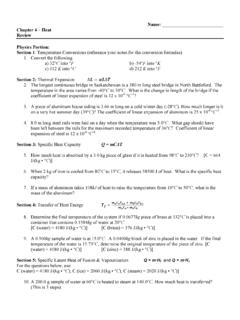
Chapter 4 Heat Review - Mr. Palmarin's Class Website
palmarin.weebly.com2H 2 + O 2 2H 2O 11. Calculate the quantity of heat required to change 50g of ice at -10°C into steam at 120°C.(This is 5 steps). 12. Calculate the quantity of heat required to change 100g of steam at 130°C into ice at -10°C? (This is 5 steps).
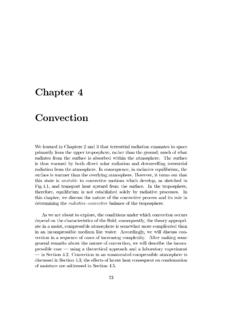
Chapter 4 Convection - MIT PAOC
paoc.mit.edu74 CHAPTER 4. CONVECTION Figure 4.1: Solar radiation warms the earth’s surface, triggering convection which carries heat vertically to the emission level from which, because the atmosphere above this level is transparent in …
Chapter 10 Temperature and Heat - Doane College
physics.doane.eduChapter 10 Temperature and Heat OVERVIEW Heat is a form of energy. As this energy moves from one object to another, we may detect physical changes in both the object losing heat energy and the object gaining heat energy. This chapter deals with many of these basic changes and the rules used to describe them.
Chapter 10 Temperature And Heat - Doane College
physics.doane.eduPhysics Including Human Applications 217 Chapter 10 Temperature And Heat GOALS When you have mastered the contents of this chapter, you will be able to achieve the
CHAPTER 4 THERMAL EFFECTIVENESS OF A …
shodhganga.inflibnet.ac.in55 CHAPTER 4 THERMAL EFFECTIVENESS OF A SPIRAL PLATE HEAT EXCHANGER 4.1 INTRODUCTION This chapter discusses the study of thermal effectiveness of the
CHAPTER 4 DESIGN FUNDAMENTALS OF SHELL …
web.iitd.ac.inCHAPTER 4 DESIGN FUNDAMENTALS OF SHELL-AND-TUBE HEAT EXCHANGERS 4.1 INTRODUCTION The thermal design of heat exchangers is directed to …
Chapter 4: Energy from Combustion The primary …
web.mnstate.eduChapter 4: Energy from Combustion The primary means of generating energy for human endeavors is the combustion of fuels. Fuels: Coal -burned in power plants ... 4.1 Heat is a consequence of motion at the molecular level; temperature is a measure of the average speed of that motion.
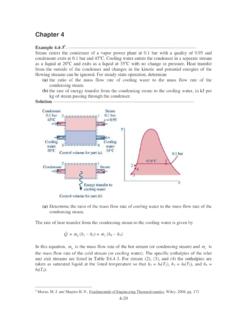
Chapter 4
www.cpp.edu4-29 Chapter 4 Example 4.4-36. Steam enters the condenser of a vapor power plant at 0.1 bar with a quality of 0.95 and condensate exits at 0.1 bar and 45oC. Cooling water enters the condenser in a separate stream as a liquid at 20oC and exits as a liquid at 35oC with no change in pressure.Heat transfer
Chapter 5
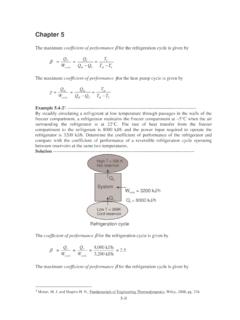
www.cpp.edu5-9 Chapter 5 The maximum coefficient of performance b for the refrigeration cycle is given by b C= CC cycle Q W = H C Q Q-Q H C T T-T The maximum coefficient of performance gfor the heat pump cycle is given by g = H H cycle Q W = H C Q Q-Q H C T T-T Example 5.4-23. By steadily circulating a refrigerant at low temperature through …
Related search queries
Chapter 4, Student, Heat, Chapter 4 Heat Review, Chapter 4 Convection, CHAPTER 4. CONVECTION, Chapter 10 Temperature And Heat, Chapter, CHAPTER 4 THERMAL EFFECTIVENESS OF A, CHAPTER 4 THERMAL EFFECTIVENESS OF A SPIRAL, CHAPTER 4 DESIGN FUNDAMENTALS OF SHELL, CHAPTER 4 DESIGN FUNDAMENTALS OF SHELL-AND, Chapter 4: Energy from Combustion The primary