
Chapter 8 The Telescope - Physics
Chapter 8 The Telescope 8.1 Purpose In this lab, you will measure the focal lengths of two lenses and use them to construct a simple telescope which inverts the image like the one developed by …
Download Chapter 8 The Telescope - Physics

Information
Domain:
Source:
Link to this page:
Documents from same domain

Chapter 9 Ohm’sLaw- Series and Parallel Circuits
physics.wm.eduChapter 9 Ohm’sLaw- Series and Parallel Circuits 9.1 Purpose. Ohm’s law will be explored in this lab using series and parallel circuits. 9.2 Introduction
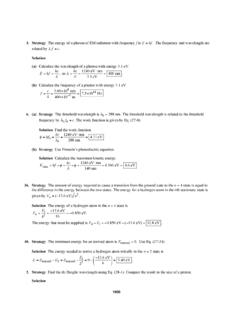
EEEE 0 3.40 eV. 24 E 13.6 eV - Physics
physics.wm.eduCollege Physics Chapter 27: Early Quantum Physics and the Photon 1003 (b) Strategy Use Eq. (14-4). Solution Find the temperature increase. 600 J, so 0.48C. 0.30 kg4186 J(kgK) Q QmcTT mc =!!== =¡"# 70.(a) Strategy Use the percent abundance of potassium-40 in the potassium in the broccoli and the atomic masses to find the mass of the potassium-40 in the broccoli.

Report on Lab 2 Thévenin resistance and voltage of a power ...
physics.wm.eduto the operation of the power supply used to power breadboard circuits in the Physics 252 laboratory course. Thévenin's theorem states that any linear power supply can be represented as an ideal voltage source in series with a single resistor, regardless of the inner workings and engineering of the supply [1]. This powerful theorem allows circuit

Chapter 6: Transistors and Gain
physics.wm.edu1. Measure the current gain of a 2N3904 transistor using the constant current source circuit from design exercise 6-1. If you measure the collector current through the collector/load resistor for a variety of base currents (i.e. change the base resistor or the voltage applied to it), then you should be able to extract a value for β.
Chapter 3: Capacitors, Inductors, and Complex Impedance
physics.wm.eduChapter 3: Capacitors, Inductors, and Complex Impedance - 21 - To study a constant supply voltage on an RC circuit, we set the left side of equation 3.12 equal to a constant voltage. Then we have a simple homogeneous differential equation with the simple solution for the current of a decaying exponential, I I e /(t RC) 0

Chapter 3 Oscillations: Mass on aSpring and Pendulums
physics.wm.eduAn electronic photo-gate timer will be used to measure the period of the different pendulums. The basic apparatus is shown in figure 3.2 • Remove the spring and mass hanger from the arm of the stand. Attach a string of approximately 0.75 meters to the arm of the stand. Attach a 0.05 kg (50 gram) mass to the end of the string.
Related documents
Gathering light; the telescope - University of Arizona
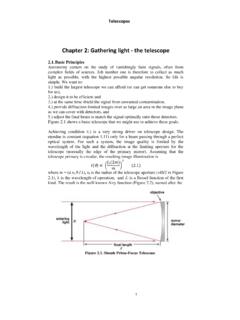
ircamera.as.arizona.eduTelescopes 3 destructive interference at increasing path differences. Although the diffraction limit is the ideal, practical optics have a series of

Astronomy 101 Lab: Telescopes - Parkland College
natsci.parkland.edutelescope composed of two different lenses: a refracting telescope. A wide lens with a long focal length is placed at the object end of the telescope. This is called the objective
Basic Functions of Telescopes - College of Charleston
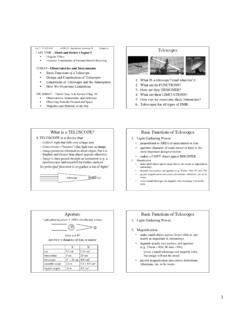
neffj.people.cofc.eduTelescope! eye! Basic Functions of Telescopes! 1. Light Gathering Power! • proportional to AREA of main mirror or lens! • aperture (diameter of main mirror or lens) is the most important design criterion! • makes a FAINT object appear BRIGHTER! 2. Magnification!

DAY LABORATORY EXERCISE #3: OPTICS AND TELESCOPES
people.bu.eduthrough a telescope to the apparent size of the object seen with the naked eye. The formula for calculating the angular magnification of a telescope is: M = fObjective / fEyepiece where M is the magnification, fObjective is the focal length of the objective and fEyepiece is the focal length

Telescope Types and Designs
sas-sky.orgTelescope Types and Designs There are three basic types of optical telescopes – Refractor, Newtonian reflector and Catadioptric. All of these telescopes are designed to collect light and …

Worksheet: Telescopes - Triton Science
sctritonscience.comtelescope independently, but not until he had heard that others had done so. A reflecting telescope (also called a reflector) is an optical telescope which uses a single or combination of curved mirrors that reflect light and form an image.

Cassegrain Telescopes for Amateurs
www.alpo-astronomy.orgmaterial on hand and Richard Berry’s first ever issue of Telescope Making Magazine in the Fall of 1978, the first article, "Cassegrain Optical Systems," by: Dr. …
Telescopes of the Future - Caltech Astronomy
www.astro.caltech.eduinterferometer it will act like a 22 m telescope with a resolution of 10 marcsec and high infrared sensitivity to complex, faint sources over a wide field of view.

Refracting Telescopes - Caltech Astronomy
www.astro.caltech.eduRefracting Telescopes ENCYCLOPEDIA OFASTRONOMY ANDASTROPHYSICS Refracting Telescopes Nobody is sure of the date when the first telescope was made. It may be as far back as the early 1550s, when there

X-Ray Telescopes - University of Maryland Observatory
www.astro.umd.eduX-Ray Telescopes ENCYCLOPEDIA OF ASTRONOMY AND STROPHYSICS X-Ray Telescopes X-ray telescopes produce images of x-ray-emitting objects within the telescope’s FIELD OF VIEW by reflection from precisely shaped mirrors. Hans Wolter’s design in the