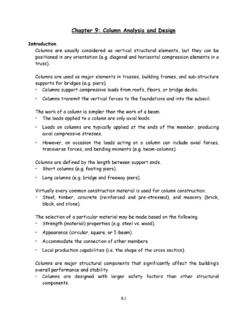
Chapter 9: Column Analysis and Design
• Long, slender columns fail by buckling – a function of the column’s dimensions and its modulus of elasticity. - Buckling is the sudden uncontrolled lateral displacement of a column at which point no additional load can be supported. - Failure occurs at a lower stress level than the column’s material strength
Download Chapter 9: Column Analysis and Design

Information
Domain:
Source:
Link to this page:
Documents from same domain
EMBEDDED SYSTEMS PROGRAMMING WITH THE …
academic.csuohio.edu5 Preface This book is intended for use by Junior-level undergraduates, Senior-level undergraduates, and Graduate students in electrical engineering as well as practicing
THEORIES OF ACCIDENT CAUSATION - Cleveland …
academic.csuohio.eduCleveland State University Work Zone Safety and Efficiency Transportation Center Section 3 Accident Theories THEORIES OF ACCIDENT CAUSATION
The Content Analysis Guidebook - Cleveland State …
academic.csuohio.edu202 The CoNTeNT ANALySIS GUIDeBooK of the Japanese earthquake of 2011, for example, the social media of the world followed and documented the crisis, aided in recovery efforts through

OSHA Subpart R: Steel Erection
academic.csuohio.eduSection 17 1926 Subparts R Cleveland State University Work Zone Safety and Efficiency Transportation Center OSHA Subpart R: Steel Erection
THEORIES OF ACCIDENT CAUSATION - …
academic.csuohio.eduCleveland State University Work Zone Safety and Efficiency Transportation Center Section 3 Accident Theories THEORIES OF ACCIDENT CAUSATION

OSHA 1926 Subpart D Occupational Health & …
academic.csuohio.eduSection 9 1926 Subparts D & E Cleveland State University Work Zone Safety and Efficiency Transportation Center 1926.50 Medical Services and First Aid
OSHA Subpart R: Steel Erection - …
academic.csuohio.eduSection 17 1926 Subparts R Cleveland State University Work Zone Safety and Efficiency Transportation Center Before Authorizing The Start Of Steel
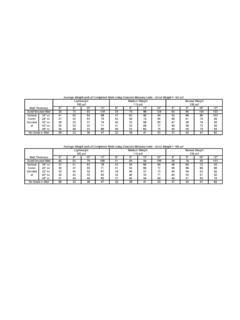
Average Weight (psf) of Completed Walls Using …
academic.csuohio.edu6" 8" 10" 12" 6" 8" 10" 12" 6" 8" 10" 12" 52 75 93 118 58 78 98 124 63 84 104 133 Vertical 16" oc 41 60 69 88 47 63 80 94 52 66 86 103 …
Preliminaries: Beam Deflections Virtual Work
academic.csuohio.eduSection 6: The Flexibility Method - Beams Washkewicz College of Engineering 1 Preliminaries: Beam Deflections –Virtual Work There are several methods available to calculate deformations (displacements and rotations)
OSHA Subpart L: Scaffolds - Cleveland State …
academic.csuohio.eduSection 12 1926 Subparts I Cleveland State University Work Zone Safety and Efficiency Transportation Center OSHA Subpart L: Scaffolds
Related documents
COMPANION TO THE AISC STEEL CONSTRUCTION MANUAL
www.aisc.orgPREFACE The primary objective of this Companion is to provide guidance and additional resources of the use of the 2016 AISC Specification for Structural Steel Buildings (ANSI/AISC 360-16) and the 15th Edition AISC Steel Construction Manual.

Welcome to Mechanical Engineering - Mechanical …
my.mech.utah.edu2-kg slender rods. If the torsional spring attached to the wheel's center has a stiffness k = 2 N m/rad, so that the torque on the center of the wheel is M = (28) N • m, where is in radians, determine the maximum angular velocity of the wheel if it is rotated two revolutions and then released from rest. 0.5 m 1.583 12 = (1.583) 02 (402 0.791702
Chapter 4 Design of Slender Columns - Engineering
by.genie.uottawa.caSlender Columns 4.4 may be used to establish conservative values of k for braced columns2. 4.2.3 Radius of Gyration, r The radius of gyration introduces the effects of cross-sectional size and shape to slenderness. For the same cross-sectional area, a section with higher moment of inertia produces a more stable column with

Manual for the design of reinforced concrete building ...
timurdhaka.weebly.comand has now been extended to cover slender columns and prestressed concrete. An appen-dix for the structural design of foundations using limit state philosophy (as foreseen by ENVEC7), has also been included. It is hoped that this extended scope will be welcomed by practitioners. It is a helping hand not a substitute for the greater range in EC2.
Design of Beams (Flexural Members) (Part 5 of AISC/LRFD)
user.engineering.uiowa.eduλ>λr the shape is slender The above conditions are based on the worst width-thickness ratio of the elements of the cross section. The following table summarizes the width-thickness limits for rolled I-, H- and C- sections (for C- sections, λ= b / t f f. The web criterion is met by all standard I- and C- sections listed in the Manual.

12 Buckling Analysis - Rice University
www.clear.rice.eduSlender is a geometric concept of a two‐dimensional area that is quantified by the radius of gyration. The radius of gyration, r, has the units of length and describes the way in which the area of a cross‐section is distributed around its centroidal axis.

Preliminary Assessment: Unidentified Aerial Phenomena
www.dni.govJun 25, 2021 · EXECUTIVE SUMMARY . The limited amount of high-quality reporting on unidentified aerial phenomena (UAP) hampers our ability to draw firm conclusions about the nature or intent of UAP.

Practical Design to Eurocode 2
concretecentre.comMoments in Slender Columns Cl. 5.8.8.2 Fig 5.10 Design Moment, MEd = Max {M 02; M0e + M 2; M01 + 0.5M 2; NEd e0} EC 2: Concise: Second order effects may be ignored if they are less than 10% of the corresponding first order effects Second order effects may be ignored if the slenderness, λis less than λlim where λlim = 20 A B C/ √n
Glossary Winter Tree Identification Key
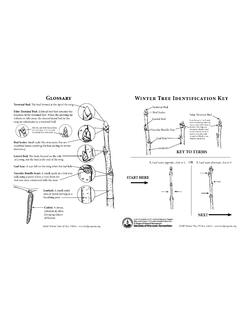
www.uwsp.eduTwigs slender red-brown and shiny; buds are pointed; acorns have caps that enclose 1/3 to ½ of the nut 6f. Twig is stout and red-brown to grey-green; buds are large, buff-colored, pointed and fuzzy; acorns have cap that covers ½ to 1/3 of the nut and the edges of the scales on the cap appear loose 6 Buds not crowded near tip of twig Go to 7 ...