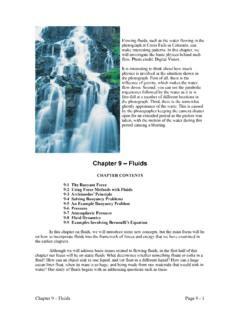
Chapter 9 – Fluids
9-3 Archimedes’ Principle 9-4 Solving Buoyancy Problems 9-5 An Example Buoyancy Problem 9-6 Pressure 9-7 Atmospheric Pressure 9-8 Fluid Dynamics 9-9 Examples Involving Bernoulli’s Equation In this chapter on fluids, we will introduce some …
Download Chapter 9 – Fluids

Information
Domain:
Source:
Link to this page:
Documents from same domain
A Beginners Guide to Contract Bridge
physics.bu.edu1 Introduction Contract bridge is a four-handed trick-taking card game played with a stan-dard 52-card deck between two cooperative partnerships, each consisting of
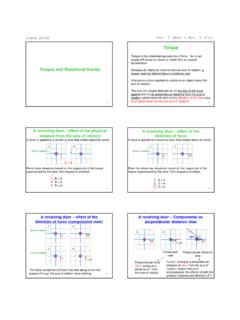
Torque Torque and Rotational Inertia
physics.bu.edu1 Torque and Rotational Inertia 2 Torque Torque is the rotational equivalence of force. So, a net torque will cause an object to rotate with an angular
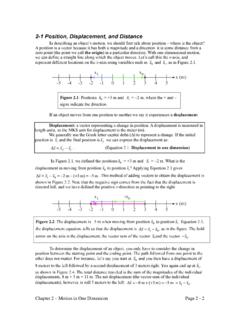
2-1 Position, Displacement, and Distance
physics.bu.eduEXAMPLE 2.1 – Interpreting graphs Another way to represent positions and displacements is to graph the position as a function of time, as in Figure 2.4.
NS 547 Concepts in Modern Physics II: Special …
physics.bu.edu1 NS 547 Concepts in Modern Physics II: Special Relativity and Related Topics Description: This course explores the foundations of Einstein’s Theory of Special Relativity and its applications to our understanding of nuclear and particle physics, and to
Electron Diffraction - Boston University Physics
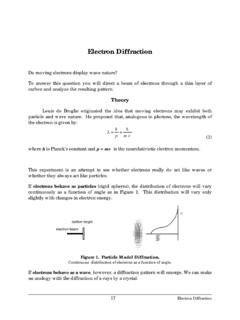
physics.bu.eduElectron Diffraction Do moving electrons display wave nature? To answer this question you will direct a beam of electrons through a thin layer of
Momentum, Energy, and Collisions Microcomputer …
physics.bu.edu1 Momentum, Energy, and Collisions Momentum, Energy, and Collisions Microcomputer-Based Lab In this experiment you will analyze various collisions involving two carts on a track.
FourierSeries - Boston University Physics
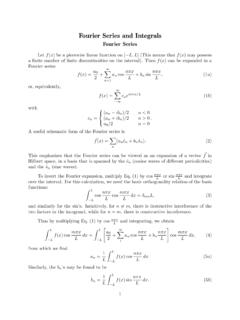
physics.bu.eduFourierSeriesandIntegrals FourierSeries Let f(x) be a piecewise linear function on [−L,L] (This means that f(x) may possess a finite number of finite discontinuities on the interval).
Big yo-yo, again - Boston University Physics
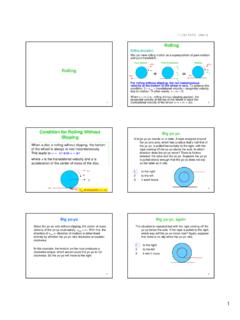
physics.bu.edu2. 7. Analyzing the yo-yo. The key to determining which way the yo-yo moves is to look at the torque due to the tension about the point of contact. All the

Boston University Charles River Campus Map
physics.bu.eduBoston University Charles River Campus Map http://www.bu.edu/visit/maps/campus/index.html 1 of 1 2006-9-1 13:30 This Site BU Directory Photo Credits | NIS | OIT ...
The Stefan Boltzmann Law - Boston University
physics.bu.eduaccurate operation. Be careful not to move the detector between readings. Analysis The data table is accompanied by a calculation table. For each voltage setting, calculate the filament resistance. The ratio of that resistance to room temperature resistance (R300) is the indicator of filament temperature. The calibration of this
Related documents
Lecture6 Hydrostatic Force on curved Surfaces
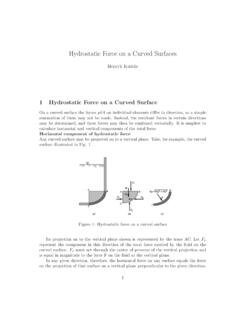
fluid.itcmp.pwr.wroc.plas the buoyancy. This buoyancy force can be computed using the same principles used to compute hydrostatic forces on surfaces. The results are the two laws of buoyancy discovered by Archimedes in the third century B.C.: 1. a body immersed in a fluid experiences a vertical buoyant force equal to the weight of the fluid it displaces.

Skill and Practice Worksheets - LPS
sites.lps.org1.3 Speed Problems 1.3 Problem Solving Boxes (template for solving problems) ... 8.2 Buoyancy 8.2 Archimedes Principle 8.3 Boyle’s Law ... 8.3 Pressure-Temperature Relationship 8.3 Charles’ Law 9.1 The Structure of the Atom 9.2 Dot Diagrams Unit 4: 10.2 Power in Flowing Energy 10.2 Efficiency and Energy 11.2 Balancing Chemical Equations 11 ...