
CHEMICAL BONDING
Ionic or electrovalent bond Covalent bond Co-ordinate covalent bond In addition to these we have a special kind of bond called hydrogen bond. Let us discuss about different types of bonds, their formation and the properties of the compounds so formed. 5.2 Ionic or Electovalent Bond According to Kossel’s theory, in the process of formation of ...
Download CHEMICAL BONDING

Information
Domain:
Source:
Link to this page:
Documents from same domain

OPEN BASIC EDUCATION PROGRAMME
nios.ac.inAPPENDIX - J Guidelines and Standard Operating Procedure for Implementation of OPEN BASIC EDUCATION PROGRAMME 2015 (Revised) (Bye-Laws Governing Examinations …
24 ENVIRONMENTAL LAW Notes
nios.ac.inMODULE - VIIA Environmental Law and Sustainable Development 1 Environmental Law INTRODUCTION TO LAW Notes 24 ENVIRONMENTAL LAW The ‘Environment’ is very important for us to understand because it constitutes

14 - National Institute of Open Schooling
nios.ac.in104 :: Certificate in Construction Supervision (CIVIL) 14 FLOORING 14.1 INTRODUCTION The job of protecting slabs of roofs on the different floors in building and providing suitable finish of floor surfaces is known as flooring.
34 - National Institute of Open Schooling
nios.ac.in34 Chemistry Notes Environmental Chemistry OPTIONAL MODULE - 1 34.3.2 Ground Water Pollution When the polluted water seeps into the ground and enters an aquifer it results intoground
PETROCHEMICALS Notes
nios.ac.inChemistry and Industry 32 PETROCHEMICALS ... polyester, plastics, synthetic detergents, rocket fuels, etc. Since every area of human activity makes use of petrochemicals or the materials made ... large quantities as a by product of petroleum refining. The major petrochemicals produced from methane are: 1. Chlorinated products 2. Unsaturated ...
SHOOT SYSTEM - National Institute of Open Schooling
nios.ac.inReduced, flattened discoid stem with crowded nodes bearing overlapping fleshy (inner) and dry (outer) scale leaves. Terminal bud (in centre) forms foliage (green) leaves. Adventitious roots grow from discoid base. Swollen tips of underground lateral branches of stem, store food as starch, bear eyes . Each eye is a node which bears bud

17 PRODUCTION FUNCTION
nios.ac.inProduction Function ECONOMICS MODULE - 7 Producer's Behaviour 17 PRODUCTION FUNCTION When you go to the market to buy commodities such as note-books, fountain pens, shirts, bread, butter, fruits, vegetables etc. do you ever think about how these things came into the market. In previous lessons, you have studied about

12 PERFORMING ARTS: MUSIC, DANCE AND DRAMA
nios.ac.inPerforming Arts: Music, Dance and Drama Notes 168 Indian Culture and Heritage Secondary Course MODULE - V Painting, Performing Arts and Architecture 12 PERFORMING ARTS: MUSIC, DANCE AND DRAMA M usic, dance, drama, folk theatre or puppetry our country India, had all of it in abundance.
ATOMIC STRUCTURE Notes
nios.ac.inAtomic Structure MODULE - 2 Notes Atomic Structure and Chemical Bonding called a photon. The energy of the quantum ( or photon) is proportional to the frequency of the radiation. The two are related as E = hv The energy of the quantum can also be …
Formulas, Functions and Charts
nios.ac.inFormulas, Functions and Charts :: 177 8.4 CHARTS Charts allow you to present data entered into the worksheet in a visual format using a variety of graph types. Before you can make a chart, you must first enter data into a worksheet. This section explains how you can create simple charts from the data.
Related documents
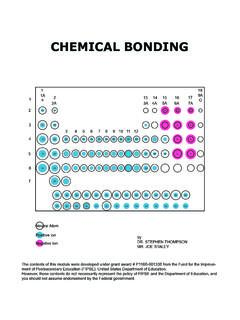
Chemical Bonding - Colorado State University
www.smallscalechemistry.colostate.eduIonic and covalent bonds are two ideal types. Many bonds share characteristics of both ionic and covalent bonding. They are called polar covalent bonds and they tend to occur between atoms of mod-erately different electronegativities. In polar covalent bonds the electrons belong predomi-nantly to one type of atom while they are still partially

Sugar or Salt? Ionic and Covalent Bonds - UU
www.uu.eduthe other hand, is composed of carbon, oxygen, and hydrogen and has covalent bonds. D Introduction A salt molecule is made up of one sodium atom and one chlorine atom. For salt to be made, the sodium atom must lose an electron and become a sodium ion. When sodium loses an electron it becomes a Na+ and is called a cation. Na → Na+ + e-

CERAMICS: Properties 1 (Physical, Chemical, Mechanical)
www-personal.umich.edu[CLICK] THERMAL PROPERTIES of ceramics are governed by the type of bonding (covalent to ionic) and number of bonds present . [CLICK] Generally for all materials, the expansion from absolute zero to the melting temperature is about 15%, so materials with higher Tm values have lower LCTE values. This is apparent in the table.

Chapter 11 Substance Mass (amu) Moment (D) Acetonitrile ...
alpha.chem.umb.educovalent-network A)supercritical B)covalent-network C)molecular D)ionic E)metallic 26) 7. ... London disperson forces, and/or hydrogen bonds. A)Molecular B)Covalent-network C)Metallic and covalent-network D)Metallic E)Ionic 27) 8. Answer Key
LEWIS STRUCTURES General Rules for Drawing Lewis Structures
clas.sa.ucsb.eduoctet and shares one electron in single bonds in covalent compounds. Fluorine generally does not make double bonds. Fluorine is not willing to share more than one electron and with a double bond the formal charge on fluorine would be +1. A +1 formal charge on the most electronegative atom is generally not observed.

List the four major differences between ionic and covalent ...
homework.sdmesa.eduIonic bonds result from transfer of electrons, whereas covalent bonds are formed by sharing. 2. Ionic bonds are electrostatic in nature, resulting from that attraction of positive and negative ions that result from the electron transfer process; charge …

Common Polyatomic Ions - West Virginia University
pltl.wvu.eduCOVALENT bonds ♦ Octet Rule - An atoms tends to gain, lose or share such that it achieves eight valence electrons. There are some exceptions to the “Octet” Rule! Formation of Ionic Compounds: ♦ All compounds are electrically neutral ⇒ possess no net charge. ♦ Number of positives = number of negatives Compounds Ionic—held together ...

Intermolecular and Ionic Forces
web.gccaz.edugeneral, intermolecular forces are much weaker than the ionic and covalent bonds that hold together the atoms and ions in a compound. For example, about 40 kJ of energy are required to vaporize 18 grams of water molecules—i.e., completely convert …

Analog Integrated Circuit Design
www.d.umn.eduvalence electrons are bound in covalent bounds and are not free to move. (silicon is an electrical insulator in this condition). • However, in room temperatures (300K), a small fraction of the electrons gain sufficient thermal energy to break loose from the covalent bonds. These free electrons can easily move through the crystal.

9.2 Network Covalent, Ionic, and Metallic Solids
www.mi.mun.ca9.2 Network Covalent, Ionic, and Metallic Solids YOU ARE EXPECTED TO BE ABLE TO: • Classify non-molecular solids as either network covalent solids, ionic solids, or metallic solids. • Relate the physical properties of non-molecular solids to the forces holding them together.