
CHM 130 Conversion Practice Problems
23. Table salt has a density of 2.16 g/mL. If you used 2.00 mL on your food, how much in mg is that? 24. The density of ethanol is 0.802 g/mL. How much in grams does 9.85 x 10⁻²L mass? 25. How many cg are in 0.497 g? 26. How many cg are in 2.49 x …
Download CHM 130 Conversion Practice Problems

Information
Domain:
Source:
Link to this page:
Documents from same domain

Chapter 14. CHEMICAL EQUILIBRIUM
web.gccaz.eduChapter 14. CHEMICAL EQUILIBRIUM 14.1 THE CONCEPT OF EQUILIBRIUM AND THE EQUILIBRIUM CONSTANT Many chemical reactions do not go to completion but instead attain a ...
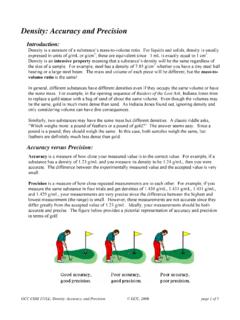
Density: Accuracy and Precision
web.gccaz.eduGCC CHM 151LL: Density: Accuracy, and Precision © GCC, 2008 page 4 of 5 glassware. ... 1. Obtain a set of 4 brass slugs and 1 aluminum slug. 2.
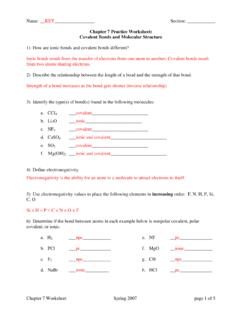
Chapter 7 Practice Worksheet: Covalent Bonds and Molecular ...
web.gccaz.eduChapter 7 Worksheet Spring 2007 page 1 of 5 Chapter 7 Practice Worksheet: Covalent Bonds and Molecular Structure 1) How are ionic bonds and covalent bonds different? ... f. Mg(OH) 2 ___ ionic and covalent _____ 4) Define electronegativity. Electronegativity is the ability for an atom in a molecule to attract electrons to itself. ...

Balancing Equations Worksheet KEY
web.gccaz.eduBalancing Equations Worksheet KEY 1. Zn (s) + 2 AgNO 3 (aq) ⇒ Zn(NO 3) 2 (aq) + 2 Ag (s) 2. N 2 (g) + 3 H 2 (g) ⇒ 2 NH 3 (g) 3. NaCl (aq) + AgC 2H 3O 2 (aq) ⇒ NaC 2H 3O 2 (aq) + AgCl (s) 4. 3 Mg(OH) 2 (aq) + 2 H 3PO 4 (aq) ⇒ 6 H 2O (l) + Mg 3(PO 4 ) 2 (aq) 5. 2 HNO 3 (aq) + Ni (s) ⇒ Ni(NO 3) 2 (aq) + H 2 (g) 6. Ba(HCO 3) 2 (s) ⇒ BaCO 3 (s) + H 2O (g) + CO
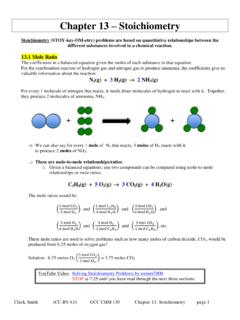
Chapter 13 Stoichiometry - Glendale Community College
web.gccaz.eduChapter 13 – Stoichiometry Stoichiometry (STOY-key-OM-etry) problems are based on quantitative relationships between the different substances involved in a chemical reaction.

Intermolecular and Ionic Forces - web.gccaz.edu
web.gccaz.eduIntermolecular and Ionic Forces ... general, intermolecular forces are much weaker than the ionic and covalent bonds that hold together the atoms and ions in a compound. ... compared in this lab. The alkane used in this activity is pentane, CH 3 CH 2 CH 2 CH 2 CH 3. Alcohols are

Marine Biology: Study Guide - web.gccaz.edu
web.gccaz.eduBIO145: Marine Biology 3 Study Guide Chapter 10 An Introduction to Ecology Ecology is the scientific study of the interactions between organisms and their environment that determine the distribution and abundance of organisms.

CHM 130LL: Electrolytes - Welcome to web.gccaz.edu
web.gccaz.edumainly in body fluids outside the cells. Human body fluids have almost the ... CHM 130LL: Electrolytes Lab . GCC CHM 130LL Spring 2016 page 2 of 7 Understanding ... This makes it possible to identify which substance is in which well (ex: A3 or C2). In your data table (on the next page), ...
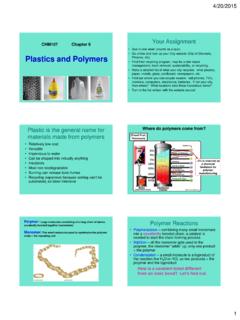
Polymers and Plastics - web.gccaz.edu
web.gccaz.edua chemical feedstock for polymer manufacturing Polymer: ... • Now back to polymers and plastics Given these monomers predict the structure of the polymer Ethylene Vinyl chloride ... recycle numbers are these plastics? • Plastic comes from oil – so less recycling means

CHM 130 Predicting Products Worksheet
web.gccaz.eduCHM 130 Predicting Products Worksheet Circle the appropriate reaction type for each, complete the reaction with products (remember to check charges for ionic compounds), include states, and finally balance each reaction.
Related documents

1. Chemical Grade Definitions from Highest to Lowest Purity.
www.info.dent.nu.ac.thPharmacopeia (USP); acceptable for food, drug, or medicinal use; may be used for most laboratory purposes. 4. N.F. A grade of sufficient purity to meet or exceed requirements of the National Formulary (NF). 5. Lab A chemical grade of relatively high quality with exact levels of impurities unknown; usually pure enough for educational applications.

Food Laws and Regulation - EOLSS
www.eolss.netDr. Lásztity’s main research activities are chemistry and biochemistry of food proteins, food analysis, and food control. The results of his research work were published in more than 700 papers in foreign and Hungarian journals. He is the author of more than 20 books and textbooks (among them: Chemistry of
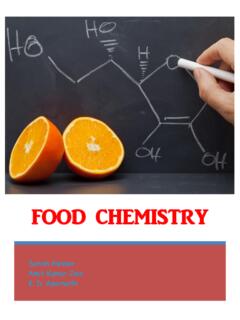
FOOD CHEMISTRY - AgriMoon
agrimoon.comFood Chemistry WWW.AGRIMOON.COM 5 Module 1 Water Lesson-1 Structure of water 1.1. Introduction Water is relatively small inorganic molecule, but organic life is highly dependent on this tiny molecule. It is the only substance on the earth that occurs abundantly in all three physical states (gas, liquid and solid). Water is essential for life: as:

National 5 Chemistry - SQA
www.sqa.org.ukChemistry research and development is essential for the introduction of new products. The study of chemistry is of benefit not only to those intending to pursue a career in science, but also to those intending to work in areas such as the food, health, textile or manufacturing industries.

Higher Chemistry - SQA
www.sqa.org.ukchemistry is of benefit not only to those intending to pursue a career in science, but also to those intending to work in areas such as the food, health or manufacturing industries. Experimental and investigative approaches develop knowledge and understanding of