
Cognitive Behaviour Therapy
Cognitive Behaviour Therapy - how it can help Cognitive Behaviour Therapy is a form of psychotherapy that talks about How you think about yourself, the world and other people How what you do affects your thoughts and feelings CBT can help you to change how you think ("Cognitive") and what you do ("Behaviour)".
Download Cognitive Behaviour Therapy

Information
Domain:
Source:
Link to this page:
Documents from same domain

Manual of the Revised Cognitive Therapy Scale …
www.getselfhelp.co.ukManual of the Revised Cognitive Therapy Scale (CTS-R) I.A. James, I.-M. Blackburn & F.K. Reichelt . Collaborators . A. Garland, P. Armstrong. Dec. 2001

SELF HELP FOR ANGER
www.getselfhelp.co.ukwww.getselfhelp.co.uk/anger.htm www.get.gg © Carol Vivyan 2009-15, permission to use for therapy purposes SELF HELP FOR ANGER Anger is a normal reaction and emotion.
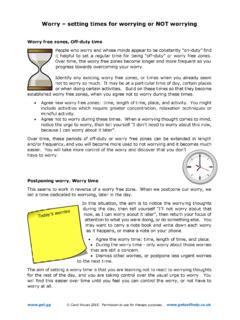
Worry setting times for worrying or NOT worrying
www.getselfhelp.co.ukwww.get.gg © Carol Vivyan 2015. Permission to use for therapy purposes.www.getselfhelp.co.uk Worry – setting times for worrying or NOT worrying Worry free zones ...
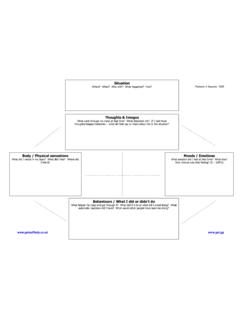
Situation Padesky 5 Aspects. 1986 Where? When? Who with ...
www.getselfhelp.co.ukPadesky 5 Aspects. 1986 Where? When? Who with?
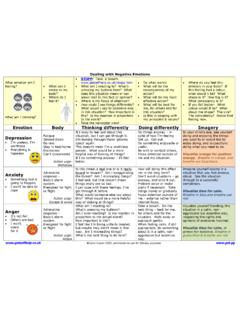
Emotion Body Thinking differently Doing differently Imagery
www.getselfhelp.co.ukDealing with Negative Emotions What emotion am I feeling? What am I thinking? What can I notice in my body? Where do I feel it? STOPP! Take a breath.

Stress Self Help
www.getselfhelp.co.ukPage 1 of 4 www.getselfhelp.co.uk/stress.htm www.get.gg © Carol Vivyan 2009-2015,permission to use for therapy purposes. Self Help for Stress Stress is our emotional ...

APPLE - Getselfhelp.co.uk
www.getselfhelp.co.ukAPPLE A Mindful Response to Thoughts A CKNOWLEDGE - Notice and acknowledge the thought as it comes to mind. P AUSE - Don't react as you normally do.Just pause, and breathe. P ULL BACK - Tell yourself this is just the anxiety or depression talking, and this thought or feeling is only a thought or feeling.
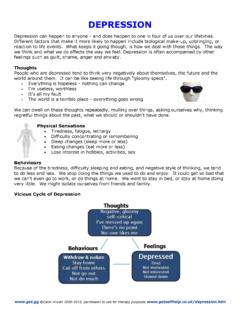
DEPRESSION - Getselfhelp.co.uk CBT self help and therapy ...
www.getselfhelp.co.ukDepression can happen to anyone - and does happen to one in four of us over our lifetimes. Different factors that make it more likely to happen include biological make …

Thought Record Sheet - Depression - Getselfhelp.co.uk
www.getselfhelp.co.ukThought Record Sheet - Depression Situation rate 0 Unhelpful Thoughts / Images Feelings: Emotion/s –100% Physical sensations Alternative response / healthier

Activity Diary - Getselfhelp.co.uk
www.getselfhelp.co.ukActivity Diary Write briefly in each box: What you did (brief description), one word that describes your Mood, and rate the intensity of your mood on a scale of 0 – 100%, your sense of Achievement for the activity on a scale of 0-10 (A0 – 10) your sense of Closeness to others (C0 – 10), and sense of Enjoyment
Related documents

What is your child’s Challenging Behaviour trying to tell you?
ddwa.org.auHowever behaviour can become challenging when it is harmful to the child or other people, it interferes with the child being able to engage in life experiences and when it persists and is severe.
Evidence-based Classroom Behaviour Management Strategies
files.eric.ed.govEvidence-based Classroom Behaviour Management Strategies dr barry s. parsonson Ministry of Education: Special Education, Hawkes Bay Region AbstrAct This paper reviews a range of evidence-based strategies for application by teachers to reduce disruptive and challenging behaviours in their classrooms. These include a number of antecedent ...

Helping Children Learn to Manage Their Own Behavior
csefel.vanderbilt.eduoccurrences of challenging behavior, is through “self-management.” • Self-management can be used to • Teach children what is expected of them (e.g., tasks they are supposed to do). • Keep track of whether or not children complete these tasks. • Monitor their own behavior and control their own actions.

PROACTIVE & REACTIVE STRATEGIES
www.wba2032.comchallenging behavior less likely. Such adjustments attempt to fit the environment to the individual. A hyperactive child’s behavior is less likely to be a problem in a funhouse than in an antique shop. Positive Programming includes training in new skills to help the person deal with his/her environment and make the challenging behaviors ...

Creating a Culture - GOV.UK
assets.publishing.service.gov.ukhigher than average levels of challenging behaviour, and should also be focused on schools that have already demonstrated reasonable efforts to create this provision using their existing budgets and resources. 2. Design a revised certification process for all headteachers that includes a
Factors Influencing Consumer Buying Behaviour: A Case Study
globaljournals.orgbuying behaviour of the selected durable goods in Nagaland, to examine the factors inducing the buying behaviour of the consumers, and to suggest appropriate measures to the ... Meanwhile, it is challenging for any marketing manager to formulate and implement an apt . Author

Leading Behaviour Change Paul Dix - Pivotal Education
pivotaleducation.comregardless of their behaviour. Adult behaviour will never be compromised by learner behaviour. Adults strip out all negative emotion/response when dealing with challenging behaviour. Recognition replaces reward. The Pivotal focus is on pride not prizes. Recognition systems are not individual but collective. Learners are interdependent.

Overcoming agoraphobia A self-help manual
www.anxietyuk.org.ukthoughts and behaviour, which are separate but linked to each other. Physical feelings – these are the bodily feelings you have when you feel anxious for example palpitations (heart racing) hyperventilating (feeling as though you are having difficulty breathing), butterflies in the stomach, feeling sick, sweating, shaking, trembling.

Strategies to guide children’s behaviour
www.education.vic.gov.auBehaviour guidance in practice Behaviour guidance is part of the educational or recreational program in a children’s service. It occurs in all interactions and communication with children, not only when children engage in challenging behaviour. The policy and strategies for behaviour guidance adopted by