
Correlation and Convolution - UMD
correlation and convolution do not change much with the dimension of the image, so understanding things in 1D will help a lot. Also, later we will find that in some cases it is enlightening to think of an image as a continuous function, but we will begin by considering an image as discrete , meaning as composed of a collection of pixels. Notation
Download Correlation and Convolution - UMD

Information
Domain:
Source:
Link to this page:
Documents from same domain

Digital Image Processing Using Matlab - cs.umd.edu
www.cs.umd.eduDigital Image Processing Using Matlab Haris Papasaika-Hanusch Institute of Geodesy and Photogrammetry, ETH Zurich haris@geod.baug.ethz.ch

Practical introduction to Frama-C
www.cs.umd.eduMERCE – Communications Technology Division Public / Export Control: NLR License CC -BY-SA 3.0 2 . Content of this introduction to Frama-C

Introduction to Machine Learning - University Of Maryland
www.cs.umd.eduIntroduction to Machine Learning CMSC 422 MARINE CARPUAT marine@cs.umd.edu. What is this course about? •Machine learning studies algorithms for learning to do stuff •By finding (and exploiting) patterns in data. What can we do ... Machine Learning as Function Approximation

More than you ever wanted to know about Java Generics
www.cs.umd.eduMore than you ever wanted to know about ... than you were without using generics at all. At least you know the code on your ...

INTRODUCTION TO DATA SCIENCE - University Of Maryland
www.cs.umd.eduTHE DATA LIFECYCLE 3 Data collection Data processing Exploratory analysis & Data viz Analysis, hypothesis testing, & ML Insight & Policy Decision

INTRODUCTION TO DATA SCIENCE - University Of Maryland
www.cs.umd.edumaintains a simple and separate 100 bytes of data per file, noting changes and supporting operations Nice because you can (and do!) store the whole thing locally
Game Theory - University Of Maryland
www.cs.umd.eduNau: Game Theory 6 Strategies Suppose the agents agent 1, agent 2, …, agent n For each i, let S i = {all possible strategies for agent i} s i will always refer to a strategy in S i A strategy profile is an n-tuple S = (s 1, …, s n), one strategy for each agent

NASDAQ Velocity and Forces: An Interactive Visualization ...
www.cs.umd.eduNASDAQ has tried to compensate for the lack of physically-based information by the creation of two data products called Market Velocity and Market Forces as part of their Market Analytix information service.

CMSC 425 Game Programming - University Of Maryland
www.cs.umd.eduLecture 1: Introduction to Game Programming Computer Game Programming: The famous game design Sid Meier once de ned a computer game as \a series of interesting and meaningful choices made by the player in pursuit of a clear and compelling

A PICTURE WORTH A THOUSAND CONTROL LOOPS: AN …
www.cs.umd.eduPERFORMANCE ASSESSMENT OF UNIVARIATE CONTROL LOOPS USING USER SPECIFIED BENCHMARKS In some cases one may wish to specify certain desired closed loop dynamics and ...
Related documents

Discrete-Time Signals and Systems - Pearson
www.pearsonhighered.comThe unit sample sequence plays the same role for discrete-time signals and systems that the unit impulse function (Dirac delta function) does for continuous-time signals and systems. For convenience, we often refer to the unit sample sequence as a discrete-time impulse or simply as an impulse. It is important to note that a discrete-time impulse

Chapter 4: Discrete-time Fourier Transform (DTFT) 4.1 DTFT ...
abut.sdsu.edu4.4 DTFT Analysis of Discrete LTI Systems The input-output relationship of an LTI system is governed by a convolution process: y[n] = x[n]*h[ n ] where h[ n ] is the discrete time impulse response of the system.
Lecture 4: Convolution - MIT OpenCourseWare
ocw.mit.educonvolution sum for discrete-time LTI systems and the convolution integral for continuous-time LTI systems. TRANSPARENCY 4.9 Evaluation of the convolution sum for an input that is a unit step and a system impulse response that is a decaying exponential for n > 0. Signals and Systems TRANSPARENCY

Lecture 13 Linear dynamical systems with inputs & outputs
see.stanford.eduInterpretations write x˙ = Ax+b1u1 +···+bmum, where B = [b1 ··· bm] • state derivative is sum of autonomous term (Ax) and one term per input (biui) • each input ui gives another degree of freedom for x˙ (assuming columns of B independent) write x˙ = Ax+Bu as x˙i = ˜aT i x+˜bT i u, where ˜aT i, ˜bT i are the rows of A, B • ith state derivative is linear function of state x ...
Circular Convolution - MIT OpenCourseWare
ocw.mit.edu6.341: Discrete-Time Signal Processing OpenCourseWare 2006 Lecture 16 Linear Filtering with the DFT Reading: Sections 8.6 and 8.7 in Oppenheim, Schafer & Buck (OSB). Circular Convolution x[n] and h[n] are two finite sequences of length N with DFTs denoted by X[k] and H[k], respectively. Let us form the product W [k] = X[k]H[k],

Think DSP - Green Tea Press
greenteapress.comThink DSP Digital Signal Processing in Python Version 1.1.1 Allen B. Downey Green Tea Press Needham, Massachusetts
2-D Fourier Transforms - New York University
eeweb.engineering.nyu.edu• Li C l tiLinear Convolution – 1D, Continuous vs. discrete signals (review) – 2D • Filter Design • Computer Implementation Yao Wang, NYU-Poly EL5123: Fourier Transform 2. What is a transform? • Transforms are decompositions of a function f(x)
2D and 3D Fourier transforms - Yale University
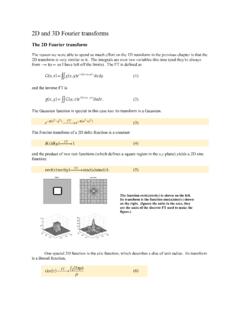
cryoemprinciples.yale.eduThe discrete Fourier transform The Fourier transform is defined as an integral over all of space. How could we evaluate this on a computer? We will have to take a finite number of discrete samples both in the real (x,y) space and in the (u,v) frequency space. Let’s first do this in one dimension, and we’ll model discrete samples by multiplying