
DeCAF: A Deep Convolutional Activation Feature for …
DeCAF: A Deep Convolutional Activation Feature for Generic Visual Recognition (a) LLC (b) GIST (c) DeCAF 1 (d) DeCAF 6 Figure 1. This figure shows several t-SNE feature visualizations on the ILSVRC-2012 validation set. (a) LLC , (b) GIST, and features derived from our CNN: (c) DeCAF 1, the first pooling layer, and (d) DeCAF
Download DeCAF: A Deep Convolutional Activation Feature for …

Information
Domain:
Source:
Link to this page:
Documents from same domain

TPOT: A Tree-based Pipeline Optimization Tool for ...
proceedings.mlr.pressJMLR: Workshop and Conference Proceedings 64:66{74, 2016 ICML 2016 AutoML Workshop TPOT: A Tree-based Pipeline Optimization Tool for Automating Machine …
Ensembles for Time Series Forecasting
proceedings.mlr.pressEnsembles for Time Series Forecasting set of real world time series. Our results clearly indicate that this is a promising research direction. In Section2we provide a brief description of the tasks being tackled in this paper.
Show, Attend and Tell: Neural Image CaptionGeneration …
proceedings.mlr.pressShow, Attend and Tell: Neural Image Caption Generation with Visual Attention Kelvin Xu? KELVIN.XU@UMONTREAL.CA Jimmy Lei Bay JIMMY@PSI.UTORONTO.CA Ryan Kirosy RKIROS@CS.TORONTO.EDU Kyunghyun Cho?
Wasserstein Generative Adversarial Networks
proceedings.mlr.pressWasserstein Generative Adversarial Networks Figure 1: These plots show ˆ(P ;P 0) as a function of when ˆis the EM distance (left plot) or the JS divergence (right plot).The EM plot is continuous and provides a usable gradient everywhere.
Self-Attention Generative Adversarial Networks
proceedings.mlr.pressSelf-Attention Generative Adversarial Networks Figure 1. The proposed SAGAN generates images by leveraging complementary features in distant portions of the image rather than local regions of fixed shape to generate consistent objects/scenarios. In each row, the first image shows five representative query locations with color coded dots.
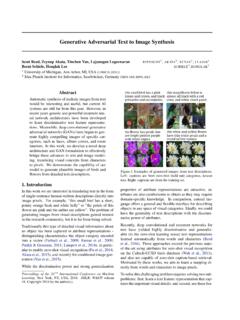
Generative Adversarial Text to Image Synthesis
proceedings.mlr.pressdeep convolutional decoder networks to generate realistic images.Dosovitskiy et al.(2015) trained a deconvolutional network (several layers of convolution and upsampling) to generate 3D chair renderings conditioned on a set of graph-ics codes indicating shape, position and lighting.Yang et al. (2015) added an encoder network as well as actions ...

On the di culty of training recurrent neural networks
proceedings.mlr.pressOn the di culty of training recurrent neural networks @Et+1 @xt+1 Et Et+1 Et 1 xt 1 xt +1 ut +11 u tu @Et @xt @Et1 @xt1 @ xt +2 @xt +1 @x +1 x @xt1 @xt1 @xt2 Figure 2. Unrolling recurrent neural networks in time by creating a copy of the model for each time step.

Deep Gaussian Processes
proceedings.mlr.pressrepresentational power of a Gaussian process in the same role is significantly greater than that of an RBM. For the GP the corresponding likelihood is over a continuous vari-able, but it is a nonlinear function of the inputs, p(yjx) = N yjf(x);˙2; where N j ;˙2 is a Gaussian density with mean and variance ˙2. In this case the likelihood is ...
Noise-contrastive estimation: A new estimation principle ...
proceedings.mlr.pressated noise y. The estimation principle thus relies on noise with which the data is contrasted, so that we will refer to the new method as “noise-contrastive estima-tion”. In Section 2, we formally define noise-contrastive es-timation, establish fundamental statistical properties, and make the connection to supervised learning ex-plicit.
Gender Shades: Intersectional Accuracy Disparities in ...
proceedings.mlr.press117 million Americans are included in law en-forcement face recognition networks. A year-long research investigation across 100 police de-partments revealed that African-American indi-viduals are more likely to be stopped by law enforcement and be subjected to face recogni-tion searches than individuals of other ethnici-ties (Garvie et al.,2016).
Related documents

Learning Deep Features for Discriminative Localization
cnnlocalization.csail.mit.eduweights of the output layer on to the convolutional feature maps, a technique we call class activation mapping. As illustrated in Fig. 2, global average pooling outputs the spatial average of the feature map of each unit at the last convolutional layer. A weighted sum of these values is used to generate the final output. Similarly, we compute a
Image Style Transfer Using Convolutional Neural Networks
www.cv-foundation.orgcent advance of Deep Convolutional Neural Networks [18] ... tent in generic feature representations that generalise across datasets [6] and even to other visual information processing tasks [19, 4, 2, 9, 23], including texture recognition [5] and ... ij is the activation of the ith filter at position j in layer l.
Siamese Neural Networks for One-shot Image Recognition
www.cs.cmu.edubetween the twin feature vectors h 1 and h 2 combined with a sigmoid activation, which maps onto the interval [0;1]. Thus a cross-entropy objective is a natural choice for train-ing the network. Note that in LeCun et al., they directly learned the similarity metric, which was implictly defined by the energy loss, whereas we fix the metric as ...

SuperPoint: Self-Supervised Interest Point Detection and ...
openaccess.thecvf.comlearning problem, and the Scale-Invariant Feature Trans-form, or SIFT [15], is still probably the most well-known traditional local feature descriptor in computer vision. Our SuperPoint architecture is inspired by recent ad-vances in applying deep learning to interest point detection and descriptor learning. At the ability to match image sub-
Squeeze-and-Excitation Networks
openaccess.thecvf.comSqueeze-and-Excitation Networks Jie Hu1∗ Li Shen2∗ Gang Sun1 hujie@momenta.ai lishen@robots.ox.ac.uk sungang@momenta.ai 1 Momenta 2 Department of Engineering Science, University of Oxford Abstract Convolutional neural networks are built upon the con-
![ABSTRACT arXiv:1409.1556v6 [cs.CV] 10 Apr 2015](/cache/preview/d/2/a/9/a/d/7/f/thumb-d2a9ad7f8b909a1967014d58c0440543.jpg)
ABSTRACT arXiv:1409.1556v6 [cs.CV] 10 Apr 2015
arxiv.orgarXiv:1409.1556v6 [cs.CV] 10 Apr 2015 Published as a conference paper at ICLR 2015 VERY DEEP CONVOLUTIONAL NETWORKS FOR LARGE-SCALE IMAGE RECOGNITION Karen Simonyan∗ & Andrew Zisserman+ Visual Geometry Group, Department of Engineering Science, University of Oxford

SuperPoint: Self-Supervised Interest Point Detection and ...
arxiv.orgcoder consists of convolutional layers, spatial downsam-pling via pooling and non-linear activation functions. Our encoder uses three max-pooling layers, letting us define H c = H=8 and W c = W=8 for an image sized H W. We refer to the pixels in the lower dimensional output as “cells,” where three 2 2 non-overlapping max pooling op-

Deep Image Prior - CVF Open Access
openaccess.thecvf.commation contained within the activations of deep neural net-works. For this, we consider the “natural pre-image” tech-nique of [21], whose goal is to characterize the invariants learned by a deep network by inverting it on the set of nat-ural images. …
Delving Deep into Rectifiers: Surpassing Human-Level ...
www.cv-foundation.orgmethod for deep rectifier networks (Sec. 2.2). 2.1. Parametric Rectifiers We show that replacing the parameter-free ReLU by a learned activation unit improves classification accuracy2. Definition. Formally, we define an activation function: f(yi)= yi, if yi > 0 aiyi, if yi ≤ 0. (1) Here yi is the input of the nonlinear activation f on ...