
Descriptive and Analytic Studies
When to Conduct a Cross- Sectional Study • To estimate prevalence of a health condition or prevalence of a behavior, risk factor, or potential for disease • To learn about characteristics such as knowledge, attitude and practices of individuals in a population • To monitor trends over time with serial cross-sectional studies 11
Download Descriptive and Analytic Studies

Information
Domain:
Source:
Link to this page:
Documents from same domain

School Chemistry Laboratory Safety Guide
www.cdc.govSchool Chemistry Laboratory Safety Guide. October 2006. U.S. Consumer Safety Product Commission DEPARTMENT OF HEALTH AND HUMAN SERVICES. Centers for Disease Control and Prevention
Biosafety in Microbiological and Biomedical …
www.cdc.goviii. Foreword. Biosafety in Microbiological and Biomedical Laboratories (BMBL) quickly became the cornerstone of biosafety practice and policy in the United States upon first
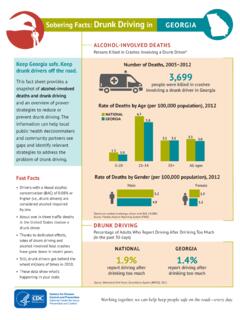
Sobering Facts: Drunk Driving in Georgia
www.cdc.govSobering Facts: Drunk Driving in GEORGIA Keep Georgia safe. Keep drunk drivers off the road. This fact sheet provides a snapshot of alcohol-involved deaths and drunk driving
ALCOHOLS III 1402
www.cdc.govALCOHOLS III: METHOD 1402, Issue 2, dated 15 August 1994 - Page 3 of 4 a. Remove and discard back sorbent section of a media blank sampler. b. Inject a known amount of analyte or DE stock solution directly onto front sorbent section
Fast Facts
www.cdc.govAny person working outdoors is at risk of exposure to poisonous plants, such as poison ivy, poison oak, and poison sumac. When in contact with skin, the sap oil (urushiol) of
Trans Fat: The Facts
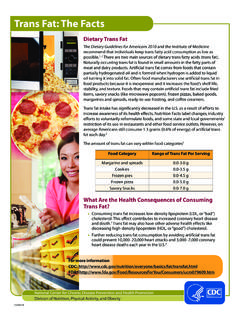
www.cdc.gov• Read the Nutrition Facts label and ingredient list to compare foods. » Choose products with 0 grams trans fat. » Check the Ingredient List to see if there is any partially hydrogenated oil in the product.

ANTIBIOTIC RESISTANCE THREATS
www.cdc.govApr 23, 2013 · 6. ANTIBIOTIC RESISTANCE THREATS IN THE UNITED STATES, 2013. Executive Summary. Antibiotic Resistance Threats in the United States, 2013. is a snapshot of the complex problem
Chlorine Residual Testing
www.cdc.govChlorine Residual Testing Fact Sheet, CDC SWS Project 4 Methods to Test Free Chlorine in the Field in Developing Countries There are three main methods to test free chlorine residual in drinking water in the field
2018 Combined Recommended Immunization …
www.cdc.govRecommended Immunization Schedule for Children and Adolescents Aged 18 Years or Younger, UNITED STATES, 2018 Approved by the Advisory Committee on …
Traveling? Make Sure You Protect Yourself from …
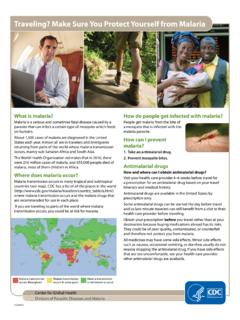
www.cdc.govCS26201 Malaria transmission occurs throughout Malaria transmission occurs in some parts Malaria transmission is not known to occur Center for Global Health
Related documents

Investor Sentiment and the Cross-Section of Stock Returns
people.stern.nyu.eduamine whether cross-sectional predictability patterns in stock returns depend uponproxiesforbeginning-of-periodsentiment.Forexample,lowfuturereturns ... pattern would be averaged away in an unconditional study. We then consider a regression approach, which allows us to control for co-movement in size and book-to-market-sorted stocks using the ...

Calculating Prevalences and Incidences
www.sjsu.eduPrevalence in cross-sectional. c. “Old” cases and “new” cases are counted in the numerator. d. Can be measured at a particular point (point prevalence) or over a period (period prevalence). ... (N )(∆t), where N is average population size and ∆t is the duration of study. For example, a population with an average size of 1000 studied ...
Impact of Procrastination and Time-Management on …
internationaljournalofcaringsciences.orgprocrastination to prepare the students to work in the hospitals. This cross-sectional study focused on assessing the procrastination, time management skills and its relationship with academic stress among 201 undergraduate nursing students in a private college of South India. Finding showed that mean (+ SD) of procrastination was 88.05 (+ 1.19)

Overview of Study Designs - University of California, Davis
health.ucdavis.eduProvide an overview of different types of study designs. Understand the strengths and limitations of each type of study design, as applied to a particular research purpose. Understand key considerations in designing a study, including randomization, matching and blinding. Next Month, will discuss how to choose a statistical
CHECKLIST FOR ANALYTICAL CROSS SECTIONAL STUDIES
jbi.globalAnalytical cross sectional studies Critical Appraisal Tool Answers: Yes, No, Unclear or Not/Applicable 1. Were the criteria for inclusion in the sample clearly defined? The authors should provide clear inclusion and exclusion criteria that they developed prior …
CASP Checklist: 11 questions to help you make ... - COVID19EC
uanalisis.uide.edu.ecSection A: Are the results of the study valid? 1. Did the study address a clearly Yes ☒ HINT: A question can be Zfocused [ focused issue? in terms of • Cant Tell ☐ the health measure(s) studied (e.g., risk factor, preventive behavior, outcome) No ☐ Comments: Se evaluó la disciplina/adherencia a las medidas de prevención y control de

Effect of Sleep Deprivation on the Academic ... - CAIMS
caims.orgResearch Design: Cross sectional design Sample Size: 150 college students Sampling Design: Convenient sampling Source of Data: Data was collected from Acharya Institute of Health Science, Bangalore. Inclusion criteria: • Normal healthy college students • Participants with age group 18-24 years • Students willing to participate in this study
PENELITIAN CROSS SECTIONAL
staff.ui.ac.idCROSS-SECTIONAL? Dikenal juga dengan istilah studi prevalensi: Subyek sekaligus diklasifikasikan sebagai terkena dan tidak terkena kelainan serta terpapar dan tidak terpapar faktor yang diteliti pada waktu yang sama Angka prevalensinya membandingkan antara mereka yang terpapar dan tidak terpapar faktor yang diteliti terhadap kelainan yang diteliti