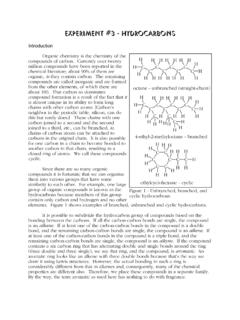
Experiment #3 - Hydrocarbons
Experiment #3 Hydrocarbons Page 4 C 3H 8 + 5 O 2 3 CO 2 + 4 H 2O H 3CCH CHCH 3 H 3CCH CHCH 3 Br Br + H 3CC CCH 3 + H 3CC CCH 3 Br Br Br Br 2 Br 2 Br 2 Natural gas is composed of alkanes; it is about 90% methane with small amounts
Download Experiment #3 - Hydrocarbons

Information
Domain:
Source:
Link to this page:
Documents from same domain

THE SYNTHESIS OF POTASSIUM ALUMINUM …
employees.oneonta.eduTHE SYNTHESIS OF POTASSIUM ALUMINUM SULFATE (Alum) FROM ALUMINUM SCRAP The Chemical Recycling of Scrap Aluminum This experiment has the following objectives:
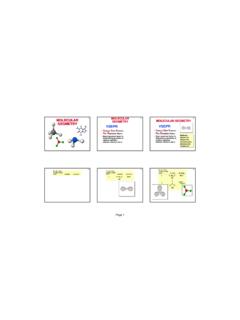
MOLECULAR 1 MOLECULAR GEOMETRY VSEPR …
employees.oneonta.eduPage 3 13 Structure Determination by VSEPR Structure Determination by VSEPR Formaldehyde, CH 2O 1. Draw electron dot structure …

COORDINATION COMPLEXES OF COBALT - Oneonta
employees.oneonta.eduCOORDINATION COMPLEXES OF COBALT Introduction In this lab, you will synthesize two cobalt coordination complexes, [Co(NH3)5(NO2)]Cl2 and [Co(NH3)5(ONO)]Cl2, and investigate linkage isomerism.

Psyc 345: Psychology of Adulthood and Aging Dr …
employees.oneonta.eduPsyc 345: Psychology of Adulthood and Aging Dr. vom Saal Disk file: D: \office zip \handouts \interview -on -relationships.doc , 03 /19 /01 8 :34 PM pa ge 1 of 2

TEACHING TECHNIQUES - Oneonta
employees.oneonta.eduTEACHING TECHNIQUES 2 Progression of Commands - The steps in the development of a unit look something like this... a. Simple actions (“walk”, “jump”)

Chem 226 — Problem Set #2 — edition, John …
employees.oneonta.eduH2CCHCH2CH2CH2CH2CH3 CC H C CCC C H H H H H H H H H H H H H This is one possible isomer. This Lewis structure can be condensed in a number of ways as shown here. H2CCH(CH2)4CH3 Some other isomers --Note: The boxed structures are identical; they are the same molecule.
AB titration expt - Oneonta
employees.oneonta.eduACID-BASE TITRATION Form A The Molar Mass of an Unknown, Diprotic Acid Titration is the process for ascertaining the exact volume of one solution that is chemically equivalent to a given amount of another substance,

Chapter 4 Chemical Reactions and Solution Stoichiometry
employees.oneonta.eduChapter 4 Chemical Reactions and Solution Stoichiometry - 3 - Interactive Figure 4.1.2 Explore combination reactions. Zinc reacts with iodine to form zinc iodide.

Minitab@Oneonta.Manual
employees.oneonta.eduThe inclusion of Minitab Statistical Software input and output contained in this manual is done with permission of Minitab, Inc. Screen shots were taken from Minitab version 13.0. For additional documentation, FAQ’s, etc. go to Minitab’s web

Experiment #6 – Isolation of Caffeine from Tea Leaves
employees.oneonta.eduExperiment #6 Isolation of Caffeine from Tea Leaves Page 4 Hirsh funnel Micro filter flask Filter paper Fritted polyethylene disk 6. Allow the contents of the separatory funnel to settle.
Related documents

HYDROCARBONS 365 - National Council Of …
ncert.nic.inHYDROCARBONS 365 UNIT 13 After studying this unit, you will be able to • name hydrocarbons according to IUPAC system of nomenclature; • recognise and write structures

II Alkanes, Alkenes, and Alkynes
web.chemistry.gatech.edu9 2.1.3 Properties of Alkanes • Melting and boiling points increase with increased molecular weight (Methane bp.-164 °C, decane bp. 174 °C) • Boiling point decrease with chain branching (decrease in surface area) but metling

An Introduction to Organic Chemistry - cffet.net
www.cffet.netIntroduction to Organic Chemistry Chem. Nat. Substances p3 An Introduction to Organic Chemistry Organic chemistry is the study of carbon containing compounds and their properties.
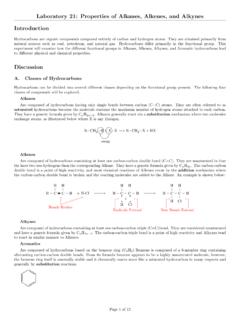
Laboratory 21: Properties of Alkanes, Alkenes, and …
www.chemhaven.orgLaboratory 21: Properties of Alkanes, Alkenes, and Alkynes Procedure A. Combustion 1.Perform the following test in the hood (be sure the hood is turned on).
Chemistry - Chhatrapati Shahu Ji Maharaj University, …
www.kanpuruniversity.orgSolids in liquids (sols): properties – kinetic, optical and electrical; stability of colloids, protective action, Hardy-Schulze law, gold number.
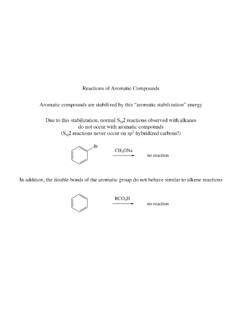
Reactions of Aromatic Compounds Aromatic …
www.utdallas.eduThe properties of this arenium ion therefore control electrophilic aromatic substitutions! (just like any reaction consider the stability of the intermediate !
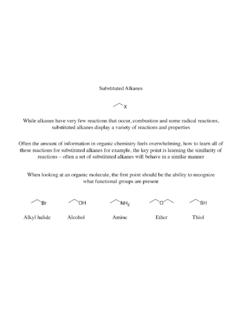
Substituted Alkanes - The University of Texas at …
www.utdallas.eduSubstituted Alkanes! While alkanes have very few reactions that occur, combustion and some radical reactions, substituted alkanes display a variety of reactions and properties!
Rolling Revision of the WHO Guidelines for …
www.who.int1 WHO/SDE/WSH/04.08/123 Rolling Revision of the WHO Guidelines for Drinking-Water Quality Draft for review and comments (Not for citation) Petroleum oils in drinking-water
Related search queries
Hydrocarbons, Alkanes, Alkenes, Properties of Alkanes, Introduction to Organic Chemistry, Properties, Laboratory 21: Properties of Alkanes, Alkenes, and, Chemistry, Reactions of Aromatic Compounds Aromatic, Substituted alkanes, University of Texas at, Revision of the WHO Guidelines, Revision of the WHO Guidelines for Drinking-Water Quality