Explicit Systematic Phonics
• Task 1—The ability to hear rhymes and alliteration a. rhyme Example: I once saw a cat, sitting next to a dog. I once saw a bat, sitting next to a frog. b. alliteration Example: Six snakes sell sodas and snacks. c. assonance Example: The leaf, the bean, the peach—all were within reach. • Task 2—The ability to do oddity tasks a. rhyme
Download Explicit Systematic Phonics

Information
Domain:
Source:
Link to this page:
Documents from same domain
Most Common Prefixes - Scholastic
teacher.scholastic.comMost Common Suffixes Copyright © Scholastic Inc. All rights reserved. This page may be photocopied for use with students. red_c2_ar_l04_commsuf
Rikki Tikki Tavi - Scholastic
teacher.scholastic.comRIKKI-TIKKI-TAVI by Rudyard Kipling, ill. by Jerry Pinkney (William Morrow) Themes: Courage/Animals Grade Level: K – 3 Running Time: 30 minutes SUMMARY
The Story of Ferdinand - teacher.scholastic.com
teacher.scholastic.comThe Story of Ferdinand 5 Word Scramble Directions: Unscramble the words below.To help the students you might consider demonstrating the …
NCTE and IRA Standards for the English Know & Grow
teacher.scholastic.comNCTE and IRA Standards for the English Language Arts: www.ncte.org/about/over/standards/118046.htm McREL Language Arts Standards: www.mcrel.com/compendium ...
Cloud Observations - Scholastic
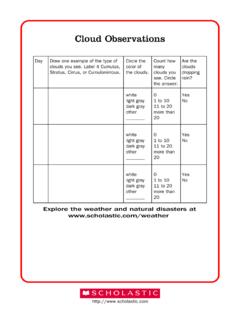
teacher.scholastic.comhttp://www.scholastic.com Cloud Observations Day Explore the weather and natural disasters at www.scholastic.com/weather Draw one example of the type of
THE NIGHT BEFORE CHRISTMAS - Scholastic
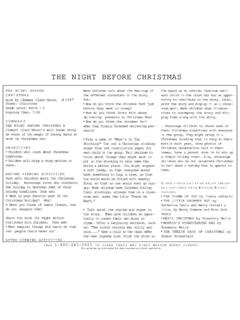
teacher.scholastic.comTHE NIGHT BEFORE CHRISTMAS THE NIGHT BEFORE CHRISTMAS Book by Clement Clark Moore, ©1997 Theme: Christmas Grade Level: Pre-K - 2 Running Time: 7:00 SUMMARY THE NIGHT BEFORE CHRISTMASis Clement Clark Moore’s well known story in verse of the magic of seeing Santa at work on Christmas Eve. OBJECTIVES • Children will learn about Christmas
CORRELATION SUNSHINE STATE STANDARDS SUBJECT: …
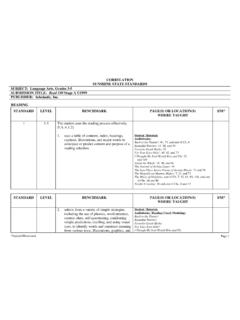
teacher.scholastic.comFavorite Greek Myths: 52 For Your Eyes Only!: 40, 42, and 73 I Thought My Soul Would Rise and Fl y: 22 and 149 Jonah the Whale: 11, 30, and 64 The Journal of Joshua Loper: 44 The Last -Place Sports Poems of Jeremy Bloom: 71 and 76 The Magnificent Mummy Maker: 7, 31, and 71
Performance Standards Learning Standards READ 180 …
teacher.scholastic.comBeautiful Warrior: 11, and end of Folio 15 Favorite Greek Myths: 45 For Your Eyes Only!: 6 I Thought My Soul Would Rise and Fly: 9, 43, 144, 164,

Unlocking the meaning of Shakespeare’s metaphors.
teacher.scholastic.comDevelop students’ understanding of figurative language by asking them to interpret, extend, and create m e t a p h o r s . A metaphor is a figure of speech in
The Wheels On The Bus - Scholastic
teacher.scholastic.comthe song, “The Wheels on the Bus.” Using ideas from the video, help students design props and assign them to be different characters, such as, the driver, the mommies, the riders, etc. All of the children can participate in the chorus. Other videos based on songs available from We ston Woods are:
Related documents
The Highwayman Poem Analysis
cpb-ca-c1.wpmucdn.comdevices can be found as well such as alliteration, consonance and onomatopoeia. Some examples of alliteration include, “ghostly galleon”, “breeches of brown,” and “she stood up, straight and still,” whereas “press me sharply, and harry me through,” displays consonance due
Elements of Poetry - University of New Mexico
www.unm.eduElements of Poetry Alliteration is a repetition of the same consonant sounds in a sequence of words, usually at the beginning of a word or stressed syllable: “descending dew drops;” “luscious lemons.” Alliteration is based on the sounds of letters, rather …
GCSE (9-1) English Language - Pearson qualifications
qualifications.pearson.comreaders by using alliteration 'Subtle, stylish business'. This engages the reader by making MI6 sound interesting and exciting. Another way the writer uses language and structure to engage the reader is by using formal language. 'Managed to conceal his clandestine life'. Using formal language was appropriate for the
Beowulf: An Anglo-Saxon Epic Poem - English 12
english12hamlinhighschool.weebly.comthe alliteration; and the last accented syllable alliterates only sporadically. Alternate alliteration is occasionally used as in the original. (See 7 61, 8 5.) No two accented syllables have been brought together, except occasionally after a cæsural pause. (See 2 19 and 12 1.) Or, scientifically
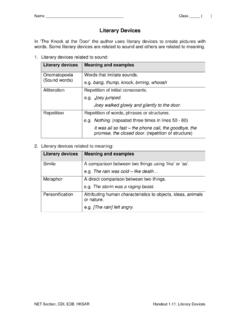
Literary devices Meaning and examples
www.edb.gov.hkAlliteration Repetition of initial consonants. e.g. Joey jumped. Joey walked slowly and silently to the door. Repetition Repetition of words, phrases or structures. e.g. Nothing. (repeated three times in lines 50 - 60) It was all so fast – the phone call, the goodbye, the promise, the closed door. (repetition of structure) 2.
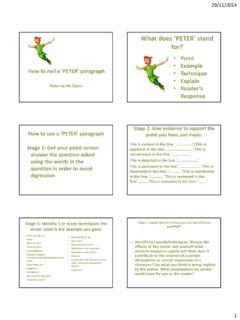
How to nail a ‘PETER’ paragraph
bailieborocslibrary.weebly.comTECHNIQUE Point out and identify a Technique the writer used in Your example. Give evidence to support and To help prove your point. It is good because it can get you a higher
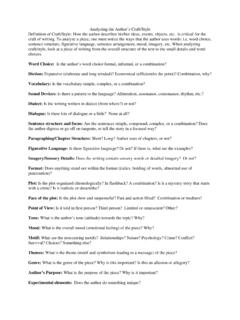
Analyzing the Author’s Craft/Style
www.npsri.netAlliteration, assonance, consonance, rhythm, etc.? Dialect: Is the writing written in dialect (from where?) or not? Dialogue: Is there lots of dialogue or a little? None at all? Sentence structure and focus: Are the sentences simple, compound, complex, or a combination? Does the author digress or go off on tangents, or tell the story in a ...
Second Grade - Mississippi Department of Education
www.mdek12.orgbeats, alliteration, rhymes, repeated lines) authors use to convey their message and make writing more appealing to the reader. A student should be able to do (Evidence of Knowledge) Demonstrate the use of context clues to determine meanings of unknown words and phrases in text. Describe how language choice impacts and creates meaning in text.
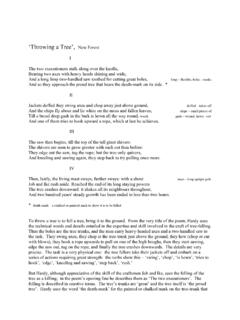
‘Throwing a Tree’, - Hardy Society
www.hardysociety.orgAlliteration – several words starting with the same letter or sound, for example, ‘bleared and black and blind’. Assonance – same vowel sound in different words, for example, ‘abode’, ‘sloped’. Cesura – a break or pause in the middle of a line of poetry.