Fuel properties - UPM
Fuel pyrolysis..... 20 FUEL PROPERTIES Fuels, as for any other type of substance, can be assigned some physical and chemical properties (e.g. density, thermal capacity, vapour pressure, chemical formula, etc. ... originally obtained from crude-oil distillation (petrodiesel), but alternatives are increasingly being developed for partial or total ...
Download Fuel properties - UPM

Information
Domain:
Source:
Link to this page:
Documents from same domain
Thermal effects on materials - UPM
webserver.dmt.upm.esThermal effects on materials 2 THERMAL EFFECTS In the broad sense, thermal effects are those caused by a redistribution of internal energy in a system, and
MAGNITUDES, UNIDADES Y MEDIDA - Portal del DMT
webserver.dmt.upm.esMagnitudes, unidades y medida 3 cifras y tal vez un decimal o dos. Así, la masa de las piedras preciosas se medía en quilates (no confundir
NOZZLES - UPM
webserver.dmt.upm.esNozzles 2 • There is viscous dissipation within the boundary layer, and erosion of the walls, what can be critical if the erosion widens the throat cross-section, greatly reducing exit-area ratio and
Properties of solutions - UPM
webserver.dmt.upm.esProperties of some particular solutions 3 Four solidphases appear in this phase diagram (and only one liquid phase). Besides H 2O(s) and NaCl(s), the di-hydrate NaCl·2H
THERMODYNAMICS OF SOLUTIONS - UPM
webserver.dmt.upm.esThermodynamics of solutions 2 suspensions, treated under the heading . Reacting mixtures are covered in Mixture settling Chemical reactions, aside.
HEAT AND MASS TRANSFER - UPM
webserver.dmt.upm.esHeat and mass transfer page 2 moment about mass transfer (dealt with separately under ), and concentrate on the simpler Mass Transfer problem of heat transfer.
MASS DIFFUSION - UPM
webserver.dmt.upm.esMass diffusion page 3 • Radiation. First of all, from the three heat transfer modes (conduction, convection, and radiation), only the two first are considered in mass transfer (diffusion and convection), radiation of material
Termodinámica del volumen de control - webserver.dmt.upm.es
webserver.dmt.upm.esCapítulo 5 Termodinámica del volumen de control Ecuaciones generales aplicadas a un volumen de control La elección del sistema termodinámico puede interesar ...
openings - UPM
webserver.dmt.upm.esHeat exchangers page 3 Fig. 1. Types of heat exchanges: a) shell-and-tube, b) plates, c) open-flow, d) rotating-wheel. Additionally, heat exchangers may be classified according to the type of …
Heat transfer and thermal modelling - UPM
webserver.dmt.upm.esHeat transfer and thermal radiation modelling page 3 geometry to an ideal geometry (assuming perfect planar, cylindrical or spherical surfaces, or a set of
Related documents
What’s the Difference between Biodiesel and Renewable ...
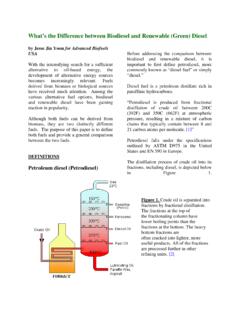
www.advancedbiofuelsusa.infoMar 11, 2011 · pyrolysis, rapid thermal processing) “Renewable Diesel” Process Thermal depolymerization is another process that can convert biomass or other carbon-containing material into a “bio-oil” that is then refined into a petrodiesel-like fuel. Conversion temperatures are typically 570-660 degrees Fahrenheit with a pressure

CHAPTER 9 RENEWABLE ENERGY SUPPLY - UNFCCC
unfccc.intthe rate of formation. For coal, oil, and natural gas, the ratio of time between formation and use is on the order of 1 million to one: that is, the world uses in one year what took natural processes one million years to create. Only biomass among these stored forms has a time ratio that is within a human time frame of years or decades.
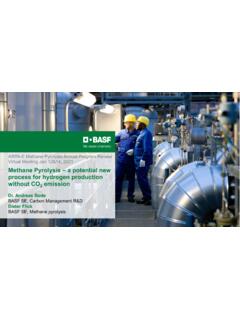
Methane Pyrolysis – a potential new process for hydrogen ...
arpa-e.energy.govMethane pyrolysis using grey electricity and natural gas would apply for blue certification Green electricity and biogas for . Source: F. Barth “ CertifHy – green certification Developing a European guarantee of origin scheme for green hydrogen. CertifHy.eu, 05.11.2019 | …

An Introduction to Biomass Thermochemical Conversion
www.nrel.govPOTENTIAL BIOMASS PRODUCTS • Potential Biomass Products • Biomass • Syngas • Hydrogen • Pyrolysis Oil – Whole or Fractionated • Hydrothermal Treatment Oils • Biomass • Solid • CH 1.4O 0.6 • HHV = 16 – 17 MBTU/ton (MAF) • Syngas • Major components – CO, H 2, CO 2 • CO/H 2 ratio set by steam rate in conditioning step, typical range 0.5 – 2 • HHV: 450 …

Tyre safety for earth-moving machinery on Western ...
www.dmp.wa.gov.au• pyrolysis or diffusion — leading to explosions. 3.2 Compressed air Compressed air poses a significant injury risk to workers, ... ) should . always be worn to protect workers from injury by high-velocity air jets, as well as particles of dust, metal, oil and other debris that can be mobilised by a high-velocity air stream. Overalls and ...
Renewable Diesel Fuel - Energy
cleancities.energy.gov4 RD and Biodiesel •Biodiesel is solely produced through esterification of fats/oils •RD can be produced through multiple processes o Hydrogenation (hydrotreating) of fats/oils/esters o Fermentation of sugar o Co-processing with petroleum o Biomass pyrolysis/hydrotreating o Catalytic upgrading of sugar o Biomass-to-liquids (FT diesel) o Biogas-to-liquids (GTL/FT diesel)
Plastic Waste Management - NPC
www.npcindia.gov.inFigure 4: Process block diagram for Conversion of plasc waste into fuel-oil 19 Figure 5: Process Flow Diagram of Plasma Pyrolysis for Disposal of Plasc Waste 21. The rapid rate of urbanizaon and development has led to increase in consumpon of plasc

The #H2IQ Hour
www.energy.gov• Reforming, pyrolysis, air separation, catalysts, CCS, upstream emissions . Advanced Pathways . Photelectrochemical (PEC), thermochemical, biological, etc. *2020 Baseline: PEM (Polymer Electrolyte Membrane) low volume capital cost ~$1,500/kW, electricity at $50/MWh. Pathways to t argets include capital cost

Plastics-to-Oil: Conversion Technology—A Complement to ...
www.polymerinnovationblog.comfacilities that use pyrolysis technology to convert plastics into oil and fuel are being established in Europe and Asia. The benefits presented by plastic to fuel (PTF) technologies are two-fold: transforming non-recycled plastic into a valuable commodity, and creating a reliable source of alternative energy from an abundant, no-cost feedstock.