Generative Adversarial Imitation Learning
networks [8], a technique from the deep learning community that has led to recent successes in modeling distributions of natural images: our algorithm harnesses generative adversarial training to fit distributions of states and actions defining expert behavior. We test our algorithm in Section 6, where
Download Generative Adversarial Imitation Learning

Information
Domain:
Source:
Link to this page:
Documents from same domain
Prototypical Networks for Few-shot Learning
proceedings.neurips.cc˚: RD!RMwith learnable parameters ˚. Each prototype is the mean vector of the embedded support points belonging to its class: c k= 1 jS kj X (x i;y i)2S k f ˚(x i) (1) Given a distance function d: R M R 
Inductive Representation Learning on Large Graphs
proceedings.neurips.ccnode classification, clustering, and link prediction [11, 28, 35]. ... (e.g., citation data with text attributes, biological data with functional/molecular markers), our approach can also make use of structural features that are present in all graphs (e.g., node degrees). ... through theoretical analysis, that GraphSAGE is capable of learning ...
Bootstrap Your Own Latent A New Approach to Self ...
proceedings.neurips.ccmining strategies [14, 15] to retrieve the nega-tive pairs. In addition, their performance criti-cally depends on the choice of image augmenta- ... to prevent collapsing while preserving high performance. To prevent collapse, a straightforward solution …
Spatial Transformer Networks - NeurIPS
proceedings.neurips.ccConvolutional Neural Networks define an exceptionally powerful class of models, ... localisation, semantic segmentation, and action recognition tasks, amongst others. ... can take any form, such as a fully-connected network or a convolutional network, but should include a final regression layer to produce the transformation ...
Semi-supervised Learning with Deep Generative Models
proceedings.neurips.ccapproximately invariant to local perturbations along the manifold. The idea of manifold learning ... We show for the first time how variational inference can be brought to bear upon the prob- ... probabilities are formed by a non-linear transformation, with parameters , of a set of latent vari-ables z. This non-linear transformation is ...
Unsupervised Learning of Visual Features by Contrasting ...
proceedings.neurips.ccpseudo-labels to learn visual representations. This method scales to large uncurated dataset and can be used for pre-training of supervised networks [7]. However, their formulation is not principled and recently, Asano et al. [2] show how to cast the pseudo-label assignment problem as an instance of the optimal transport problem.
PyTorch: An Imperative Style, High-Performance Deep ...
proceedings.neurips.ccFacebook AI Research benoitsteiner@fb.com Lu Fang Facebook lufang@fb.com Junjie Bai Facebook jbai@fb.com Soumith Chintala Facebook AI Research soumith@gmail.com Abstract Deep learning frameworks have often focused on either usability or speed, but not both. PyTorch is a machine learning library that shows that these two goals
Visualizing the Loss Landscape of Neural Nets
proceedings.neurips.cctask that is hard in theory, but sometimes easy in practice. Despite the NP-hardness of training general neural loss functions [3], simple gradient methods often find global minimizers (parameter configurations with zero or near-zero training loss), even when data and labels are randomized before training [43].
InfoGAN: Interpretable Representation Learning by ...
proceedings.neurips.ccof the digit (0-9), and chose to have two additional continuous variables that represent the digit’s angle and thickness of the digit’s stroke. It would be useful if we could recover these concepts without any supervision, by simply specifying that an MNIST digit is generated by an 1-of-10 variable and two continuous variables.

Learning Structured Output Representation using Deep ...
proceedings.neurips.ccposterior inference. However, the parameters of the VAE can be estimated efficiently in the stochas-tic gradient variational Bayes (SGVB) [16] framework, where the variational lower bound of the log-likelihood is used as a surrogate objective function. The variational lower bound is written as: logp (x) = KL(q ˚(zjx)kp (zjx))+E q ˚(zjx) logq ...
Related documents
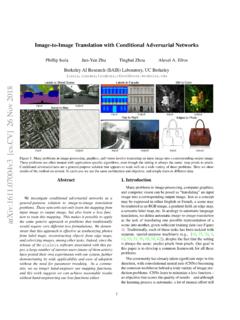
Labels to Street Scene Labels to Facade BW to Color
arxiv.orgexactly what is done by the recently proposed Generative Adversarial Networks (GANs) [24,13,44,52,63]. GANs learn a loss that tries to classify if the output image is real or fake, while simultaneously training a generative model to minimize this loss. Blurry images will not be tolerated since they look obviously fake. Because GANs learn a loss

Deep Learning on Graphs - Michigan State University
cse.msu.edu9.3 Recurrent Neural Networks on Graphs 191 9.4 Variational Autoencoders on Graphs 193 9.4.1 Variational Autoencoders for Node Represen-tation Learning 195 9.4.2 Variational Autoencoders for Graph Generation 196 9.5 Generative Adversarial Networks on Graphs 199 9.5.1 Generative Adversarial Networks for Node Representation Learning 200
Wasserstein Generative Adversarial Networks
proceedings.mlr.pressWasserstein Generative Adversarial Networks Figure 1: These plots show ˆ(P ;P 0) as a function of when ˆis the EM distance (left plot) or the JS divergence (right plot).The EM plot is continuous and provides a usable gradient everywhere.
Self-Attention Generative Adversarial Networks
proceedings.mlr.pressSelf-Attention Generative Adversarial Networks Figure 1. The proposed SAGAN generates images by leveraging complementary features in distant portions of the image rather than local regions of fixed shape to generate consistent objects/scenarios. In each row, the first image shows five representative query locations with color coded dots.
NANODEGREE PROGRAM SYLLABUS Deep Learning
d20vrrgs8k4bvw.cloudfront.netZhu, inventors of types of generative adversarial networks, as well as AI experts, Sebastian Thrun and Andrew Trask. For anyone interested in this transformational technology, this program is an ideal point-of-entry. The program is comprised of 5 courses and 5 projects. Each project you build will be an opportunity to
ESRGAN: Enhanced Super-Resolution Generative Adversarial ...
openaccess.thecvf.comESRGAN: EnhancedSuper-Resolution Generative Adversarial Networks Xintao Wang 1, Ke Yu , Shixiang Wu2, Jinjin Gu3, Yihao Liu4, Chao Dong 2, Yu Qiao , and Chen Change Loy5 1 CUHK-SenseTime Joint Lab, The Chinese University of Hong Kong 2 Shenzhen Institutes of Advanced Technology, Chinese Academy of Sciences 3 The Chinese University of Hong Kong, …

CartoonGAN: Generative Adversarial Networks for Photo ...
openaccess.thecvf.comis to use Generative Adversarial Networks (GANs) [9, 34], which produce state-of-the-art results in many applications suchastexttoimagetranslation[24],imageinpainting[37], image super-resolution [19], etc. The key idea of a GAN model is to train two networks (i.e., a generator and a dis-criminator) iteratively, whereby the adversarial loss pro-
Generative Adversarial Nets - NIPS
papers.nips.ccGenerative adversarial networks has been sometimes confused with the related concept of “adversar-ial examples” [28]. Adversarial examples are examples found by using gradient-based optimization directly on the input to a classification network, in order to find examples that are similar to the data yet misclassified.
Time-series Generative Adversarial Networks
papers.nips.ccA good generative model for time-series data should preserve temporal dynamics, in the sense that new sequences respect the original relationships between variables across time. Existing methods that bring generative adversarial networks (GANs) into the sequential setting do not adequately attend to the temporal correlations unique to time ...