GRAPH THEORY WITH APPLICATIONS
of figure 1.3 are. Much of graph theory is concerned with the study of simple graphs. We use the symbols v(G) and e(G) to denote the numbers of vertices and edges in graph G. Throughout the book the letter G denotes a graph. Moreover, when just one graph is under discussion, we usually denote this graph by G.
Download GRAPH THEORY WITH APPLICATIONS

Information
Domain:
Source:
Link to this page:
Documents from same domain
Bash Guide for Beginners - Université de Montréal
www.iro.umontreal.caBash Guide for Beginners Machtelt Garrels CoreSequence.com <tille@coresequence.com> Version 1.0 Last updated 20040426 Edition
Extracting and Composing Robust Features with Denoising ...
www.iro.umontreal.caExtracting and Composing Robust Features with Denoising Autoencoders Pascal Vincent, Hugo Larochelle, Yoshua Bengio, Pierre-Antoine Manzagol Dept. IRO, Universit´e de Montr´eal

Système d’Exploitation et Outils de programmation
www.iro.umontreal.cadonnées partagés, canaux de communication ... Liste d’espace libre. 35 Exemple Allocation par blocs chaînes (DOS/Windows) L’ensemble des chaînages des blocs de fichiers est regroupé dans une table FAT(File Allocation Table) Nombre d’entrées = Nombre de blocs de données sur
Les équipements d’interconnexion - Université de Montréal
www.iro.umontreal.caIFT3320/IFT6320 – Hiver 2003 B. Jaumard 14 Le pont (bridge) Couche liaison: transmission sans erreur d’une trame entre deux stations partageant le même support de transmission Pont = relais, permet de relier deux réseaux de technologies liaison différentes, e.g., Ethernet, Token
SLIC Superpixels - Université de Montréal
www.iro.umontreal.caof pixels, using graph cuts on strips of the image. While SL08 allows control of the size, number, and compactness of the superpixels, the quality and speed of the output strongly depend on pre-computed boundary maps.
Introduction aux circuits logiques de base
www.iro.umontreal.ca•Support théorique – algèbre de Boole •Les fonctions de sortie s’expriment selon des expressions logiques des seules variables d’entrée –Un circuit combinatoire est défini par une ou plusieurs fonctions logiques Entrées Circuit Combinatoire Sorties.
Représentation des nombres flottants
www.iro.umontreal.caIEEE 754, Représentation de l’exposent •Constante k d’excentrement appliquée à l’exposant •Simple précision: +127 10 •Double précision: +1023 10 •L’exposant c codé en interne •±c + 127 10 •±c + 1023 10 •Ex., – k = 127 10, •Exposant: •Représentation: 100001112 …
Représentation des nombres entiers
www.iro.umontreal.ca• Représentation binaire sur n bits • 6 : 0 0 0 1 1 0 ( 6 b i t s ) • Nombre négatif –N 1. Soustraire la valeur au modulus 2. Complément à 1 de son équivalent positif ,+N, et ajouter 1 • Inverser tous les bits 0 1 et 1 0 dans la représentation binaire de +N sur n bits et ajouter la valeur 1
Les entrées/sorties Les périphériques
www.iro.umontreal.caCe sont des bus simples constitués d'autant de fils qu'il y a de bits à transporter. Ces bus sont coûteux et peu fiables pour des distances importantes. Ils sont utilisés sur des distances courtes, par exemple, pour relier le processeur, la mémoire et les unités d'échanges. Les bus série
SPARQL By Example: The Cheat Sheet
www.iro.umontreal.caConventions Red text means: “This is a core part of the SPARQL syntax or language.” Blue text means: “This is an example of query-specific text or values that might go into a SPARQL query.”
Related documents
An Introduction to Combinatorics and Graph Theory
www.whitman.eduAny graph produced in this way will have an important property: it can be drawn so that no edges cross each other; this is a planar graph. Non-planar graphs can require more than four colors, for example this graph:. This is called the complete graph on ve vertices, denoted K5; in a complete graph, each vertex is connected to each of the others.
Graph Theory Lecture Notes
www.personal.psu.eduChapter 1. Introduction to Graph Theory1 1. An Overview of Graph Theory1 2. Graphs, Multi-Graphs, Simple Graphs2 3. Directed Graphs7 4. Elementary Graph Properties: Degrees and Degree Sequences9 5. Subgraphs14 6. Graph Complement, Cliques and Independent Sets15 Chapter 2. More De nitions and Theorems19 1. Paths, Walks, and Cycles19 2.

Spectral and Algebraic Graph Theory
cs-www.cs.yale.eduI Introduction and Background1 1 Introduction 2 2 Eigenvalues and Optimization: The Courant-Fischer Theorem21 3 The Laplacian and Graph Drawing27 4 Adjacency matrices, Eigenvalue Interlacing, and the Perron-Frobenius Theorem32 5 Comparing Graphs39 II The Zoo of Graphs46 6 Fundamental Graphs47 7 Cayley Graphs 55 8 Eigenvalues of Random Graphs63
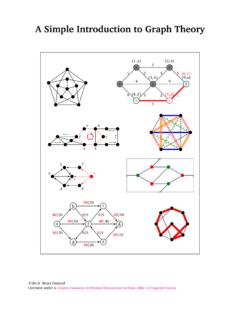
A Simple Introduction to Graph Theory - Brian Heinold
www.brianheinold.netJun 16, 2018 · A Simple Introduction to Graph Theory a b (1,a) c (8,d) d (3, b) e ... These are notes I wrote up for my graph theory class in 2016. They contain most of the topics typically found in a graph theory course. There are proofs of a lot of the results, but not of everything. ... A complete graph is a simple graph in which every vertex is adjacent ...

Lecture Notes on GRAPH THEORY
cs.bme.huR.J. WILSON, “Introduction to Graph Theory”, Longman, (3rd ed.) 1985. In theselectures we study combinatorial aspects of graphs.For more algebraic topics and methods,see

5 Graph Theory - MIT OpenCourseWare
ocw.mit.edu5 Graph Theory Informally, a graph is a bunch of dots and lines where the lines connect some pairs of dots. An example is shown in Figure 5.1. The dots are called nodes (or vertices) and the lines are called edges. c h i j g e d f b Figure 5.1 An example of a …
Graph Theory - KIT
www.math.kit.eduGraph Theory Lecture by Prof. Dr. Maria Axenovich ... Daniel Hoske and Torsten Ueckerdt 1. Contents 1 Introduction 3 2 Notations 3 3 Preliminaries 4 4 Matchings 13 5 Connectivity 17 6 Planar graphs 22 7 Colorings 27 8 Extremal graph theory 30 9 Ramsey theory 34 ... is an arbitrary (undirected, simple) graph n:= jVjis its number of vertices m ...
Graph Theory - KIT
www.math.kit.eduIntroduction These notes include major de nitions, theorems, and proofs for the graph theory course given by Prof. Maria Axenovich at KIT during the winter term 2019/20.
Graph Theory - Tutorialspoint
www.tutorialspoint.comGraph Theory 3 A graph is a diagram of points and lines connected to the points. It has at least one line joining a set of two vertices with no vertex connecting itself. The concept of graphs in graph theory stands up on some basic terms such as point, line, vertex, edge, degree of vertices, properties of graphs, etc.