
HPLC Troubleshooting Cover
phase or they may be strongly adsorbed. As you inject more and more samples, these contaminants build up on the top of the column and prevent the sample to properly adsorb and distribute. This results in a distortion of the peak profile. Often this problem is accompanied by an increase in back pressure. Q.: OK, that could be it.
Download HPLC Troubleshooting Cover

Information
Domain:
Source:
Link to this page:
Documents from same domain

Basics of LC/MS (5988-2045EN) - University of …
ccc.chem.pitt.eduContents Why Liquid Chromatography/Mass Spectrometry? 4 Instrumentation 6 Ion Sources 6 Electrospray ionization 7 Atmospheric pressure chemical ionization 8
Reversed-phase HPLC Bu ers
ccc.chem.pitt.edu9 Reversed-phase HPLC Bu!ers High-quality bu!ers (solutions, solids or concentrates) Shyam Verma shyam.verma@sial.com Consideration of …
Drying of Organic Solvents: Quantitative …
ccc.chem.pitt.eduDOI: 10.1021/jo101589h J. Org. Chem. XXXX, XXX, 000–000 A rXXXX American Chemical Society pubs.acs.org/joc Drying of Organic Solvents: Quantitative Evaluation of the ...
NMR Chemical Shifts of Trace Impurities: Common …
ccc.chem.pitt.eduNMR Chemical Shifts of Common Laboratory Solvents as Trace Impurities Hugo E. Gottlieb,* Vadim Kotlyar, and Abraham Nudelman* Department of Chemistry, Bar …
E cient Conversion of HPLC Instruments between Normal ...
ccc.chem.pitt.edu6 Liquid Chromatography sigma-aldrich.com/hplc ORDER: 800-247-6628 (US ONLY) / 814-359-3441 Reporter 28.5 E!cient Conversion of HPLC Instruments between

Incompatibilities of concentrated nitric acid: Never mix ...
ccc.chem.pitt.eduGroup 11: Olefins (cont.) Propylene tetramer (dodecene) 1-Tetradecene 1-Tridecene Turpentine 1-Undecene Group 12: Petroleum Oils Asphalt Gasolines Casingead Automotive Aviation Jet Fuels JP-1 (kerosene) JP-3 JP-4 JP-5 (kerosene, heavy) Kerosene Mineral spirits Naphtha (non aromatic) Naphtha Solvent Stoddard solvent VM&P Oils Absorption oil

1. The Wittig Reaction - CCC/UPCMLD
ccc.chem.pitt.eduFeb 12, 2007 · ratios that depend on the level of stabilization (charge delocalization) of the ylide. The Wittig reaction must involve a mechanism other than the betaine pathway. A synchronous ... An interplay of 1,2- and 1,3-steric interactions decides which diastereomeric oxaphosphetane will be favored. It is important to recall,
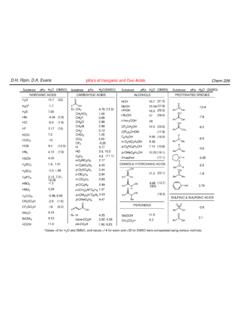
D.H. Ripin, D.A. Evans pKa's of Inorganic and Oxo-Acids ...
ccc.chem.pitt.eduD.H. Ripin, D.A. Evans 19-20 9 13 11 24.5 H2 ~36 *Values <0 for H2O and DMSO, and values >14 for water and >35 for DMSO were extrapolated using various methods. HCCH Substrate SubstrateSubstrate pKa H2O (DMSO) Substrate AMIDES HYDROCARBONS pKa H2OH(DMSO) pKa pKa2O (DMSO) H2O (DMSO) CH4 CH2=CHCH3 PhH CH2=CH2 PhCH3 …
Related documents

Chapter 8 - Above-Ground Applications for PE Pipe
plasticpipe.orgbe adsorbed which depends on the nature of the hydrocarbon and the temperature of the service. This effect on long-term strength is generally limited because hydrocarbon adsorption does not attack PE’s chemical structure. Further, it should be noted that adsorption may slowly reverse when exposure to the hydrocarbon is decreased or removed.

Surface Area and Porosity - Iowa State University
www.cif.iastate.eduPhysical Adsorption Characterization via Adsorption Material Characterization • Physical properties • Differentiate Gas Adsorption • Quantity adsorbed on a surface as a function of pressure, volume, and temperature • Modeled properties • Surface area • Pore structure • Non-destructuve 5 6 Tuesday, December 4, 12
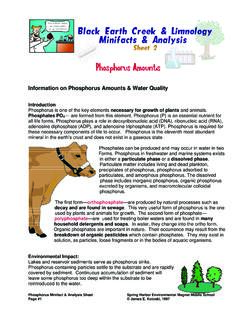
Information on Phosphorus Amounts & Water Quality
osse.ssec.wisc.eduprecipitates of phosphorus, phosphorus adsorbed to particulates, and amorphous phosphorus. The dissolved phase includes inorganic phosphorus, organic phosphorus excreted by organisms, and macromolecular colloidal phosphorus. The first form—orthophosphate—are produced by natural processes such as decay and are found in …
BOOSTRIX (Tetanus Toxoid, Reduced Diphtheria Toxoid and ...
gskpro.comToxoids Adsorbed (Td). BOOSTRIX may be administered as an additional dose 9 years or more after the initial dose of Tetanus Toxoid, Reduced Diphtheria Toxoid and Acellular Pertussis Vaccine Adsorbed (Tdap). (2.2) • BOOSTRIX may be administered for tetanus prophylaxis for wound management. For management of a tetanus-prone wound, a dose of

Commonly Administered Pediatric Vaccines
health.maryland.govCommonly Administered Pediatric Vaccines . Updated 8/1/2019 . CPT® Code Separately report the administration with CPT® codes 90460 -90461or 90471 90474 [See Table Below] Manufacturer Brand # of Vaccine

Vaccine Manufacturer/Distributor ontact ist
www.cdc.govDistributor for anthrax vaccine adsorbed (AVA), diphtheria antitoxin, smallpox vaccine CSL Limited (Merck distributor)
Surface Chemistry - NCERT
www.ncert.nic.inadsorbed by the charcoal. (iv) The air becomes dry in the presence of silica gel because the water molecules get adsorbed on the surface of the gel. It is clear from the above examples that solid surfaces can hold the gas or liquid molecules by virtue of adsorption. The process of removing an adsorbed substance from a surface on which it is

UPS Chemical Table - 49 CFR Version (Ground and Air …
www.ups.comAdsorbed gas, flammable, n.o.s. ‡ 2.1 UN3510 FLAMMABLE GAS YES FLAMMABLE GAS Forbidden Forbidden 30 kg None 302c Adsorbed gas, …
CHEM 344 Thin Layer Chromatography
www2.chem.wisc.eduweakly adsorbed, its solvating power alone may be insufficient to move any compounds fast enough to effect separation. Ideally, the affinity of the eluting solvent for the adsorbent is comparable to the compounds being separated causing different compounds to move at different rates resulting in