
Importance Sampling - Statistics
importance sampling is useful here. In other cases, such as when you want to evaluate E(X) where you can’t even generate from the distribution of X, importance sampling is necessary. The final, and most crucial, situation where importance sampling is useful is when you want to generate from a density you only know up to a multiplicative ...
Download Importance Sampling - Statistics

Information
Domain:
Source:
Link to this page:
Documents from same domain
Introduction to bivariate analysis - Statistics
dept.stat.lsa.umich.eduIntroduction to bivariate analysis • When one measurement is made on each observation, univariate analysis is applied. If more than one measurement is made on each observation,

Review of basic probability and statistics - U-M LSA ...
dept.stat.lsa.umich.eduReview of basic probability and statistics Probability: basic definitions • A random variable is the outcome of a natural process that can not be predicted with

3. Conditional probability & independence Conditional ...
dept.stat.lsa.umich.edu3. Conditional probability & independence Conditional Probabilities • Question: How should we modify P(E) if we learn that event F has occurred? • Derivation: Suppose we repeat the experiment n times. Let n(E ∩ F) be the number of times that both E and F occur, and n(F) the number of times F occurs. • The proportion of times E occurs only counting trials where F occurs is

4. Markov Chains - Statistics
dept.stat.lsa.umich.eduExample: physical systems.If the state space contains the masses, velocities and accelerations of particles subject to Newton’s laws of mechanics, the system in Markovian (but not random!)
Principles of Parametric Inference - Statistics
dept.stat.lsa.umich.eduPrinciples of Parametric Inference Moulinath Banerjee University of Michigan September 11, 2012 The object of statistical inference is to glean information about an underlying population based on a sample collected from it. The actual population is assumed to be described by

Sample Spaces, Random Variables - Statistics
dept.stat.lsa.umich.eduThe random variable Xis called a Bernoulli random variable. Example 2: This is also a discrete random variable that is composed by adding independent Bernoulli random variables.

1 Sampling from discrete distributions
dept.stat.lsa.umich.edu2 Sampling from continuous distributions Continuous random variables are (informally) those whose sample space is composed of real intervals not exclusively containing integers. In a continuous distribution the prob-ability of taking on any particular value in the sample space in 0; probabilities can only be
Related documents

Solutions to Homework 3 Statistics 302 Professor Larget
pages.stat.wisc.edumean to be higher. We estimate the mean to be about 40 million or 45 million. This is the mean of a sample, so we have xis approximately 45 million dollars. (c) Boxplot A shows the data from a sampling distribution using samples of size 30. Each data value represents the mean of one of these samples. There are 1000 means included in the distri ...
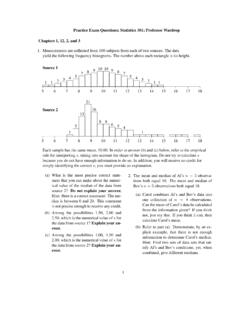
Practice Exam Questions; Statistics 301; Professor Wardrop
pages.stat.wisc.edu(e) Refer to (d). Calculate the mean of Ralph’s new data set. 4. Sarah performs a CRD with a dichotomous re-sponse and obtains the following data. Treatment S F Total 1 a b 18 2 c d 12 Total 8 22 30 Next, she obtains the sampling distribution of the test statistic for Fisher’s test for her data; it is given below. x P(X = x) P(X ≤ x) P(X ...
Normal Distribution, Confidence Intervals for the Mean ...
webspace.ship.eduFor smallish sample sizes we use the t distribution. T distribution: a symmetric distribution, more peaked than the normal distribution, that is completely described by its mean and standard deviation for . k degrees of freedom or df (we will discuss this term in more detail later). The . df. for confidence intervals is . n-1. So for our ...
Designing a Statistically Sound Sampling Plan
www.statisticaloutsourcingservices.comSampling Plans zSimple Random Sample zEach sampling unit has an equal probability of being sampled with each selection. zCan perform simple random sampling if: zEnumerate every unit of the population zRandomly select n of the numbers and the sample consists of the units with those IDs zOne way to do this is to use a random number table or random number generator
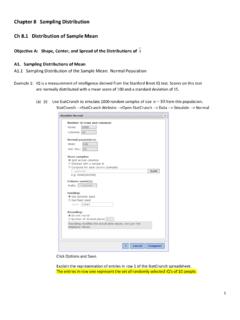
Chapter 8 Sampling Distribution Ch 8.1 Distribution of ...
mymission.lamission.eduA1. Sampling Distributions of Mean A1.2 Sampling Distribution of the Sample Mean: Non-normal Population Example 1: The waiting time in line can be modeled by an exponential distribution which is similar to skewed to the right with a mean of 5 minutes and a standard deviation of 5 minutes.
The Truncated Normal Distribution
people.sc.fsu.edu1.5 Sampling the Normal Distribution Sampling a distribution means to select one item from the range of legal values, using the PDF as the probability of selection. A histogram of the selected data should roughly approximate the shape of a graph of the PDF. Assuming we have some function rand() which is a source of uniform random numbers in the ...

Estimating Population Size & Distribution
www.deanza.eduthe mean number of individuals per quadrat. This gives us a reliable way to measure aggregation. Statisticians have demonstrated that the variance/mean ratio, x, yields a value close to 1 in a randomly dispersed population, because in samples from a random distribution the variance is equal to the mean.

RECOMMENDED METHODS OF SAMPLING FOR THE …
www.fao.orgdistribution, the units should be allocated randomly to replicate laboratory samples at the time of taking the primary samples. In this case, the result to be used should be the mean of valid results obtained from the laboratory samples analyzed. 3.4 Preparation of the laboratory sample
Chapter 6 Importance sampling
www.math.arizona.eduThe sampling distribution is an exponential shifted to the right by 4. In other words, if Y has an exponential distribution with mean 1, then Y +4 has the distribution q.