
Introduction to spectroscopy
spectroscopy to find out the chemical constitution of known and unknown gases. The same procedure is used for starlight, telling us what its source is composed of. The baseline is a ... Read the “Introduction to Spectroscopy” and answer the three questions in the space provided in the report form. (4) Answer the three questions at the end ...
Download Introduction to spectroscopy

Information
Domain:
Source:
Link to this page:
Documents from same domain
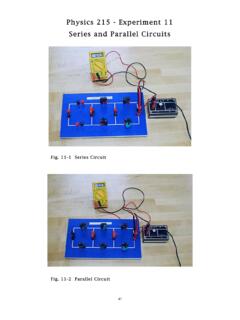
Physics 215 - Experiment 11 Series and Parallel …
www.phy.olemiss.eduPhysics 215 - Experiment 11 Series and Parallel Circuits 43 + V - Advance Reading Urone, Chapter 20, sections 20-1 & 20-4. Appendix B Computers and Software

Experiment 16: Series and Parallel Circuits
www.phy.olemiss.eduExperiment 16: Series and Parallel Circuits 85 Advance Reading Text: Resistors in series, parallel, combination. LabManual: AppendixC Appendix??-DMM Objective The objective of this lab is to study circuits with re-

Experiment 26 Reflection and Refraction
www.phy.olemiss.eduReflection and Refraction Advanced Reading: (Serway) Chapter 35, sections 35-4, ... Objective: The object of this experiment is to study the laws of reflection and refraction. Theory: The Law of Reflection states that the angle of incident ray equals the ... The Law of Refraction (Snell's Law) relates how a ray of light will behave when passing ...
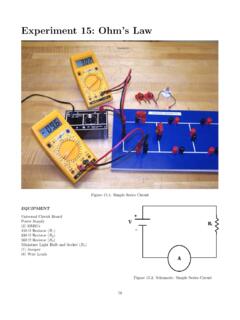
Experiment 15: Ohm’s Law - University of Mississippi
www.phy.olemiss.eduOhm’s Law states that the current, I, that flows in a circuit is directly proportional to the voltage, V, across the circuit and inversely proportional to the resistance,

Experiment 10: Archimedes’ Principle
www.phy.olemiss.edu54 Experiment 10: Archimedes’ Principle Advance Reading Text: Archimedes’ principle, buoyant force, density Objective The objective of this lab is to investigate the buoyant force acting on a variety of objects, the density of the objects, and the density of our tap water. Theory

Introduction to the Dobsonian Telescopes
www.phy.olemiss.eduIntroduction to the Dobsonian Telescopes One type of telescope that students in the astronomy class frequently use is a 10 - inch Dobsonian telescope. These telescopes are medium-size, as amateur telescopes go (the amateur rage would be 4 to 20 inches in …

Experiment 24 The Oscilloscope - University of Mississippi
www.phy.olemiss.eduExperiment 24 The Oscilloscope Advanced Reading: (Physics by Randall Knight) Chapter 15, section 15-1. You need to understand what is meant by wavelength, frequency, period and root mean square

Seebeck and Peltier Effects - Department of Physics and ...
www.phy.olemiss.edu1. Create two junctions between two different materials (as shown in Figure 1, above) by twisting wires firmly together. As shown in the diagram, you'll need one length of the first material, and two lengths of the second material. 2. Set your voltmeter to …
Experiment 15: Ohm’s Law
www.phy.olemiss.eduof about 100⌦. Once the voltage of a de-vice and your skin’s resistance are known, we can estimate the current that will flow through your body. Current E↵ect 0.001 A Can be felt 0.005 A Is painful 0.010 A Causes involuntary muscle contractions (spasms) 0.015 A Causes loss of muscle control 0.070 A If through the heart, causes serious
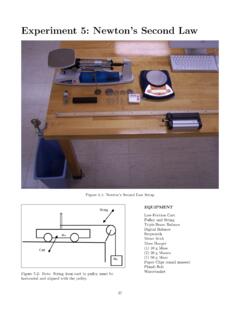
Experiment 5: Newton’s Second Law
www.phy.olemiss.edu1. State Newton’s First and Second Laws (qualitative explanations). (20 pts) 2. How is tension applied to the cart in this experiment? (15 pts) 3. How is friction compensated for in this experiment? (15 pts) 4. Should the acceleration determined in Step 5 (or any part of this experiment) be greater than, less than, or equal to the ...
Related documents
Module 1: Fundamentals of Spectroscopy
ocw.mit.eduFluorescence spectroscopy of electronic states IR (infrared) vibrational spectroscopy NMR (nuclear magnetic resonance) spectroscopy of nuclear spin states In most cases, you will be able to see the insides of the spectrometers and develop an understanding of how they work.
An Introduction to Fluorescence Spectroscopy
www.chem.uci.eduAn Introduction to Fluorescence Spectroscopy 6 Approximate sizes of Quanta Radiation ν(cm) (typical values) Wave- number (µm-1) Size of quantum (electron volts) Size of einstein (kilogram calories) Absorption or emission of radiation involves Gamma rays 10-10 106 1.2 x 10⁶ 2.9 x 10⁷ Nuclear reactions X-rays 10-8 104 1.2 x 10⁴ 2.9 x 10⁵ ...
CHAPTER 1 2 3 Introduction, Chromatography Theory, and ...
people.whitman.edu37 chemist will use Infrared Spectroscopy (IR) to observe functional groups, Mass 38 Spectrometry (MS) to obtain the compound’s molecular weight, and Nuclear 39 Magnetic Resonance (NMR) spectroscopy to determine the molecular structure. 40 Information from all three techniques is used to conclusively identify the 41 synthesized product. 42
Infrared Spectroscopy
mmrc.caltech.eduIntroduction Infrared (IR) spectroscopy is one of the most common spectroscopic techniques used by organic and inorganic chemists. Simply, it is the absorption measurement of different IR frequencies by a sample positioned in the path of an IR beam. The main goal of IR spectroscopic analysis is to determine the chemical functional groups in the ...

Gas Chromatography-Mass Spectroscopy
cires1.colorado.eduGas Chromatography-Mass Spectroscopy Introduction Gas chromatography-mass spectroscopy (GC-MS) is one of the so-called hyphenated analytical techniques. As the name implies, it is actually two techniques that are combined to form a single method of analyzing mixtures of chemicals. Gas chromatography separates the components of a mixture and

Introduction to 1H-NMR Spectroscopy Hydrogen NMR ...
web.mnstate.eduH NMR Spectroscopy and Interpretation: More Detailed than the “Summary” 89 Introduction to 1H-NMR Spectroscopy Hydrogen NMR spectroscopy is considerably more complex than 13C-NMR. The interpretation is more difficult. However, the extra complexity provides extra information that is unavailable from carbon NMR. In interpreting carbon NMR, we

FTIR Spectroscopy: Attenuated Total Reflectance (ATR)
resources.perkinelmer.comIntroduction Mid-Infrared (IR) spectroscopy is an extremely reliable and well recognized fingerprinting method. Many substances can be characterized, identified and also quantified. One of the strengths of IR spec-troscopy is its ability as an ana-lytical technique to obtain spectra from a very wide range of solids, liquids and gases. However, in
Signal, Noise, and Detection Limits in Mass Spectrometry
www.agilent.comintroduction, separation, and detections processes in the instrument. The LOQ is the limit at which we can reasonably tell the difference between two different values of the amount of analyte. The LOQ can be drastically different between labs so another detection limit referred to as the Practical Quantitation Limit (PQL) is commonly used.