
Lecture 7: ARM Arithmetic and Bitwise Instructions
Basic Types of ARM Instructions 1. Arithmetic: Only processor and registers involved 1. compute the sum (or difference) of two registers, store the result in a register 2. move the contents of one register to another 2. Data Transfer Instructions: Interacts with memory 1. load a word from memory into a register 2.
Download Lecture 7: ARM Arithmetic and Bitwise Instructions

Information
Domain:
Source:
Link to this page:
Documents from same domain
WILLIAM V. TORRE APRIL 10, 2013
cseweb.ucsd.eduWILLIAM V. TORRE APRIL 10, 2013 Power System review . Basics of Power systems Network topology Transmission and Distribution
Linear Equations and Matrices - University of …
cseweb.ucsd.edu115 C H A P T E R 3 Linear Equations and Matrices In this chapter we introduce matrices via the theory of simultaneous linear equations. This method has the advantage of leading in a natural way to the
Lecture 1: Course Introduction - Home | Computer …
cseweb.ucsd.eduAbout me CSE 120 – Lecture 1: Course Introduction 4 I work at the intersection of networking, operating systems and computer security Research Large-scale network measurement projects
11 VHDL Compiler Directives - University of California ...
cseweb.ucsd.eduIf you try to simulate a VHDL design that has this variable on and also uses the directives, the Synopsys simulator displays a warning and continues. Synopsys does not ... circuit by using VHDL design (entity) attribute MAX_AREA with a value of 0.0. Example 11–3 Circuit Area Constraint entity EXAMPLE is port (A, B: in BIT;
Maximum Likelihood, Logistic Regression, and Stochastic ...
cseweb.ucsd.eduMaximum Likelihood, Logistic Regression, and Stochastic Gradient Training Charles Elkan elkan@cs.ucsd.edu January 10, 2014 1 Principle of maximum likelihood
Poker Strategies - Computer Science and Engineering
cseweb.ucsd.eduPoker Strategies Joe Pasquale CSE87: UCSD Freshman Seminar on The Science of Casino Games: Theory of Poker Spring 2006. References •Getting Started in Hold’em, E. Miller –excellent beginner book •Winning Low Limit Hold’em, L. Jones –excellent book for non-beginners •The Theory of …
Text mining and topic models - University of California ...
cseweb.ucsd.eduMar 10, 2011 · Text mining means the application of learning algorithms to documents con- ... mining tasks, including classifying and clustering documents, it is sufficient to use ... imation of the whole matrix; doing this is called latent semantic analysis (LSA) and is discussed elsewhere.
A Short Introduction to Boosting - Home | Computer Science ...
cseweb.ucsd.eduA Short Introduction to Boosting Yoav Freund Robert E. Schapire ... @research.att.com Abstract Boosting is a general method for improving the accuracy of any given learning algorithm. This short overview paper introduces the boosting algorithm AdaBoost, and explains the un- ... Introduction A horse-racing gambler, hoping to maximize his ...
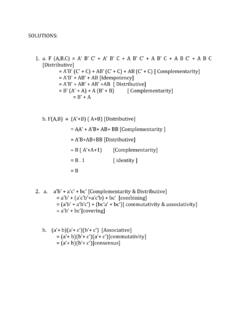
SOLUTIONS - University of California, San Diego
cseweb.ucsd.edub. F(A,B,C,D) = D (A’ + C’) 6. a. Since the universal gates {AND, OR, NOT can be constructed from the NAND gate, it is universal.
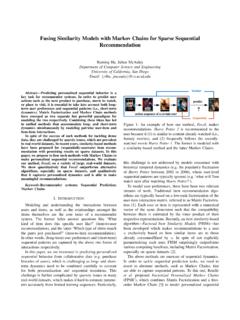
Fusing Similarity Models with Markov Chains for Sparse ...
cseweb.ucsd.eduFusing Similarity Models with Markov Chains for Sparse Sequential Recommendation Ruining He, Julian McAuley Department of Computer Science and Engineering
Related documents
William Stallings Computer Organization and Architecture ...
faculty.tarleton.edu—2.4 –Embedded systems and the ARM •Take notes in notebook! Embedded Systems - ARM •ARM evolved from RISC design •Early 1980s: Acorn Computers (ARM = ... •It’s not a processor, but an architecture! •AMR licenses it to manufacturers •As of 2007, about 98 percent of the more .
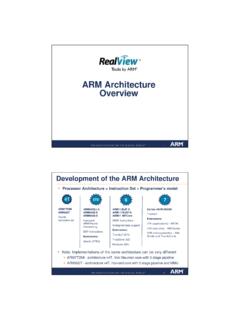
04 ARM Architecture Overview - Electrical Engineering and ...
web.eecs.umich.edu§Architecture 5TEJ and later only §J = 1: Processor in Jazelle state §Interrupt Disable bits §I = 1: Disables IRQ §F = 1: Disables FIQ §T Bit §T = 0: Processor in ARM state §T = 1: Processor in Thumb state §Introduced in Architecture 4T §Mode bits §Specify the processor mode f s x c 31 27 N Z C V Q 28 7 6 I F T mode 24 23 16 15 5 4 0

AM335x Sitara™ Processors - Texas Instruments
www.ti.comThe microprocessor unit (MPU) subsystem is based on the ARM Cortex-A8 processor and the PowerVR SGX™ Graphics Accelerator subsystem provides 3D graphics acceleration to support display and gaming effects. The PRU-ICSS is separate from the ARM core, allowing independent operation and clocking for greater efficiency and flexibility.
Cortex-M3 Technical Reference Manual - Keil
www.keil.comlicense restrictions in accordance with the terms of the agreement entered into by ARM and the party that ARM delivered this document to. Unrestricted Access is an ARM internal classification. Change History Date Issue Confidentiality Change 15 December 2005 A Confidential First Release 13 January 2006 B Non-Confidential Confidentiality status ...