Lecture Notes on Classical Mechanics (A Work in Progress)
Lecture Notes on Classical Mechanics (A Work in Progress) Daniel Arovas Department of Physics University of California, San Diego May 8, 2013
Download Lecture Notes on Classical Mechanics (A Work in Progress)

Information
Domain:
Source:
Link to this page:
Documents from same domain
3.1 Reflection and Refraction - University of California ...
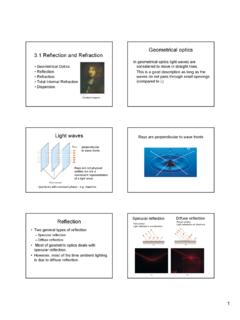
courses.physics.ucsd.edu3.1 Reflection and Refraction • Geometrical Optics • Reflection • Refraction • Total Internal Refraction • Dispersion Christian Huygens Geometrical optics In geometrical optics light waves are ... Refraction and Reflection The light beam (3) is refracted at the interface. 4
Reflection and Refraction of Light
courses.physics.ucsd.edu688 Reflection and Refraction of Light Q25.6 If a laser beam enters a sugar solution with a concentration gradient (density and index of refraction increasing with depth) then the laser beam will be progressively bent downward (toward the normal) as it passes into regions of greater index of refraction.
Lecture Notes on Classical Mechanics (A Work in Progress)
courses.physics.ucsd.eduLecture Notes on Classical Mechanics (A Work in Progress) Daniel Arovas Department of Physics University of California, San Diego May 8, 2013
The Zeeman Effect - Physics Courses
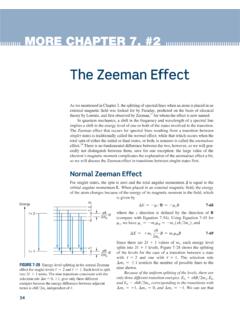
courses.physics.ucsd.eduMore Chapter 7 37 spin-orbit effect and decouples L and S so that they precess about B nearly indepen- dently; thus, the projections of L behave as if S 0, and the effect reduces to three lines, each of which is a closely spaced doublet. EXAMPLE 7-5 Magnetic Field of the Sun The magnetic field of the Sun and stars can be determined by measuring the Zeeman-effect splitting of …
Lecture Notes on Condensed Matter Physics (A Work in …
courses.physics.ucsd.eduLecture Notes on Condensed Matter Physics (A Work in Progress) Daniel Arovas Department of Physics University of California, San Diego March 14, 2010
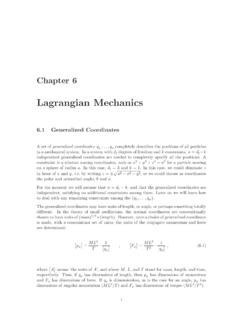
Lagrangian Mechanics - Physics Courses
courses.physics.ucsd.edu2 CHAPTER 6. LAGRANGIAN MECHANICS 6.2 Hamilton’s Principle The equations of motion of classical mechanics are embodied in a variational principle, called Hamilton’s principle. Hamilton’s principle states that the motion of a system is such that the action functional S q(t) = Zt2 t1 dtL(q,q,t˙ ) (6.2) is an extremum, i.e. δS = 0.
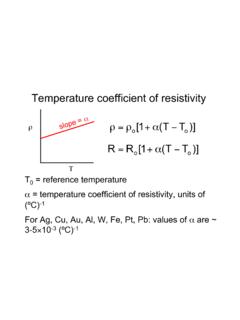
Temperature coefficient of resistivity
courses.physics.ucsd.eduPower Transmission Transmitting electrical power is done much more efficiently at higher voltages due to the desire to minimize (I2R) losses. Consider power transmission to a small community which is 100 mi from the power plant and which consumes power at a rate of 10 MW. In other words, the generating station needs to supply whatever power it ...
Lecture Notes on Superconductivity (A Work in Progress)
courses.physics.ucsd.eduLecture Notes on Superconductivity (A Work in Progress) Daniel Arovas Congjun Wu Department of Physics University of California, San Diego June 23, 2019

Physics 1B: Electricity & Magnetism
courses.physics.ucsd.eduMedical Devices (Defibrillators) EM Radiation (visible light, radio, TV, cell phones) Ch. 19: Electric Forces & Electric Fields Properties of electric charges & how they interact with each other --on both macroscopic and microscopic scales. Electric Charges & Conservation of Charge
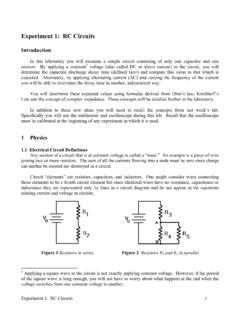
Experiment #1: RC Circuits
courses.physics.ucsd.eduIn more complicated circuits you will need to generalize the notions of series and parallel. For example, in Figure 2, the equivalent resistance of R 4 and R 5 in parallel, 1 R 4 1 R 5 1 R 4 * R 5 R 4 R 5 , is in series with R 3. 1.2 Ohm’s Law Ohm’s Law states that for a resistor the current and voltage are in phase and proportional. That ...
Related documents
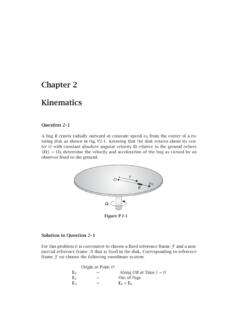
Chapter 2 Kinematics
vdol.mae.ufl.edu4 Chapter 2. Kinematics Finally, corresponding to reference frame B, we choose the following coordinate system: Origin at point O er = Along OP ez = Out of Page eθ = ez ×er Then, the position of the particle can be desribed in terms of the basis {er,eθ,ez} as r = rer. (2.10) Now, in order to compute the velocity of the particle, it is ...

Circular Motion Kinematics - Massachusetts Institute of ...
web.mit.eduA particle is moving in a circle of radius R. At t = 0, it is located on the x-axis. The angle the particle makes with the positive x-axis is given by where A and B are positive constants. Determine the (a) angular velocity vector, and (b) the velocity vector (express your answers in polar coordinates). (c) At what time t = t

CHAPTER 2 KINEMATICS OF A PARTICLE - Purdue University
engineering.purdue.eduKINEMATICS OF A PARTICLE Kinematics: It is the study of the geometry of motion of particles, rigid bodies, etc., disregarding the forces associated with these motions. Kinematics of a particle motion of a point in space

Introduction To Spacetime Diagrams
physics.unc.eduacceleration kinematics, we find that the red ball meets Sarah at (t = 1.2 s, x = 3.6 m) in Tom’s reference frame. Sarah continues to approach and reaches Tom’s location at t = 3 s. In contrast, Sarah considers herself to be at rest. She sees Tom moving in her direction at 2 m/s and the red ball moving in her direction at 2+3=5 m/s.
Physics 100A Homework 10 – Chapter 10 (part 2) - CSUN
www.csun.eduChapter 10: Rotational Kinematics and Energy thJames S. Walker, Physics, 4 Edition Kinetic Energy with Moment of Inertia . Consider a particle of mass m = 22.0 kg revolving around an axis with angular speed . ω. The perpendicular distance from the particle to the axis is r = 0.750 m.

Classical Dynamics - University of Cambridge
www.damtp.cam.ac.uk3.1 Kinematics 46 3.1.1 Angular Velocity 47 3.1.2 Path Ordered Exponentials 49 3.2 The Inertia Tensor 50 3.2.1 Parallel Axis Theorem 52 ... We’ll start with a single particle.. A particle is de ned to be an object of insigni cant size. e.g. an electron, a tennis ball or a planet. Obviously the validity of this statement
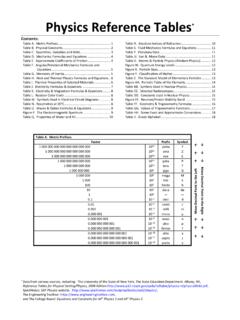
Physics Reference Tables - Mr. Bigler
www.mrbigler.comKinematics (Distance, Velocity & Acceleration) x o 2. o tt ave v v ' v v v a o t 1 2 a oott2 222(2 ) x o o var. name of quantity (unit) 2. m s m s m s 1 s change in something ( means change in ) sum distance (m) displacement (m) position (m) time (s) velocity average velocity acceleration frequency Hz force (N ave E.g., x x d t f ' ' 6 d x v v ...