Lecture Notes on Superconductivity (A Work in Progress)
Lecture Notes on Superconductivity (A Work in Progress) Daniel Arovas Congjun Wu Department of Physics University of California, San Diego June 23, 2019
Download Lecture Notes on Superconductivity (A Work in Progress)

Information
Domain:
Source:
Link to this page:
Documents from same domain
3.1 Reflection and Refraction - University of California ...
courses.physics.ucsd.edu3.1 Reflection and Refraction • Geometrical Optics • Reflection • Refraction • Total Internal Refraction • Dispersion Christian Huygens Geometrical optics In geometrical optics light waves are ... Refraction and Reflection The light beam (3) is refracted at the interface. 4
Reflection and Refraction of Light
courses.physics.ucsd.edu688 Reflection and Refraction of Light Q25.6 If a laser beam enters a sugar solution with a concentration gradient (density and index of refraction increasing with depth) then the laser beam will be progressively bent downward (toward the normal) as it passes into regions of greater index of refraction.
Lecture Notes on Classical Mechanics (A Work in Progress)
courses.physics.ucsd.eduLecture Notes on Classical Mechanics (A Work in Progress) Daniel Arovas Department of Physics University of California, San Diego May 8, 2013
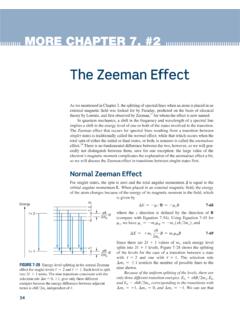
The Zeeman Effect - Physics Courses
courses.physics.ucsd.eduMore Chapter 7 37 spin-orbit effect and decouples L and S so that they precess about B nearly indepen- dently; thus, the projections of L behave as if S 0, and the effect reduces to three lines, each of which is a closely spaced doublet. EXAMPLE 7-5 Magnetic Field of the Sun The magnetic field of the Sun and stars can be determined by measuring the Zeeman-effect splitting of …
Lecture Notes on Condensed Matter Physics (A Work in …
courses.physics.ucsd.eduLecture Notes on Condensed Matter Physics (A Work in Progress) Daniel Arovas Department of Physics University of California, San Diego March 14, 2010
Lecture Notes on Classical Mechanics (A Work in Progress)
courses.physics.ucsd.eduLecture Notes on Classical Mechanics (A Work in Progress) Daniel Arovas Department of Physics University of California, San Diego May 8, 2013
Lagrangian Mechanics - Physics Courses
courses.physics.ucsd.edu2 CHAPTER 6. LAGRANGIAN MECHANICS 6.2 Hamilton’s Principle The equations of motion of classical mechanics are embodied in a variational principle, called Hamilton’s principle. Hamilton’s principle states that the motion of a system is such that the action functional S q(t) = Zt2 t1 dtL(q,q,t˙ ) (6.2) is an extremum, i.e. δS = 0.
Temperature coefficient of resistivity
courses.physics.ucsd.eduPower Transmission Transmitting electrical power is done much more efficiently at higher voltages due to the desire to minimize (I2R) losses. Consider power transmission to a small community which is 100 mi from the power plant and which consumes power at a rate of 10 MW. In other words, the generating station needs to supply whatever power it ...
Physics 1B: Electricity & Magnetism
courses.physics.ucsd.eduMedical Devices (Defibrillators) EM Radiation (visible light, radio, TV, cell phones) Ch. 19: Electric Forces & Electric Fields Properties of electric charges & how they interact with each other --on both macroscopic and microscopic scales. Electric Charges & Conservation of Charge
Experiment #1: RC Circuits
courses.physics.ucsd.eduIn more complicated circuits you will need to generalize the notions of series and parallel. For example, in Figure 2, the equivalent resistance of R 4 and R 5 in parallel, 1 R 4 1 R 5 1 R 4 * R 5 R 4 R 5 , is in series with R 3. 1.2 Ohm’s Law Ohm’s Law states that for a resistor the current and voltage are in phase and proportional. That ...
Related documents
Experiment 7 Electron Spin Resonance (ESR)
physics.unm.eduUsing ESR (Electron Spin Resonance, also known as Electron Paramagnetic Resonance) you will be measuring one of the best known quantities in all of physics, the famous g s-factor of the electron. This will be achieved by looking for the “spin-flip” transition of a free (unpaired) electron exposed to a magnetic field. 7.1.1 ESR in Theory
Lec 6 - Phosphine & Carbene Ligands
alpha.chem.umb.eduof electron density from the metal centre. 6 ... –not resonance forms (sinlget↔ triplet resonance forbidden) ... e.g. just as paramagnetic triplet :CH 2can dimerizeto form diamagnetic H 2C=CH 2, it also binds to a triplet LnMfragment to give a diamagnetic LnM=CH 2complex.

Electron Paramagnetic Resonance Theory E. Duin
webhome.auburn.eduElectron Paramagnetic Resonance Theory E. Duin . 1 - 2 1. Basic EPR Theory 1.1 Introduction This course manual will provide the reader with a basic understanding needed to be able to get useful information using the technique of electron …

NMR Spectroscopy
casegroup.rutgers.eduN.M.R. = Nuclear Magnetic Resonance Basic Principles ... 0 = 9.5 T) is 3.8 x 10⁻⁵ Kcal/mol N /N =1.000064 The surplus population is small (especially when compared to UV or IR). ... more precisely on the local electron distribution this effect is called the chemical shift. NMR Spectroscopy The Chemical Shift Nuclei, however, in molecules are ...

ELECTRON SPIN RESONANCE (ESR) SPECTROSCOPY
www.nou.ac.inElectron spin resonance (ESR), also called electron paramagnetic resonance (EPR), is a spectroscopic technique confined to the study of species having one or more unpaired electrons. Among the large number of systems having one or more unpaired electrons, i.e. paramagnetic system, the most important ones are free radicals, transition metal ions ...

Module 2 Spectroscopic techniques Lecture 3 Basics of ...
www.nptel.ac.inelectron paramagnetic resonance spectroscopy. iii. Infrared radiation: The energies associated with molecular vibrations fall in the infrared region of electromagnetic spectrum. Infrared spectroscopy is therefore also known as vibrational spectroscopy and is a very useful
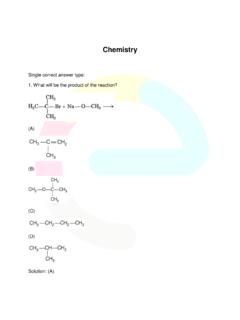
Chemistry
d2cyt36b7wnvt9.cloudfront.netand are isoelectronic and contains one unpaired electron each. Thus, both are paramagnetic. III. In carbonate ion. all three bonds are identical due to resonance IV. is more stable than due to inert pair effect, hence, prefers to form divalent compounds. Thus, the incorrect statements are III …

Chapter 6 Molecular Fluorescence and Phosphorescence
www.philadelphia.edu.joPhosphorescence involves change in electron spin and may endure for several seconds. In most cases, photoluminescent radiation tends to be at ... • Resonance radiation ... Molecule is paramagnetic in the T excited state and diamagnetic in the S excited state 2. S T transitions (or reverse) are less probable